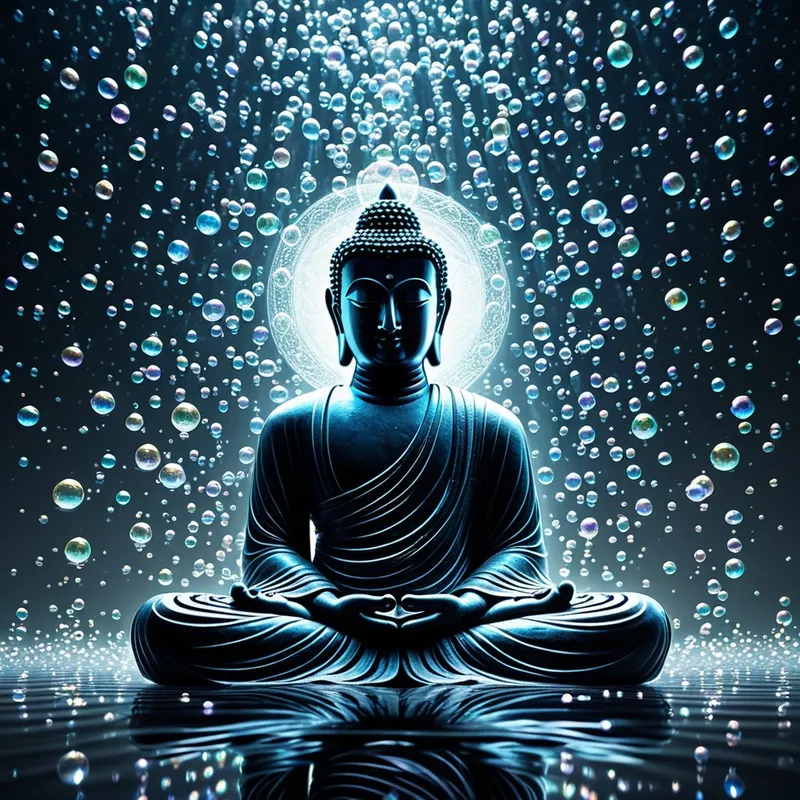
Bubble Simile Myth Meaning & Symbolism
A teaching on the fleeting, insubstantial nature of all conditioned things, comparing the self and the world to a shimmering, fragile bubble.
The Tale of Bubble Simile
Listen, then, to a truth spoken not in thunder, but in the quiet space between breaths. It was spoken beneath the spreading limbs of a Bodhi tree, where the air itself seemed to hold its breath, thick with the scent of earth and resolve. The one who had awakened, the Tathagata, sat with the stillness of a mountain, his gaze holding the depth of a clear, night sky.
Before him sat a monk, his mind a churning river of questions. He saw the world in its solidity—the weight of his own body, the permanence of the monastery walls, the enduring ache of his own identity. He felt real, substantial, a traveler on a long road.
The Buddha did not speak of gods or demons. He lifted a hand, not in blessing, but in simple indication, toward the world as it was. The morning dew clung to spiderwebs, each droplet a trembling sphere. A child’s breath, visible in the cool air, formed a brief, misty globe that vanished into light. From a nearby stream, where water cascaded over a stone, a perfect, shimmering sphere of air and water was born, rising.
“Behold,” came the voice, calm as deep water. “The bubble born in the cascade. See how it catches the world—the green of the leaf, the blue of the sky, the gold of the sun—and makes of them a dazzling, spinning jewel. It has color. It has form. It moves with purpose on the wind. It is beautiful. It is.”
The monk watched, captivated. The bubble was a tiny, perfect universe, a globe of iridescent promise. It was.
“It dances,” continued the voice, a thread of compassion woven through its clarity. “It seems to have a life, a destiny. It journeys from its birth at the stone, over the ferns, toward the open sky. It is a traveler, like you.”
And the monk felt a kinship with this radiant wanderer. But the Buddha’s gaze never wavered from the fragile sphere. The bubble rose, a captive sun, and for a moment, it hung in a beam of light, a masterpiece of ephemeral art.
Then, it touched a single needle of a pine.
There was no sound. No drama. No cry of ending. One moment there was a world in miniature, holding light and color and journey. The next, there was only a fleeting dampness on the air, a memory of refraction, and then… nothing. Empty space where a universe had been. No essence remained. No traveler. No jewel. Just the clear, empty air, and the silent, enduring stream.
The monk’s breath caught. The solid ground of his being trembled. The Buddha’s final words fell into the silence left by the vanished world.
“Such are all conditioned things. Such is form. Such is feeling. Such is perception. Such are mental formations. Such is consciousness. Seen with right wisdom: ‘This is not mine. This I am not. This is not my self.’”
And in the space where the bubble had been, a deeper seeing was born.

Cultural Origins & Context
This is not a myth of epic battles or cosmic births, but a simile, a teaching tool of razor-sharp precision. It originates from the core of the Buddha’s discourses, found in texts like the Samyutta Nikaya. Its primary function was pedagogical, aimed squarely at the monks and nuns of the early Sangha.
The audience lived a life of rigorous introspection, dissecting their own experience to uproot suffering. The Bubble Simile was a surgical instrument for this work. It was delivered not as a grand parable to the masses, but often in intimate settings—a one-on-one dialogue, or a small group instruction—where a practitioner was caught in the trap of sakkaya-ditthi, the view of selfhood. Its power lies in its immediacy and universality; the bubble is a phenomenon any person, in any age, can witness. It required no special revelation, only mindful observation of the natural world, turning the everyday into the door to the profound.
Symbolic Architecture
The bubble is the perfect symbol for the entire spectrum of conditioned existence, known in Samsara. Its symbolic architecture is devastatingly complete.
The Film of the Bubble represents the Five Aggregates. Like the bubble’s fragile skin, these aggregates—our physical form, our feelings, our perceptions, our volitional thoughts, and our conscious awareness—cohere momentarily to create the illusion of a separate, solid entity. They are empty in themselves, dependent on conditions, yet they create a dazzling, convincing show.
The Refracted World Inside is our perceived reality—our personal history, our relationships, our triumphs and failures, the entire narrative of “me” and “my life.” It feels vast, central, and full of meaning, yet it is merely a play of light upon a transient, insubstantial surface.
The Popping is not a tragedy, but a revelation. It is the moment of vipassana. It signifies the end of clinging to the aggregates as self. The pop is the dissolution of the illusion, not the destruction of a real thing.
The self is not a thing that ends, but a perception that ceases. The pop is the sound of a knot untied, not a thread cut.
The true terror—and the true liberation—of the simile is that there is no essence that flees the bursting bubble. No soul escapes. No tiny homunculus flies away. There is just the cessation of a configuration. This points directly to the doctrine of Anatta. The beauty we clung to, the traveler we identified with, was never there. Only the clinging was real.
The Dreamer's Resonance
When this myth stirs in the modern psyche, it often surfaces in dreams not of bubbles, but of profound, unsettling insubstantiality. One may dream of living in a house made of glass that shatters at a touch, or of discovering that one’s own body is hollow, filled only with light and dust. The dreamer might find themselves in a familiar city that begins to pixelate and dissolve at the edges, or they may look in a mirror to see their reflection ripple and vanish like a disturbance in water.
These are somatic dreams of ego-dissolution. The psyche, in its night-sea journey, is experimenting with the terrifying, liberating truth of the simile. The anxiety felt upon waking is the residue of the ego, the “bubble-film,” re-inflating itself, clinging back to its familiar configuration. The dream is a rehearsal for a necessary death—the death of the illusion of a separate, permanent self. It is the unconscious processing the truth that all security based on form, status, or identity is, by its nature, fragile and destined to pop.
Alchemical Translation
The alchemical work modeled here is the transmutation of identification into dispassionate observation. The base metal is our naïve, unquestioning belief in the solidity of our self-narrative. The fire is the mindful application of the simile to our direct experience.
The modern individual begins by identifying the “bubbles” they live within: the bubble of their professional identity, the bubble of a cherished relationship, the bubble of a past trauma that defines them, the bubble of future ambition. They learn to see these not as eternal truths, but as shimmering, temporary configurations, beautiful in their way, but empty of lasting substance.
The alchemical process is to hold these bubbles in awareness—to appreciate their iridescent beauty without grasping, and to watch their inevitable dissolution without despair. The death of a dream, the end of a life phase, the fading of a capability—these are not failures, but natural “pops.”
Individuation is not about building a better, shinier, more permanent bubble. It is about becoming the clear, open sky in which all bubbles arise and cease.
The triumph is not in preservation, but in the profound, unshakable peace that comes when one is no longer identified with the film, but rests as the knowing space itself. The individual no longer says, “I am the bubble,” or “I own that bubble.” They can say, with the quiet certainty of the sage, “There is bubbling.” In that shift, the entire world is transformed from a prison of fragile objects into a luminous, ephemeral dance of conditions. This is the ultimate psychic transmutation: from a thing that suffers, to the awareness that is free.
Associated Symbols
Explore related symbols from the CaleaDream lexicon: