Bàtá Drums Myth Meaning & Symbolism
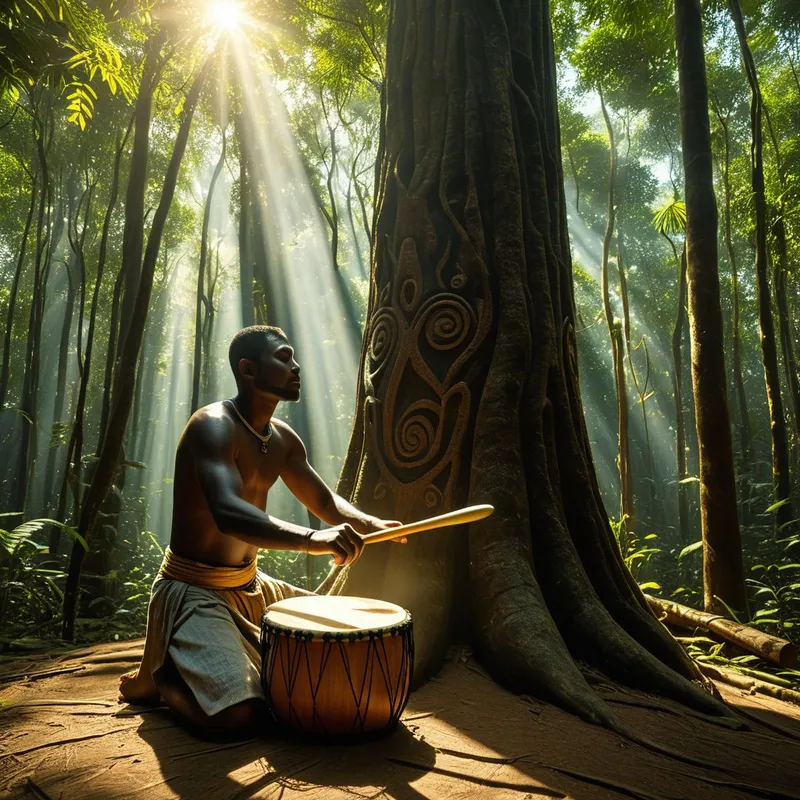
A divine artisan, exiled for his genius, carves drums from a sacred tree to speak the language of the gods, birthing music that connects heaven and earth.
The Tale of Bàtá Drums
Listen. Before the world knew the name for rhythm, there was silence. Not an empty silence, but a pregnant one, thick with the unspoken words of Olódùmarè and the restless stirring of the Òrìṣà. In the celestial realm of Òrun, the air hummed with power, but it was a power without a voice to shape it for the ears of the world below.
There lived an artisan, a spirit of unparalleled skill, whose hands were guided by the fire of Ṣàngó and the deep wisdom of Ifá. He was not a warrior, but a shaper. He could coax song from stone and story from wood. Yet, in Òrun, his creations, though beautiful, were static. They held majesty but not movement; they had form but no pulse. A deep yearning grew within him—a desire to craft something that could carry the very breath of the divine, something that could speak.
He looked to the sacred Iroko tree, whose roots plunged into the mysteries of the earth and whose branches brushed the floor of heaven. He saw in its grain the pathways of destiny, and in its spirit, a latent music. With tools of lightning and resolve, he began to work. But his ambition became his transgression. To give voice to the divine is to wield a portion of its authority, and in the ordered realm of Òrun, such an act was seen as overreach, a dangerous blurring of realms. The artisan was cast out, exiled to the earthly plane, Ayé, his spirit heavy with unfinished purpose.
On earth, the silence was different. It was filled with the wind in the grass, the rush of rivers, the cry of animals, and the beating of human hearts—but these were disparate sounds, a cacophony without a conductor. The exiled artisan, his celestial fire now a smoldering ember within, remembered the Iroko. He found a towering one, an ancient witness, and with reverence, he explained his need. The tree, in its wisdom, offered a limb.
Alone, with only his memory of the divine and his aching need to create, he carved. He hollowed the wood, shaping a body. He stretched skin, tight as a drumhead of heaven. He fashioned cords, tuning them to the tensions he felt in his own soul. He did not make one drum, but three: the Ìyá Ìlù (Mother Drum), the Omelẹ, and the Kùdi. They were plain wood and hide, yet when his fingers touched the skin of the Ìyá Ìlù for the first time…
It was not a sound. It was a summoning.
The first strike was a thunderclap that held a voice. The second was the patter of rain that formed words. The third was the crackle of fire that spoke in proverbs. He played, and the rhythms that flowed were not invented but remembered—the cadence of creation, the stutter-step of destiny, the rolling gait of the gods. The drums spoke the secret language of Òrun, and the very air of Ayé shivered in recognition. The Àwọn ẹ̀mí drew near. The exiled one was no longer an outcast, but a bridge. Through the Bàtá, heaven found its tongue on earth, and earth found a way to answer back.
Cultural Origins & Context
The myth of the Bàtá drums is not a singular, frozen text but a living resonance embedded in the very practice of the drumming tradition itself, primarily among the Yoruba people of present-day Nigeria, Benin, and Togo, and their diasporic descendants in Cuba, Brazil, and beyond. It is an etiological myth, explaining the sacred origin of a profound cultural technology.
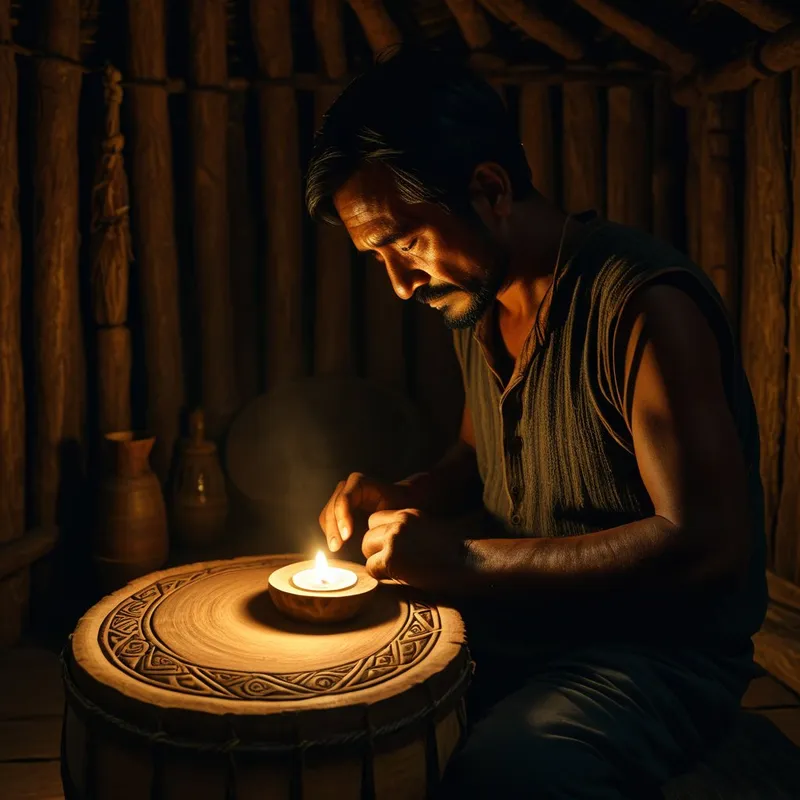
This story was traditionally passed down not through written scripture, but through the lineage of the Oní Ìlù (Owner of the Drum) and the Àwọn òṣiṣà. It was told during initiations, whispered in the sacred grove (Igbo Òrìṣà), and enacted every time the drums were consecrated with offerings. Its societal function was multifaceted: it sanctified the drums as more than instruments, establishing them as vessels of Àṣẹ; it encoded the sacred responsibility of the drummer as a mediator; and it preserved the understanding that music, particularly rhythm, is a primary conduit for interacting with the divine and ancestral realms. The myth legitimized a form of communication that bypassed ordinary language, reaching directly into the realm of spirit and emotion.
Symbolic Architecture
At its core, the myth maps the archetypal journey of bringing the numinous—the awe-inspiring, spiritual reality—into tangible, earthly form. The exiled artisan represents the creative spirit that exists between worlds, too revolutionary for the static perfection of heaven, yet holding the divine template needed to animate the raw potential of earth.
The drum is the hollowed vessel that must be created to contain the voice of the ineffable. Its emptiness is not a lack, but a sacred space waiting to be filled with meaning.
The three drums—Ìyá Ìlù, Omelẹ, Kùdi—symbolize a holistic system of communication. The Ìyá Ìlù is the conscious, commanding voice (the Self). The Omelẹ is the responsive, dialogic voice (the relational Ego). The Kùdi is the constant, underlying pulse (the instinctual, somatic Body). Together, they create a complete language. The sacred Iroko tree represents the axis mundi, the world pillar connecting all levels of existence—its sacrifice allows for the creation of this connective tool. The exile is the necessary descent, the creative wound that forces genius to engage with the limitations and textures of reality to produce something truly new and bridging.
The Dreamer's Resonance
When this myth pattern stirs in the modern psyche, it often manifests in dreams of finding a lost or forgotten object that holds incredible power—a box, a key, a forgotten instrument in an attic. One may dream of trying to speak but producing only music or rhythmic noise, or of a tree that seems to pulse with a hidden heartbeat.
Somatically, this signals a process of vocalization of the deep self. The dreamer is at a point where an inner knowing, a spiritual insight, or a long-suppressed creative impulse is demanding expression in the "earthly" realm of their daily life, relationships, or work. There is often a felt sense of exile—of feeling out of sync with one's environment or community because of this inner truth. The psychological process is one of crafting a vessel (a new skill, a piece of art, a difficult conversation, a lifestyle change) sturdy and tuned enough to carry this powerful inner content without being shattered by it. The dream urges the dreamer to become the artisan, to do the careful, lonely work of shaping a form so that the spirit within can finally be heard.
Alchemical Translation
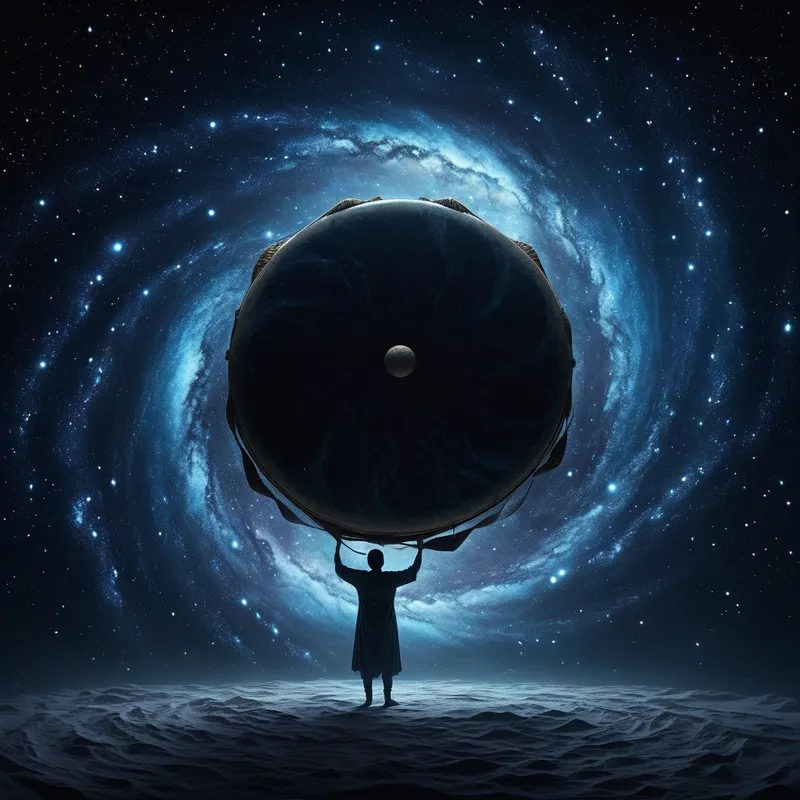
The myth models the individuation process of the Creator archetype, specifically the phase of rendering the unconscious conscious. The celestial realm (Òrun) symbolizes the unconscious, teeming with potent archetypal energies and patterns. The earthly realm (Ayé) is the conscious ego and its reality.
Individuation requires the courageous exile of a part of the psyche into the unknown, where it must use the raw materials of life experience (the Iroko) to build a tool for integration.
The initial, unintegrated creative fire leads to a "fall" or crisis (the exile from Òrun). This is not a punishment, but a necessary incubation. The alchemical work happens in the solitude of Ayé—the labor of shaping the drum. This is the disciplined practice, the suffering, the honing of skill that transforms grand, internal visions into a functional form. The consecration of the drum—the moment it speaks—is the moment of psychic integration. The newly crafted "vessel" (a matured talent, a philosophical understanding, an embodied wisdom) now allows for a fluent dialogue between the deep, often chaotic, wisdom of the unconscious (the gods) and the structured world of the conscious personality. The individual is no longer possessed by unconscious forces nor alienated from them. They have become the bridge, the Oní Ìlù of their own soul, able to translate the profound, rhythmic language of the Self into the unique music of a lived life.
Associated Symbols
Explore related symbols from the CaleaDream lexicon: