Brigid's Cross Myth Meaning & Symbolism
A dying chieftain is healed not by force, but by a saint weaving a simple cross of rushes, transforming pagan despair into a symbol of eternal protection.
The Tale of Brigid's Cross
Listen, and let the peat-smoke carry you back. To a time when the land of Éire was a tapestry of old gods and new whispers, where the cold breath of Imbolc still gripped the bare earth. In a chieftain’s dim dwelling, a shadow thicker than winter lay upon the house. The lord of the fort was dying. Not from a warrior’s wound, but from a sickness of the spirit, a wasting that no herb-charm or druid’s chant could touch. His breath rattled like dry reeds in the wind, and the despair in the room was a palpable chill, colder than the stone underfoot.
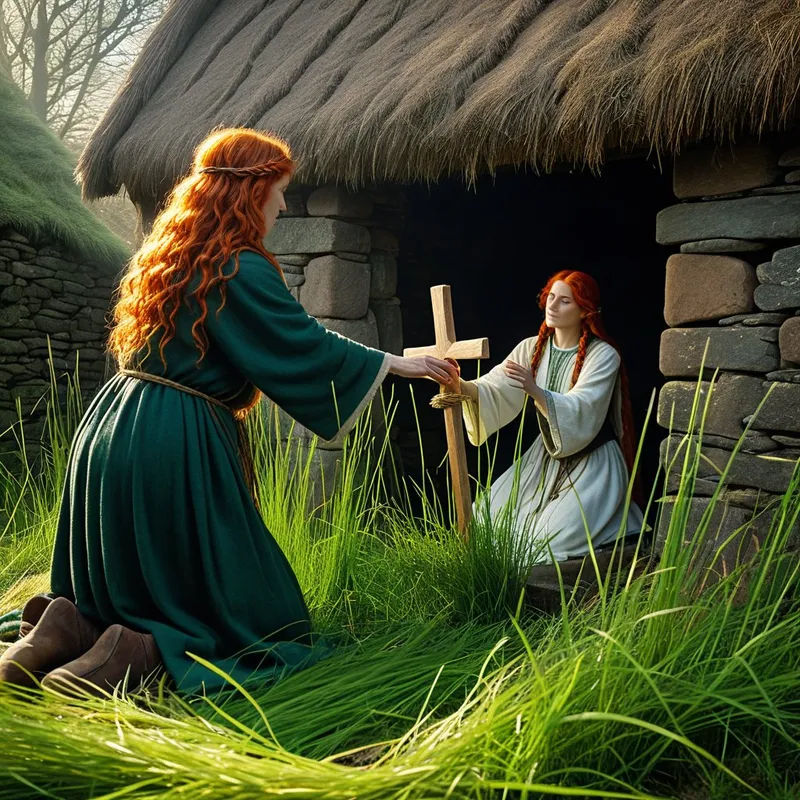
They sent for Brigid. Not yet a saint in the new way, but a woman already known as a threshold-walker, one in whom the fire of the old goddess and the compassion of the new faith burned as one flame. She arrived not with a priest’s retinue, but with the quiet authority of the land itself. She knelt by the chieftain’s bed, seeing not a pagan enemy, but a man lost in the dark between worlds.
The attendants fretted, offering complex cures. Brigid said nothing. Her eyes fell upon the rushes strewn across the earthen floor, green and common. In the heavy silence, broken only by the dying man’s labored breath and the crackle of the hearth-fire—her sacred fire—she began to gather them. Her fingers, skilled from milking cows and blessing fields, began to work. Not a spell of power, but an act of profound attention. She bent, she folded, she wove. Over, under, through. The simple, rhythmic motion was a prayer in itself, a pulling of order from chaos, of form from the formless.
As she wove, a stillness entered the room. The frantic energy of impending death softened. The chieftain’s glazed eyes, fixed on the smoke-blackened roof beams, slowly lowered. They focused on her hands, on the emerging shape: a square with four arms reaching out, bound at the center. It was a wheel, a shield, a crossroads. She spoke then, her voice as steady as her hands. She spoke of the sun, of the four seasons held in balance, of the one who sustains all things. She spoke not of doctrine, but of life.
With the final tuck, the simple cross was complete. She held it up. It was no mighty talisman of metal or stone, but a humble thing of gathered grass. Yet, in that moment, it held the entire logic of the cosmos—the intersection of the earthly and the divine, the weaving of spirit into matter. She placed it gently upon the chieftain’s chest, over the heart that had been closing like a frozen bud.
And a miracle, quiet as the unfurling of a fern, occurred. The rattling breath eased. The grey pallor of his skin warmed as if touched by the first sun of spring. He did not leap from his bed a warrior reborn; he simply returned. The shadow lifted. The man, once lost, was found—not conquered by a foreign god, but met at the crossroads of his own soul by a compassion that could weave a bridge from despair to hope. The cross of rushes remained, and from that day, it was said to guard any home that held it, a silent witness to the alchemy that happens when hands make prayer tangible.
Cultural Origins & Context
This story emerges from the fertile, complex ground of early Christian Ireland (5th-7th centuries CE), a period of profound cultural syncretism. The historical Saint Brigid of Kildare (c. 451–525 CE) was a formidable abbess whose life and legacy became a vessel for the attributes of the pre-Christian goddess Brigid, a pan-Celtic deity of poetry, healing, smithcraft, and sacred fire. The myth of the cross is a folk narrative, passed down not in Latin manuscripts but in the oral tradition of the seanchaí (the traditional storyteller), around hearths and at the festival of Imbolc (February 1st), which marked the beginning of spring and was sacred to the goddess.
Its societal function was multifaceted. Practically, it explained and sanctified the folk custom of crafting Brigid's Crosses each Imbolc to protect the household, barn, and livestock for the coming year. Psychologically and theologically, it served as a foundational myth of peaceful conversion and integration. It did not portray the triumph of one belief system over another through force, but rather their healing synthesis at a personal, mortal level. The dying pagan chieftain is not defeated; he is cured by a symbol that encapsulates both the solar wheel of his own tradition and the cross of the new one, woven by a woman who embodied the continuity of the land’s protective, generative spirit.
Symbolic Architecture
At its core, the myth is a masterclass in symbolic alchemy. The dying chieftain represents the old, rigid consciousness—the patriarchal, warrior ethos that has reached its limit and is now spiritually impotent, "wasting away." The rushes on the floor symbolize the ignored, humble, and ever-present raw material of life and spirit, literally underfoot.
The true magic is not in breaking the old form, but in re-weaving its essential materials into a new pattern that includes, rather than excludes, the heart.
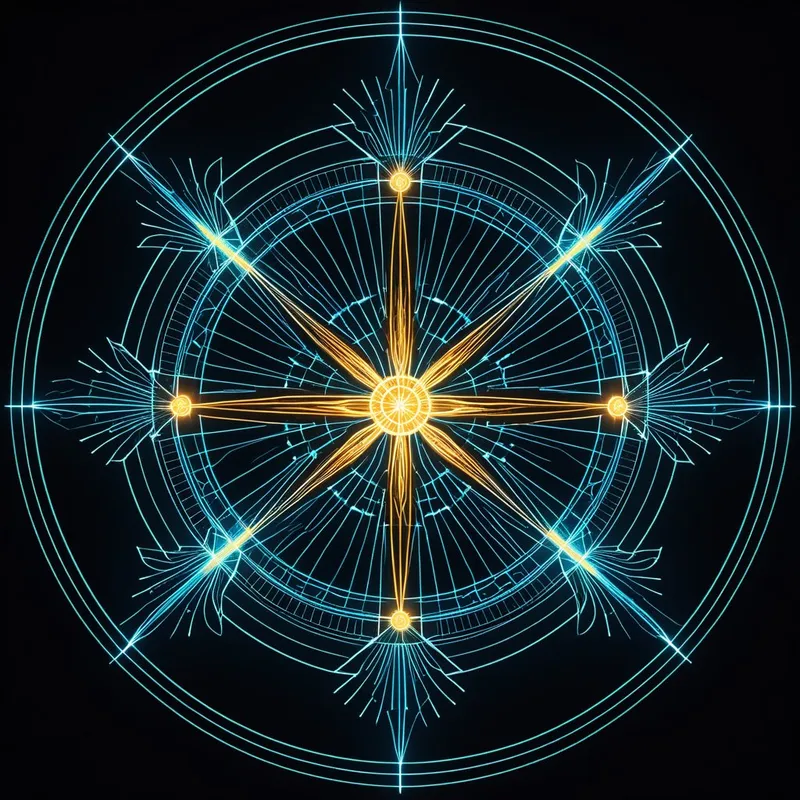
Brigid acts as the mediating archetype. She does not bring a pre-made solution from the outside (a ready-made crucifix). Instead, she engages in a creative, participatory act with the immediate environment. The weaving of the cross is the act of consciousness itself—taking the disparate, chaotic strands of experience (pagan despair, Christian hope, human mortality) and braiding them into a meaningful, stable center. The four arms signify stability, the cardinal directions, the elements, and the cyclical nature of time—all concepts deeply rooted in the pre-Christian Celtic world-view, now anchored to a new central point of meaning.
The Dreamer's Resonance
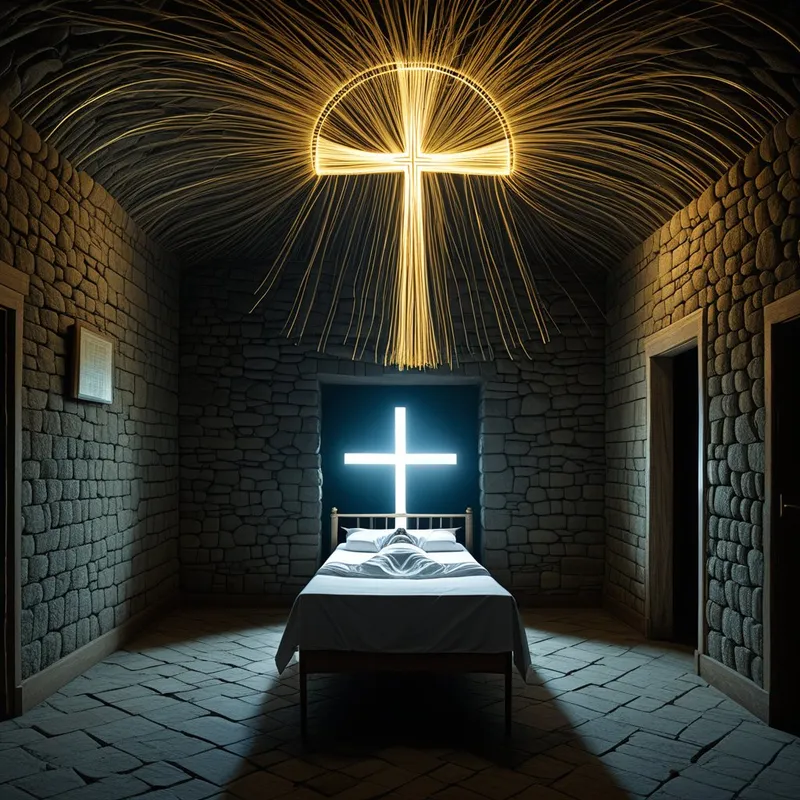
When this myth pattern surfaces in modern dreams, it often signals a critical moment of psychic integration and healing through creation. To dream of a dying or sick authority figure (a father, a boss, an old version of oneself) points to an outmoded, life-denying complex or attitude that is finally breaking down. This is often accompanied by feelings of anxiety and helplessness.
The dream may then introduce a nurturing, creatively focused feminine presence (who may not be named Brigid) or simply focus on the dreamer’s own hands engaged in a simple, repetitive craft—weaving, knitting, braiding, building. This is the somatic signal of the psyche’s innate healing intelligence at work. The act is not grandiose; it is humble, attentive, and deeply physical. The resulting artifact—often a mandala, a knot, or a woven shield—symbolizes the nascent, self-generated structure of meaning that can hold the dreamer through the transition. The dream is essentially showing the process of weaving a new psychic center from the raw, overlooked rushes of one’s own daily life and unresolved history.
Alchemical Translation
For the modern individual navigating the "wasting sickness" of meaninglessness, burnout, or inner conflict, Brigid’s Cross models the complete process of individuation.
First, the Nigredo: The "blackening." This is the chieftain’s state—the recognition that an old way of being (a career, a relationship, a core belief) is dying, leaving one in a state of sterile despair. All known remedies fail.
Then, the Albedo: The "whitening." Brigid’s calm, focused presence. This is not an external savior, but the awakening of the inner nurturing creator—the part of the self that can observe the chaos without panic and attend to the immediate, humble materials at hand (one’s feelings, memories, small daily practices).
The crucial Coniunctio: The "union." This is the weaving act itself. It is the conscious, patient work of therapy, journaling, art, or meditation where one begins to connect disparate parts of the self. The pagan (instinctual, earthy) and the Christian (ethical, spiritual) within the psyche are not at war; they are the very strands being woven together at a new center.
The cross is not found, it is made. Individuation is not a destination one reaches, but a living pattern one continually weaves from the substance of one’s own experiences.
Finally, the Rubedo: The "reddening" or realization. The new form is complete—the integrated cross. It does not eliminate life’s challenges (the winter still comes), but it provides a stable, protective center from which to face them. The healed chieftain represents the ego, now in service to this greater, self-created wholeness. The myth instructs us that our protection and our meaning are not granted from on high; they are crafted, with humble materials and devoted attention, at the intersection of our deepest struggles and our innate, creative spirit.
Associated Symbols
Explore related symbols from the CaleaDream lexicon: