Breaking of the Tablets Myth Meaning & Symbolism
Moses shatters the divinely inscribed tablets upon seeing the golden calf, a moment of sacred rupture that paradoxically forges a deeper covenant.
The Tale of Breaking of the Tablets
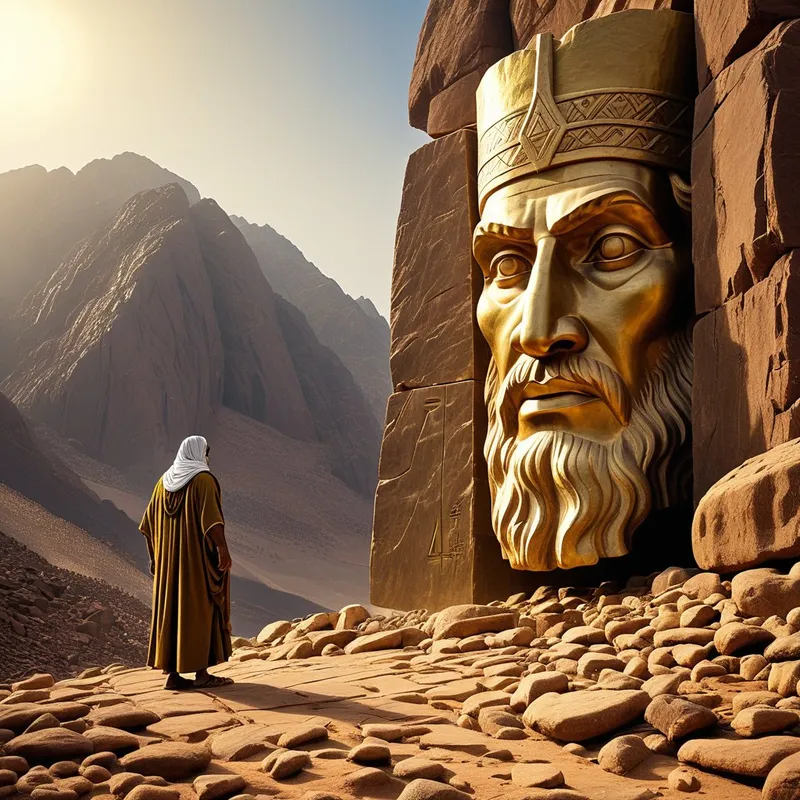
The mountain still smoked. For forty days and forty nights, the summit of Sinai had been a forge of the divine, a place where the very breath of the Creator etched law into the heart of stone. Below, in the vast and trembling plain, the people waited. The air, once thick with the thunder of revelation, grew thin with their doubt. Their leader, Moses, was lost to them in the cloud. Time stretched, a silent void, and in that void, fear was born.
They gathered around Aaron, their voices a rising clamor. "Make us a god who will go before us!" For the God of the mountain was too terrible, too abstract, a consuming fire. They wanted a god they could see, a presence to hold in their hands. From their ears came rings of gold, melted in a fire, poured into a mold. And from the fire emerged a calf, a form of molten sun, a god of Egypt remembered. The people rejoiced! They had a center for their dance, an idol for their feast. "This is your god, O Israel, who brought you out of the land of Egypt!" The sound of revelry rose to the smoking peak.
And on that peak, the work was complete. Moshe turned, the weight of the cosmos in his arms. Two tablets of stone, hewn by God, inscribed by God—the very finger of the Eternal had carved the boundaries of life into their faces. He began his descent, the covenant cradled against his chest, a bridge between heaven and earth. His apprentice, Joshua, walked with him. "There is a noise of war in the camp," said Joshua. But Moses, his senses tuned to a different frequency, heard the truth beneath the sound. "It is not the voice of victory, nor the voice of defeat," he said, his voice like gravel. "It is the voice of singing that I hear."
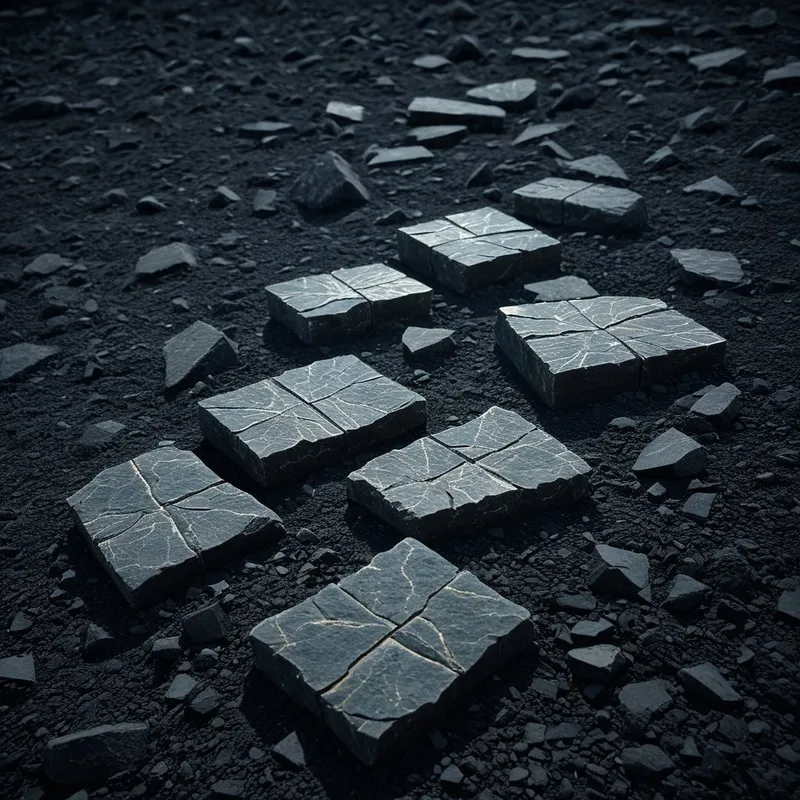
Then the camp came into view. The golden calf. The naked, ecstatic dance. The covenant shattered before it was even delivered. In that moment, a holy fury, colder than the stone and hotter than the forge, seized the prophet. The tablets, the perfect, divine law, became suddenly, terribly profane in his hands. To bring this immutable perfection into that cauldron of betrayal would be the greatest desecration of all. Without a word, without a second thought, his arms swung high. The tablets, the work of God, met the work of the mountain. The sound was not of breaking stone, but of a world cracking at its axis. The written light of the commandments fled the fragments, scattering into the dust of the human world.
Cultural Origins & Context
This foundational narrative is recorded in the book of Shemot (Exodus), specifically in chapters 31 and 32. It is a cornerstone of Torah law and prophetic history. The story was not merely a historical account but a liturgical and moral engine for the ancient Israelites and later Jewish communities. Recited and studied, it served as the ultimate parable of covenantal failure and the possibility of repair (tikkun). It explained the complex, non-linear nature of the relationship with the Divine—a relationship that could survive even the most catastrophic breach. The rabbinic sages of the Talmud and Kabbalah poured over this story, seeing in Moses’s act not a loss of control, but a profound, calculated intervention. It was passed down not just as a warning against idolatry, but as a deep teaching about the nature of law, grace, and the necessary shattering that precedes a more mature wholeness.
Symbolic Architecture
The tablets represent the ideal, the perfect blueprint for consciousness and community. They are the Logos, the divine word made structure, absolute and uncompromising. The golden calf is the shadow of the Eros principle—the desperate, chaotic human need for tangible connection, for an immanent god of feeling and sensation, even if it is a regressive one. Moses stands at the threshold between these two realms.
His act of breaking is the critical symbolic pivot. It is not an act of despair, but of sacred, protective rage.
To impose a perfect system upon an unready psyche is to condemn it to hypocrisy or annihilation. The shattering is a merciful act.
The broken tablets symbolize the necessary death of the ideal when it meets the reality of the flawed, unconscious human condition. The law is not abandoned; it is released from its pristine, monolithic form into a state where it can be gathered, studied piece by piece, and internalized through effort. The second set of tablets, later hewn by Moses himself and reinscribed by God, represent the earned covenant—one that incorporates the memory of the break, making it more resilient, more human, and ultimately more holy. The broken pieces, according to tradition, were kept in the Ark of the Covenant alongside the whole ones, a eternal testament that wholeness contains its own fractures.
The Dreamer's Resonance
When this myth stirs in the modern dreamer, it often manifests as dreams of shattered objects of great value—a heirloom vase, a prized trophy, a perfect mirror. The somatic feeling is one of devastating release, often accompanied by a shocking sense of rightness beneath the horror. The dreamer is undergoing a process where a long-held, rigid ideal—about the self, a relationship, a career, or a spiritual path—has collided with an undeniable, shadowy reality (the "golden calf" of one's own neglected desires, fears, or instincts).
The psyche, in the figure of the dream's Moses, is performing an auto-sacrifice of a perfection that has become idolatrous. It is breaking the "tablets" of a life script that, while seemingly perfect, is now alien to the living soul. The dream is not about destruction for its own sake, but about the protection of the sacred from profanation by a consciousness not yet ready to receive it in its totality. The anxiety upon waking speaks to the terror of the void left by the shattered ideal, but also to the nascent freedom now possible.

Alchemical Translation
The alchemical journey of individuation requires the nigredo, the blackening, the dissolution of the old, rigid form. The myth of the Breaking of the Tablets is a master narrative of this stage. The individual identifies with a perfect, God-given identity or set of rules (the first tablets). This is the persona at its most spiritualized, but also its most brittle. Life inevitably presents the "golden calf"—a crisis, a betrayal, a surge of the repressed shadow that reveals the persona's inability to contain the full self.
The conscious ego must then perform the Moses act: it must shatter its own most cherished self-concept to save the soul from a lifeless, hypocritical adherence.
This is the ultimate rebellious act against the inner tyrant of perfection. The shattered pieces—the insights, the failures, the humiliated truths—are gathered into the "ark" of the developing Self. They are not discarded. From this prima materia of brokenness, the second tablets are fashioned. This represents the albedo and rubedo: the creation of a new, integrated consciousness. This second covenant is not handed down pure; it is co-created by the individual (Moses hewing the stone) and the transcendent Self (God inscribing it again). The law is now earned, written on a heart that has known fracture, making the resulting wholeness (Shalom) dynamic, compassionate, and truly holy. The broken pieces remain in the ark, a permanent part of the foundation, teaching that true strength is not in never breaking, but in holding the memory of the break within a greater, more merciful unity.
Associated Symbols
Explore related symbols from the CaleaDream lexicon: