Brahmanda Myth Meaning & Symbolism
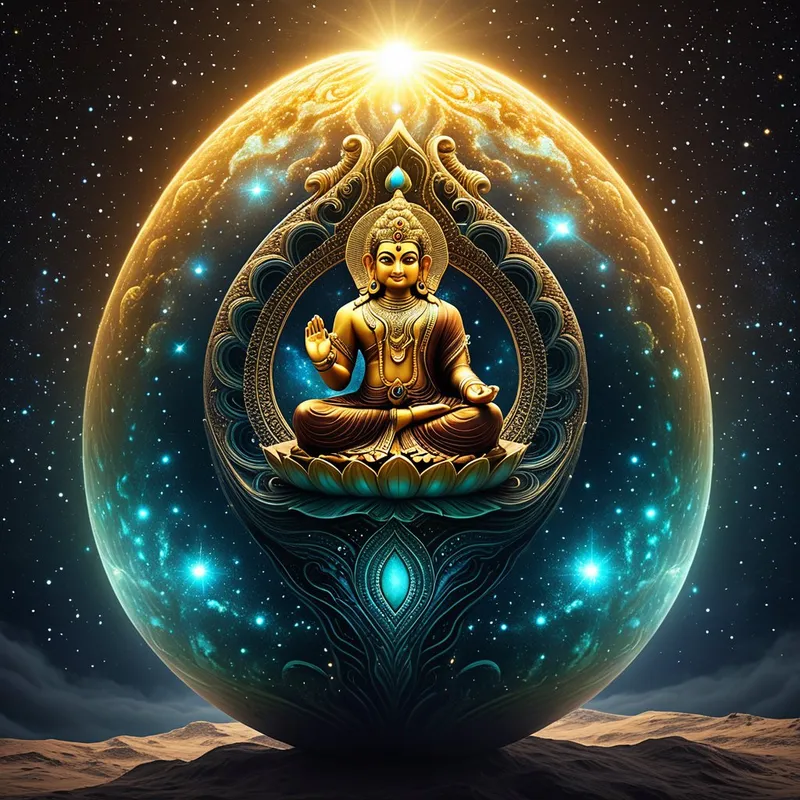
The primordial egg containing all universes, born from the infinite, cracked open by the divine will of Brahma to release the manifest cosmos.
The Tale of Brahmanda
In the beginning, which was not a beginning, there was only the One. The Brahman rested in itself, a boundless ocean of potential without shore, without ripple, without time. It was a profound, pregnant silence.
From that stillness, a vibration arose. A desire, a first thought: “I am.” This was the Pranava, the sacred OM, which echoed in the void and gathered substance. From the infinite waters of causality, the Karana Samudra, a golden warmth began to coalesce. It was not a sun, for there was no sky. It was a concentration of pure being, a focal point of divine intent.
This warmth swelled and took form—a perfect, self-contained orb of incandescent light. It was the Brahmanda. Its shell was not of calcium, but of the fundamental layers of reality itself—earth, water, fire, air, and ether—woven into an impenetrable, shimmering membrane. Inside, all possibilities churned: galaxies yet unborn, mountains yet unformed, the laughter of children yet unconceived, and the tears of saints yet to walk the earth. It contained every story, every atom, every dream, compressed into a single, throbbing point of existence.
For an acon, it floated on the causal waters, a self-sufficient universe in potential. Then, from within the very essence of the egg, a consciousness awoke. This was Brahma, the architect of manifestation. He opened his eyes—not two, but four, gazing simultaneously into the past, present, future, and the timeless. He beheld the perfect, suffocating completeness of his shell. He felt the immense pressure of all that could be, yearning to become.
With a thought that was also an act, Brahma stretched. He pressed his being against the inner wall of the Brahmanda. A sound, like the cracking of a thousand glaciers, echoed through the non-space. A fissure, brilliant and terrifying, split the shell. Not with violence, but with the inevitable force of a seed pushing through soil, of a chick breaking into the air.
Through that crack poured the cosmos. Not as an explosion, but as an unfurling—a slow, majestic exhalation. The elements separated: fire rose to become suns, air spread to become space, water flowed to become oceans, and earth settled to become worlds. The single light within the egg diffracted into the seven rays of the sun, the cycles of the moon, the twinkling of countless stars. The one became the many. The contained became the vast. And Brahma, seated now on a lotus that sprang from the navel of Vishnu who rested in the causal waters, began his work of arranging the liberated potentials into the rhythms of time, space, and life.
Cultural Origins & Context
The myth of the Brahmanda is not a single story from one text, but a foundational concept woven through the tapestry of Hindu cosmological thought. Its most detailed expositions are found in the Puranas, particularly the Vishnu Purana and the Brahmanda Purana, which is named for this very concept. These texts were composed and compiled over centuries, from around the 4th to the 10th century CE, and served as encyclopedic narratives for priests, scholars, and the lay populace.
The myth was transmitted orally long before being codified in Sanskrit verse, recited by storytellers and gurus to explain the incomprehensible scale of existence. Its societal function was multifaceted: it was a metaphysical map, placing the human realm within a grand, hierarchical cosmos of multiple Lokas (worlds) contained within the egg. It was also a theological anchor, illustrating the cyclical nature of time (Kalpas)—each day of Brahma sees the emergence of a Brahmanda, each night its reabsorption. This provided a framework that made the transient nature of human life part of a vast, eternal rhythm, offering both humility and a profound sense of connection to the divine creative process.
Symbolic Architecture
The Brahmanda is perhaps the ultimate symbol of contained potential. It represents the state of the universe—and by profound extension, the psyche—before differentiation.
The cosmic egg is the womb of all form, the perfect latency where opposites are not yet at war, where everything exists as a shimmering possibility.
Psychologically, it symbolizes the totality of the Self in its unconscious, undifferentiated state. The shell is not a prison, but the necessary boundary that allows complexity to coalesce. It is the ego, the persona, the defined identity that holds the chaotic, infinite contents of the personal and collective unconscious in a manageable form. The figure of Brahma within represents the emerging conscious mind, the organizing principle (Dharma) that must eventually engage with the world. The cracking of the shell is the inevitable, often traumatic, moment of consciousness—the first breath, the first independent thought, the crisis that forces a new structure of being to emerge from the old containment.
The seven layers of the shell, often described as concentric spheres of elemental reality, map perfectly onto the journey of consciousness from the dense material world to the subtlest spiritual realms, illustrating that enlightenment is not an escape from the world, but a journey through its layered depths to its unified source.
The Dreamer's Resonance
When the motif of the Brahmanda appears in modern dreams, it rarely manifests as a literal egg. Instead, one might dream of being inside a perfectly round, enclosed space—a domed room, a geodesic greenhouse, a translucent bubble. The space feels simultaneously safe and stifling, complete yet limiting. Everything one needs is there, but the dreamer feels a restless, inexplicable urge to break out.
This is the psyche signaling a critical stage in development. The somatic sensation is often one of pressure—in the chest, the skull, like something is ready to be born. Psychologically, the individual is at the limit of their current identity structure. They have integrated a certain level of experience, achieved a state of competence or stability (the “complete egg”), but the soul’s deeper potentials are now pressing against the boundaries of that self-concept. The dream is an expression of the Self urging the ego-structure to expand or fracture to allow for a new, more complex phase of life. It can precede major life transitions: the end of a long career, the empty nest, a spiritual awakening, or the integration of a powerful shadow aspect. The fear is of the cracking itself—the loss of a known, contained world. The promise is the universe waiting on the other side.

Alchemical Translation
The alchemical process mirrored in the Brahmanda myth is the solve et coagula—dissolve and coagulate—applied to the very structure of the self. The journey of individuation is not a linear path outward, but a cyclical process of creating containers, outgrowing them, and creating new, more capacious ones.
The great work of the soul is to willingly become both the egg and the force that cracks it open, to be the contained universe and the god who sets it free.
First, we must form our “egg.” This is the coagula stage: building a coherent ego, a stable life, a defined personality from the primal waters of our innate potential and childhood experiences. This is necessary and sacred work. But life, in its role as Brahma, inevitably brings pressure—a crisis, a loss, a deep insight—that shows us the limits of our shell. The old identity becomes a confinement.
The alchemical translation is in how we meet that pressure. Do we resist, trying to reinforce the shell until it shatters us? Or do we participate consciously in our own cracking? This is the solve stage: allowing old certainties, self-images, and life structures to dissolve so that a more authentic, expansive consciousness can emerge. We move from being passive inhabitants of our psyche to active co-creators of our reality. The “cosmos” that spills out is not chaos, but the liberated aspects of our own being—talents suppressed, emotions buried, connections yearned for—now available to be organized into a new, richer life by our awakened, Brahma-like consciousness. The myth teaches that creation is not a one-time event, but a perpetual, intimate, and courageous act of self-unfolding.
Associated Symbols
Explore related symbols from the CaleaDream lexicon: