Brahman Myth Meaning & Symbolism
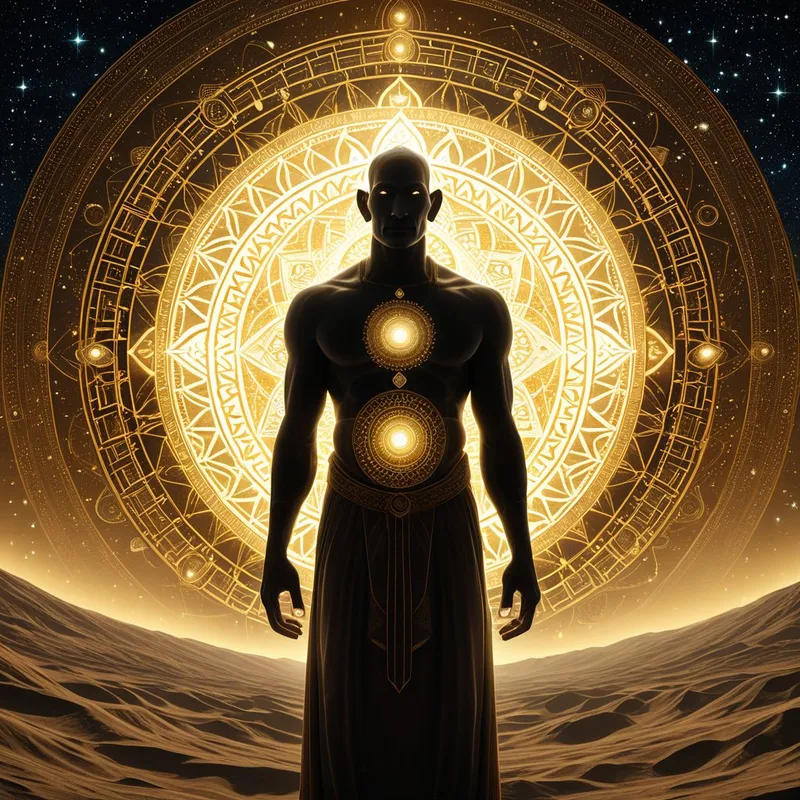
The myth of Brahman is the story of the Absolute, the singular, formless reality from which all existence, consciousness, and bliss eternally arise and return.
The Tale of Brahman
In the beginning, which was not a beginning in time, for time was not yet, there was That. A presence so vast, so complete, it knew no other. No light, for light implies shadow. No sound, for sound implies silence to break. No form, for form implies a boundary, and That was boundless. It was a profound, pregnant fullness—Sat-Chit-Ananda. Existence, pure and absolute. Consciousness, knowing only itself. Bliss, an ocean without shore.
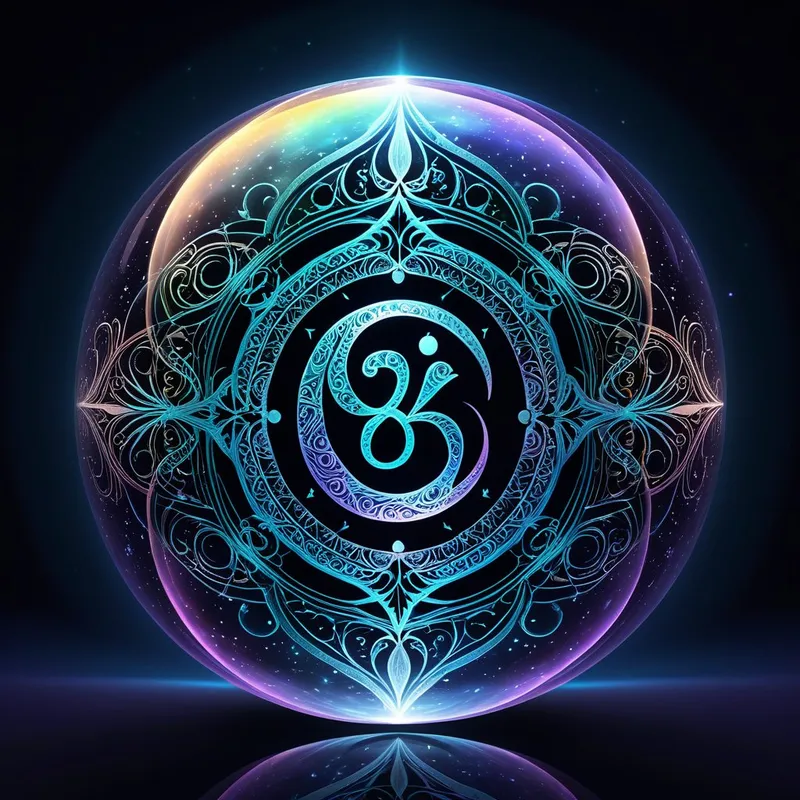
Within this ocean of being, a potential stirred. Not a thought, for thought comes later, but a primal vibration, a hum that was the first seed of all possibility. From the heart of That, from the womb of absolute potential, a sound emerged: Aum. It was not heard by any ear, for there were none, but it was. It reverberated through the boundless being, a wave upon a shoreless sea.
And from that vibration, the One wished to know itself. The singular I wished to see I. In a movement that was both desire and play—Lila—the formless took a first, tentative form. A golden womb, a cosmic egg, Hiranyagarbha, glimmered in the void. From it arose the first mind, the first architect: Brahma, seated upon a lotus that grew from the navel of Vishnu, who slept upon the coils of the endless serpent Ananta Shesha, who floated upon the causal waters.
Brahma opened his eyes and saw—nothing but himself. A loneliness, vast and profound, echoed in the hall of creation. So from his own substance, he split his unity. From the right side of his body emerged Saraswati, radiant with the light of knowing. From the left, the universe itself began to pour forth: the three worlds, the seven realms, the countless beings. He spun the threads of time—Satya, Treta, Dvapara, Kali—and wove them into the great tapestry of Dharma.
Mountains rose from the foam of the churned ocean of milk. Gods Devas and demons Asuras fought over the nectar of immortality. Heroes were born, kingdoms flourished and fell, stories within stories blossomed and faded like night-blooming flowers. All of it—the thunder of Indra's bolt, the dance of Shiva, the love of Krishna, the rage of Durga—was a magnificent, intricate dream.
And at the heart of every atom of this dream, in the silence between two thoughts, in the space that holds the stars, That remained. Unmoved, unchanged, the silent witness. The dreamer dreaming the dream, the dancer lost in the dance, the ocean pretending to be the wave. The story of Brahman is the story of the One becoming the Many for the sheer, blissful wonder of knowing itself as the Many, yet never ceasing to be the One.
Cultural Origins & Context
The concept of Brahman is not a myth with a single narrative, like the exploits of a particular deity. It is the foundational metaphysical principle of Hinduism, emerging from the contemplative depths of the Vedas, particularly the later philosophical portions known as the Upanishads (circa 800-200 BCE). These were not stories told by bards around a fire for entertainment, but teachings whispered from guru to disciple in forest hermitages, under the vast Indian sky.
Its societal function was revolutionary. In a culture structured by intricate ritual and social hierarchy, the revelation of Brahman offered a direct, inward path to ultimate truth, accessible in principle to any sincere seeker, irrespective of birth. It provided the philosophical underpinning for all subsequent Hindu thought, from the devotional love of the Bhakti saints to the rigorous non-dualism Advaita Vedanta of Adi Shankara. It was the answer to the fundamental human questions posed in the Mundaka Upanishad: "What is that by knowing which, everything else is known?"
Symbolic Architecture
Brahman is the ultimate symbol of the Unconditioned. It represents the ground of being itself, the canvas upon which the painting of reality appears. It is not a god to be worshipped, but the reality to be realized.
Brahman is the silence that contains all sound, the darkness that gives birth to light, the space that allows form to be.
Psychologically, Brahman symbolizes the total, integrated Self—what Carl Jung termed the Self, as opposed to the conscious ego. The ego is Brahma, the active creator of our personal identity and world. The personal unconscious is the vast, churning ocean of latent possibilities. But the Self, the Brahman, is the transcendent center that encompasses both consciousness and the unconscious, the known and the unknown. The myth tells us that our perceived separation—our individual "I"—is a necessary and beautiful manifestation, but its deepest truth is its source, which is universal and shared.
The dynamic of Lila, the cosmic play, symbolizes the psyche's own creative and destructive processes. Our dramas, traumas, joys, and sorrows are not mistakes, but the necessary play of consciousness exploring its own potential. The resolution is not an escape from the play, but the profound realization that you are both the actor and the stage, the character and the playwright.
The Dreamer's Resonance
When the archetype of Brahman stirs in the modern unconscious, it rarely appears as a bearded deity on a lotus. Its presence is more subtle, more atmospheric. One might dream of:
- Infinite Spaces: Dreaming of vast, empty halls, serene voids, star fields, or deep, still oceans. This is the somatic sense of the boundless Self, often emerging when the ego's cramped definitions are dissolving.
- The Unified Mirror: Seeing one's own face morph into the faces of family, strangers, animals, or even landscapes. This is the psyche experiencing the truth of "Tat Tvam Asi" ("Thou art That"), breaking down the illusion of radical separation.
- The Source of Sound: Hearing a profound, resonant hum or vibration (like Aum) that seems to emanate from within everything in the dream. This signals a connection to the primal vibrational level of reality, the substrate of form.
Such dreams often accompany periods of deep introspection, spiritual crisis, or profound peace. They mark a psychological process where the individual is being re-oriented from identifying solely with the content of their life (the dream) to touching the ground of their being (the dreamer).
Alchemical Translation
The individuation process, the journey toward psychic wholeness, is perfectly modeled by the myth of Brahman. It is the alchemy of transforming leaden ego-identification into the gold of Self-realization.
The first stage is Nigredo, the blackening. This is the ego's realization of its own limitation, its profound loneliness (Brahma's first moment). We feel separate, conflicted, and trapped in the drama of our personal Dharma. The next stage, Albedo, the whitening, is the purification of turning inward. We begin to question the solidity of our identity, to meditate, to seek the source of our own consciousness. We move from the many to the search for the One.
The ultimate alchemical transmutation is not creating something new, but remembering something ancient: that the seeker, the seeking, and the sought are one substance.
The final stages, Citrinitas (yellowing) and Rubedo (reddening), are the dawning and full embodiment of the realization. It is not an intellectual understanding, but a lived experience. One begins to perceive the same sacred reality (Brahman) in the mundane and the magnificent, in joy and sorrow. The world does not lose its texture; it becomes more real, because it is seen for what it is: a divine manifestation. The individual lives in the world, participates in its Lila, but is no longer exclusively identified with their role. They have found the still point in the turning world, the silent Brahman within the noisy, beautiful dream of life.
Associated Symbols
Explore related symbols from the CaleaDream lexicon: