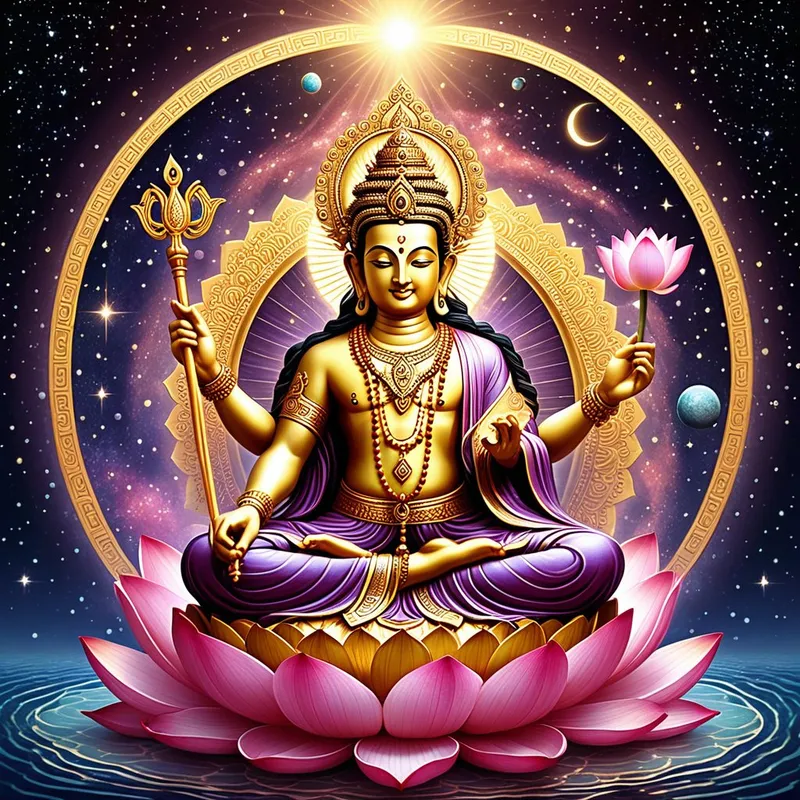
Brahma Myth Meaning & Symbolism
The story of Brahma, the four-faced creator who emerges from the cosmic lotus, crafts reality, yet is rarely worshipped, embodying the paradox of the creative act.
The Tale of Brahma
In the beginning, which was not a beginning but a turning, there was only the One. Brahman, without quality, without end, a boundless ocean of potential silence. Upon this dark, limitless water, Vishnu lay in yogic sleep, dreaming the seed of all that was, is, and will be.
From the depths of that divine navel, a stirring. A single stem, radiant and purposeful, pierced the primordial waters. It grew, reaching upward through the timeless dark until it burst forth into a bloom of unimaginable splendor—a lotus with a thousand petals of dawn-light. And within that cradle of creation, a being manifested. He was golden, like the first thought of light, and from his form blossomed four heads, each facing a cardinal direction, so that he might see all of existence at once. This was Brahma, the Svayambhu.
Alone in the lotus, Brahma gazed out upon the void. The silence was complete, a canvas of pure potential. A profound loneliness, the loneliness of the unmanifest, settled within him. From this longing, the desire to create—kama—was born. With a thought, he divided the lotus. From one half, he fashioned the heavens, Svarga, studding it with stars. From the other, he sculpted the earth, Bhuloka, with its mountains, rivers, and forests. He breathed life into the waters and kindled the fire in the heart of stones.
Yet, the worlds were empty. So, from his own immensity, he brought forth the mind-born sons, the Saptarishis, to be the pillars of wisdom. From different parts of his being, he manifested all the gods, the demons, the humans, the animals, and every creeping, crawling, flying thing. The universe erupted into a symphony of forms, colors, sounds, and seasons—a dazzling, chaotic, beautiful tapestry woven from his own essence.
But a shadow fell upon the creator’s heart. As he beheld the teeming multitude of his creation, a profound question arose: Who am I? And from where did this lotus, my throne, emerge? Determined to find his own source, he began a journey. One of his faces looked down, following the stem of the lotus deep into the abyssal waters. For a hundred celestial years he traveled, but found no end. Another face looked upward, climbing the stem toward the blossom’s origin. For another hundred years he climbed, but found no beginning. He was the center of a mystery, the author of a story whose first page was missing.
In that moment of cosmic uncertainty, the sound of a divine flute echoed through the layers of reality. Krishna appeared, revealing the form of Vishnu resting upon the serpent Shesha in the causal ocean. Brahma understood. He, the creator, was but a manifestation within the dream of the sustainer. Humbled, he returned to his lotus, his task complete yet eternally ongoing. He would continue to create, cycle after cycle, but the worship of the world would flow not to him, the architect, but to the preserver and the transformer. His was the first, most necessary, and most forgotten act.
Cultural Origins & Context
The figure of Brahma is woven into the earliest strands of Hindu thought, appearing in the Vedas as Prajapati, the Lord of Creatures. His classical form in the Puranas crystallizes a profound philosophical shift. These stories were not mere entertainment; they were the vessels of cosmology, recited by traveling bards and learned gurus at festivals and in temple courtyards. They served to map the metaphysical universe for the common person.
Brahma’s myth functioned as a foundational narrative explaining the origin and structure of reality. Yet, his curious lack of widespread worship—with only a handful of major temples dedicated to him—speaks volumes. Culturally, this reflects a deep-seated understanding that the act of creation, once initiated, becomes secondary. The focus of spiritual life is not on the source that was, but on the forces that sustain (Vishnu) and transform (Shiva) the created world. Brahma’s story encapsulates the Hindu view of time as cyclical (kalpa) rather than linear. He is not a one-time creator, but a recurring function, appearing at the dawn of each new cosmic cycle, only to recede as the drama of preservation and dissolution takes center stage.
Symbolic Architecture
Brahma is the archetype of pure, undirected creativity. His four heads symbolize the four Purusharthas (righteousness, prosperity, desire, liberation), the four directions (omniscience), and the four Vedas, representing the totality of knowledge necessary for creation.
The creator must forget himself to become absorbed in the act of creation, and in doing so, he becomes forgotten by his creation.
The lotus from which he is born is a universal symbol of spiritual emergence—beauty and complexity arising from murky, unconscious waters. His search for the beginning and end of the lotus stem is the mind’s futile attempt to comprehend its own origin, to grasp the infinite with the tools of the finite. His ultimate realization is the core of the myth: the creator is not the ultimate reality, but a function within it. He is the personified first thought of Brahman, the moment the unmanifest decides to manifest.
The curse of being "un-worshipped" is not a punishment, but a symbolic necessity. It represents the transcendence of the creative ego. The work, once released into the world, must stand on its own. The artist must recede for the art to live.
The Dreamer's Resonance
When the pattern of Brahma appears in modern dreams, it often signals a profound engagement with a creative or generative process in the dreamer’s psyche. One might dream of designing vast, intricate cities that remain empty; of writing a seminal book whose author’s name is erased; or of giving birth to something magnificent only to turn and find it unrecognizable.
Somatically, this can feel like a buzzing, generative energy in the crown of the head or the center of the forehead—the locus of ideas—accompanied by a deep, hollow loneliness in the chest. Psychologically, it is the process of bringing something new from the unconscious into the conscious world. The conflict is the "Brahma’s dilemma": the exhilarating, god-like power of conception followed by the terrifying alienation of completion. The dreamer is experiencing the necessary "death of the author" that must occur for any true creation to have an independent life. It is the psyche working through the paradox of claiming ownership of an idea that, in truth, emerged from a source far deeper than the individual self.

Alchemical Translation
The alchemical journey modeled by Brahma’s myth is the opus of bringing the inner vision into outer reality, the transmutation of prima materia (the chaotic, dark waters) into the philosophical gold (the ordered cosmos).
The first stage is nigredo: the dark, formless ocean of potential, the unarticulated longing or idea. The lotus is the albedo, the pure, emerging form arising from the depths. Brahma himself, the conscious ego taking charge of creation, represents citrinitas, the dawning of the intellectual and structural framework. He actively shapes the world.
The final and most crucial transmutation is rubedo: not the glory of the created thing, but the humbling realization of one’s role within a greater process. It is the red heat of ego dissolution.
The modern individual’s "Brahma cycle" begins with an inspired idea (emergence from the lotus). We build, plan, and give it form (creating the worlds). We then often become obsessed with the origin of our genius or seek endless validation for our creation (searching for the stem’s end). The alchemical triumph is the "Krishna moment"—the realization that our creativity is not a act of solitary genius, but a participation in a sustaining, intelligent flow of life far greater than ourselves. We learn to create not for legacy or worship, but as an offering, releasing the work and ourselves from the prison of authorship. In doing so, we move from being the isolated Creator to becoming a conscious vessel of the creative principle, which is the true goal of psychic individuation. The creator is re-absorbed, so that creation may truly begin.
Associated Symbols
Explore related symbols from the CaleaDream lexicon: