Book of the Dead Myth Meaning & Symbolism
An ancient Egyptian funerary text guiding the soul through the perilous underworld to achieve eternal life, symbolizing the ultimate journey of transformation.
The Tale of the Book of the Dead
Listen. The sun has set in the west, and the world of light is gone. You are alone in the deepest dark, your body a husk of linen and resin. But you—the breath, the spark, the name—you are awake. This is the Duat, a river of night pierced by strange stars, a land of whispering reeds and silent sands that stretch into forever.
Your guide is not a map, but a voice. It is the Book of Coming Forth by Day, its papyrus pages inscribed with charcoal and ochre, tucked within the bindings of your own stillness. It speaks first to your shadow, teaching it to remember its shape. It gives your heart its true name, so it does not betray you in the silence.
The journey begins with a plea to the ferryman, a being of rushes and silence, to carry you across the black water. The spells are your oars. Then come the gates—not one, but many, each guarded by a sentinel more terrible than the last. One has the head of a crocodile and the body of a lion, its teeth dripping with the forgetfulness of the world. You must speak its secret name, a word of power given to you by the Book, or be consumed. The air is thick with the scent of lotus and decay.
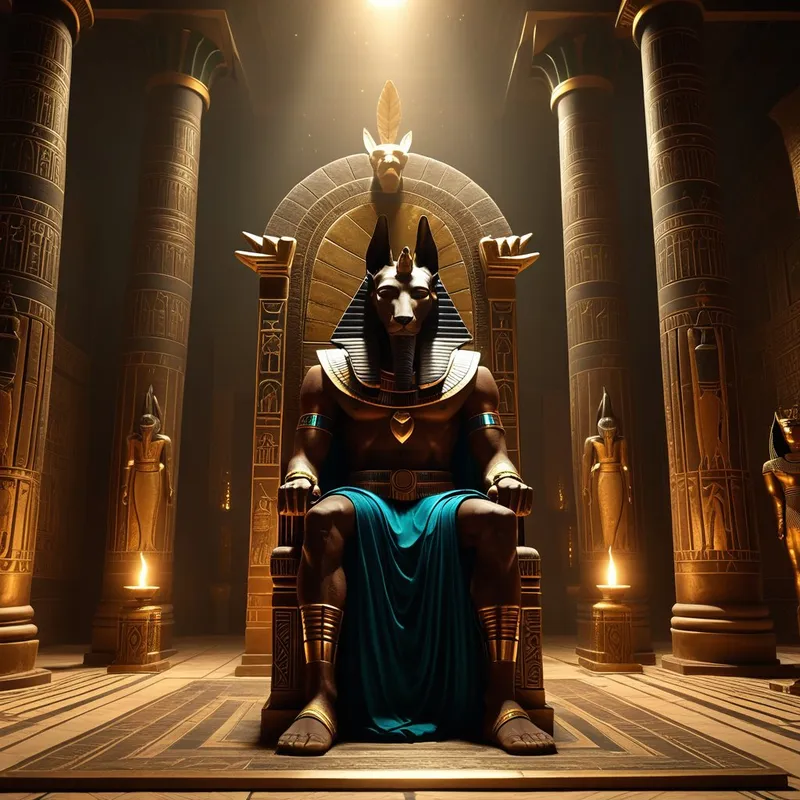
You pass through deserts of fire and islands of bliss, but the true trial awaits in the hall of Osiris</ab title>, the Lord of Silence. This is the Hall of Ma’at. The ceiling is the night sky; the floor, a pool of obsidian. Here, the jackal-headed Anubis approaches. He does not speak. With hands that have prepared a thousand kings for eternity, he takes your heart—the seat of your memory, your desire, your regret—and places it upon the golden scale.
On the other plate rests the feather of Ma’at, light as a sigh. The scale must balance. Your whole life hangs in that stillness. If your heart is heavy with falsehood, a beast waits—the Ammit, crouching in the shadows, jaws agape. But if the scales settle in equilibrium, a voice, deep as the earth, resonates from the green-skinned god upon the throne. It is Osiris. He speaks your name, not the name you were given, but the name you have earned. “True of Voice,” he declares. And with that utterance, you are born again into the Field of Reeds, where the sun rises from within.
Cultural Origins & Context
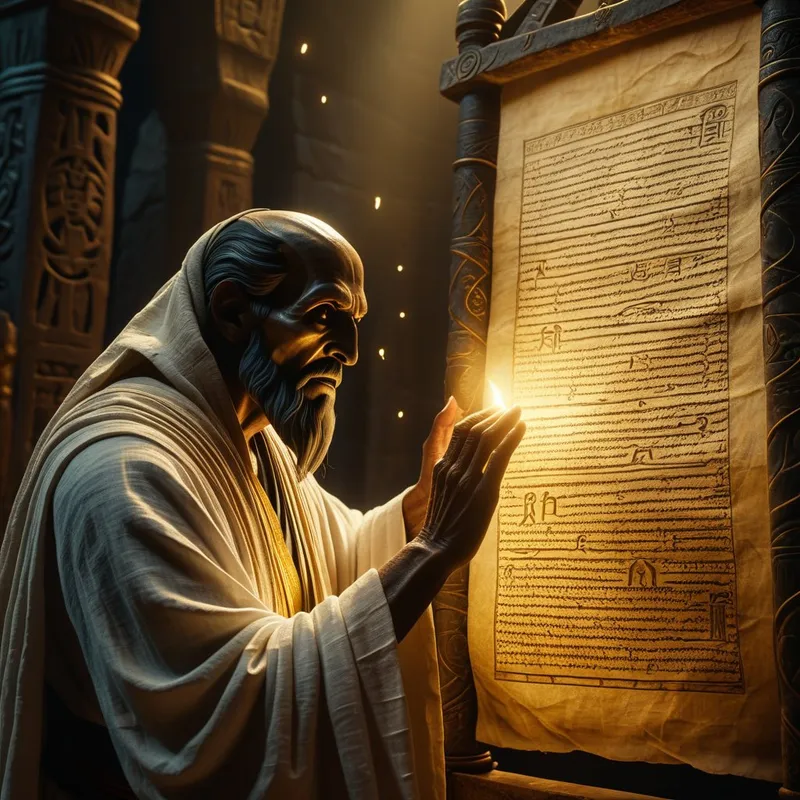
This was not a single book, but a evolving tradition spanning nearly two millennia. Its roots are in the Pyramid Texts of the Old Kingdom, spells reserved for the pharaoh alone to ascend and join the circumpolar stars. By the Middle Kingdom, these democratized into the Coffin Texts. The so-called Book of the Dead reached its classic form in the New Kingdom, becoming accessible to any who could afford its commissioning.
It was a supremely practical artifact of faith. Scribes produced copies, often with blank spaces for the deceased’s name, which would be filled in upon their death. It was placed in the tomb—tucked within the wrappings, laid upon the breast, or depicted in tomb paintings—as an active tool for the soul. Its function was societal and cosmic: to maintain ma’at by ensuring the successful transition of the individual, thereby preserving the harmony of the community and the cosmos itself. It was a guide written by the living for the dead, a profound act of love and necessity that blurred the line between manual and scripture.
Symbolic Architecture
The myth is a meticulous cartography of the soul’s architecture. The journey through the Duat is not a travel through geography, but through the layers of the self. The monstrous gatekeepers are not external demons, but the crystallized forms of one’s own unintegrated fears, regrets, and passions. To know their secret names is to achieve self-knowledge, to face and name the shadows within.
The heart on the scale is not judged by an external god, but by the weight of its own alignment with truth.
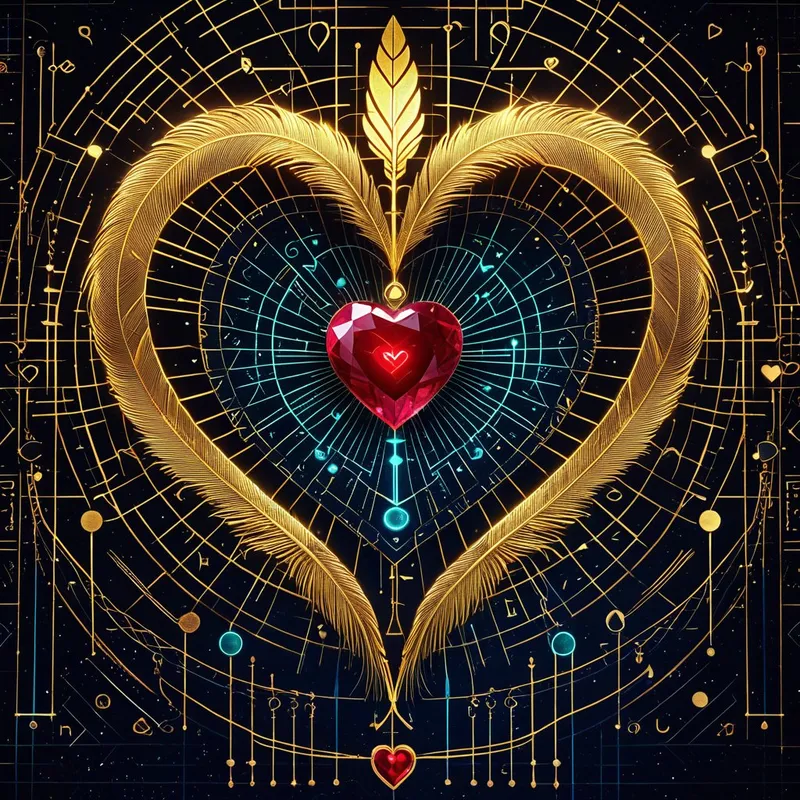
The feather of Ma’at symbolizes the irreducible core of integrity, the essential, weightless self before it is burdened by life’s compromises. The goal is not to be heartless, but to have a heart purified of deceit, a consciousness where action and essence are one. Ammit represents the ultimate psychic catastrophe: total annihilation of identity through self-betrayal. Conversely, the declaration “True of Voice” is the achievement of a fully coherent self, where one’s inner reality and outer expression are unified—the state of wholeness.
The Dreamer’s Resonance
When this myth stirs in modern dreams, it often manifests as a profound process of self-assessment. One may dream of being lost in a vast, labyrinthine building (the Duat), searching for a crucial document or password. There is a somatic weight, a literal feeling of heaviness in the chest—the unweighed heart. Dreams of being on trial, of facing a stern but impartial tribunal, or of trying to prove one’s innocence speak directly to the judgment in the Hall of Ma’at.
The composite animal figures—the dream crocodile-lion or snarling beast at a threshold—are classic manifestations of the shadow, the terrifying yet vital aspects of the psyche we have disowned. The dream is initiating a psychic weighing. It asks the dreamer: Where is your life out of balance? What falsehoods have you told yourself? What have you not confessed, even to your own soul? This is not a nightmare of punishment, but a profound, if unsettling, call to integrity.
Alchemical Translation
For the modern individual, the Book’s journey models the alchemical process of individuation. The first alchemical stage, nigredo (the blackening), is the descent into the Duat—the confrontation with the shadow, depression, or a life crisis that forces a reckoning. The spells are the practices of self-inquiry, therapy, or art that provide guidance and protection through this inner darkness.
The weighing is the albedo (the whitening), the purification. It is the ruthless, compassionate audit of one’s life. What must be released—the resentments, the inflated self-image, the old stories—to make the heart as light as the feather? This is the dissolution of the ego’s heavy constructs.
The ultimate transmutation is not becoming a god, but becoming true of voice—where the persona falls away and the authentic self speaks.
The declaration by Osiris and entry into the Field of Reeds symbolizes the rubedo (the reddening) and citrinitas (the yellowing): the dawn of a new, conscious life born from the ordeal. The resurrected one is not the old self restored, but a new self synthesized, capable of bearing the conscious light of the sun. The Book, therefore, is the eternal human text: the guide for turning the lead of an unexamined life into the gold of a realized one.
Associated Symbols
Explore related symbols from the CaleaDream lexicon: