Bonshō Myth Meaning & Symbolism
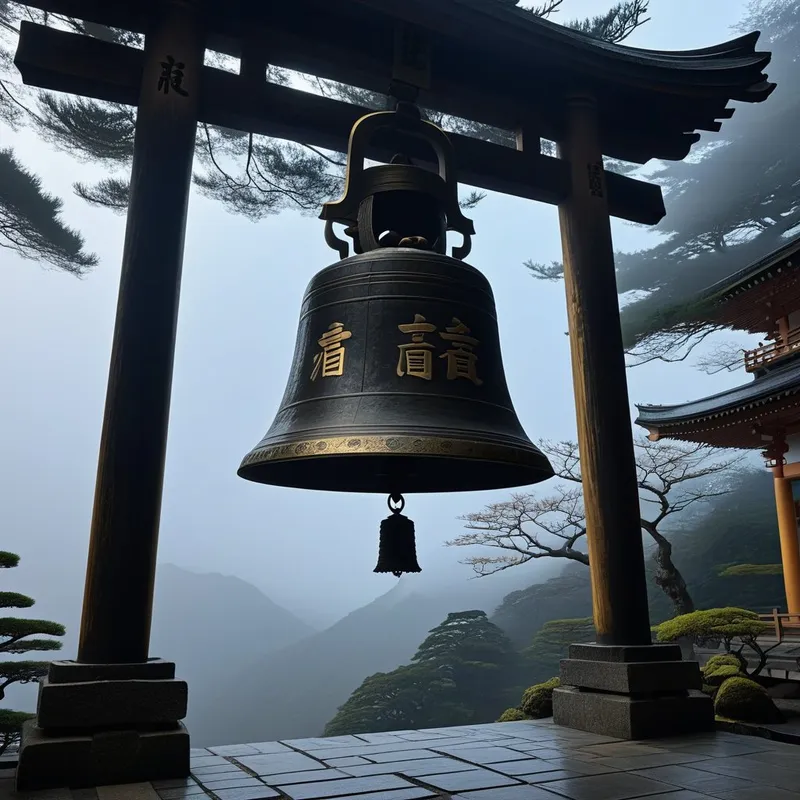
A temple bell, cast with a human heart, rings to purify the world, embodying the alchemy of sacrifice into sacred sound and collective awakening.
The Tale of Bonshō
Listen. In the deep mountains, where the mist clings to ancient cedars like a ghostly shroud, there was a silence so profound it was a presence itself. The world was heavy, not with peace, but with a stagnant sorrow. The people moved through their days under a sky that felt like lead, their prayers falling to the earth unheard, their spirits clouded by a nameless malaise. The air was thick, not with humidity, but with unspoken grief and spiritual murk.
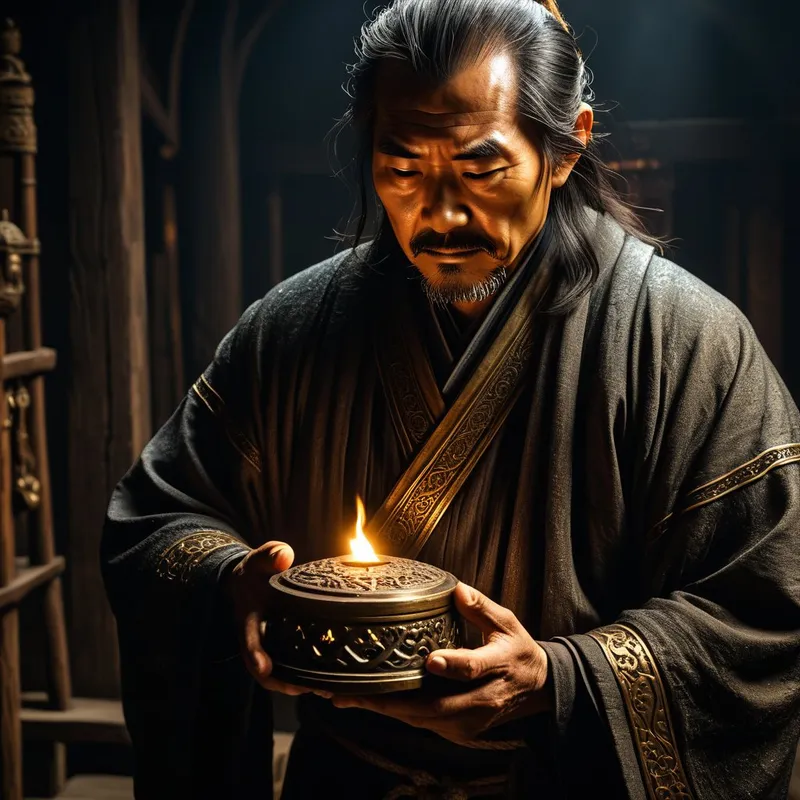
In this time, a master bell-caster, a man whose soul was as tempered as the metals he worked, received a vision. It came not in a dream, but in the very failure of his craft. Bell after magnificent bell he cast—perfect in form, flawless in alloy—and yet when struck, each produced only a dull, dead clank. The sound died at its birth, failing to soar, to cleanse, to reach the kami. He knew then the terrible truth: the world required not just a bell, but a voice. And a true voice requires a heart.
His journey was not one of distance, but of depth. He descended into the village not as a craftsman, but as a petitioner. He asked not for gold or bronze, but for a sacrifice of a different metal: the unyielding ore of human suffering. He asked the people to bring him their deepest regrets, their most secret shames, their unresolved angers—the spiritual poisons that clouded the collective soul. For days, they came. They whispered into clay jars their tales of betrayal, of love lost, of promises broken, of envy that gnawed at their bones. The bell-caster collected these whispers, these tangible ghosts, and sealed them away.
But the final ingredient was more terrible still. The vision was clear: the molten bronze itself must be tempered with the very essence of life, a catalyst of pure, selfless intent. It is said a volunteer emerged from the grieving crowd—a parent who had lost a child, a seeker who had found nothing but emptiness. Or perhaps, in the most profound versions, it was the caster himself. With a ritual of unbearable solemnity, a physical heart—the ultimate symbol of individual feeling and vitality—was prepared, wrapped in silks inscribed with sutras, and consecrated.
The night of the casting was an alchemical theatre. The furnace roared like a dragon, painting the foundry in hellish oranges and reds. The gathered bronze glowed, a lake of liquid sun. As the metal reached its zenith, the caster, his face a mask of tears and transcendent focus, offered the sacred bundle to the crucible. There was no sizzle of flesh, but a great, silent acceptance. The bronze seemed to sigh, its light deepening from orange to a profound, holy gold.
When the great bell—the Bonshō—was cool and hung in its temple tower, the entire world seemed to hold its breath. The caster lifted the massive log striker. He did not strike it. He met it. The contact was not a blow, but a marriage.
And then… the Sound.
It was not heard first with the ears, but felt in the chest, in the marrow. A deep, rolling OM that was at once a lament and a lullaby. It rolled out from the mountain, a visible wave of purity that parted the clinging mists, that shook the dust from leaves, that lifted the leaden sky. Where the sound touched, the heaviness lifted. People felt their private sorrows dissolve, not forgotten, but woven into a larger, compassionate tapestry. The bell’s voice was the heartbeat of the world itself, now audible. It rang of sacrifice, yes, but also of release, of the individual note finding its eternal chord.
Cultural Origins & Context
The myth of the Bonshō is not a single, canonical tale from a text like the Kojiki, but a powerful folkloric motif that crystallized around the very real, profound object of the Japanese temple bell. These bells, found at Buddhist temples across Japan, are central to ritual life, marking the hours, calling to ceremony, and symbolizing the Buddha's voice. Their casting was (and is) a sacred, community-wide endeavor, often involving donations of metal from villagers—sometimes even personal items like mirrors or coins, which carried their own psychic weight.
The story likely emerged from the esoteric (Mikkyō) Buddhist practices that permeated medieval Japan, where the concept of spiritual alchemy—transforming base passions into enlightened wisdom—was paramount. The act of "throwing oneself into the fire" is a known metaphor for ultimate dedication, seen in tales of pious self-immolation. This myth provided a tangible, metaphorical container for that terrifying, sublime concept. It was told not by bards in courts, but perhaps by monks in sermons or by elders in villages, serving to explain the uncanny, soul-stirring power of the bell's sound. Its function was to bind the community: the bell's voice was their voice, purified and unified, a sonic representation of collective karma being resolved and elevated.
Symbolic Architecture
At its core, the Bonshō myth is a masterful allegory for the transformation of individual, often painful, consciousness into a vessel for transpersonal resonance.
The Molten Bronze represents the chaotic, fiery state of the unrefined psyche—our raw emotions, memories, and complexes, heated to the point of dissolution. It is the prima materia of the soul.
The Whispered Regrets and Shames are the specific contents of the personal and collective shadow. By confessing them into the vessel, they are not discarded but acknowledged as essential, if toxic, ingredients. They are the impurities necessary for the final purity.
The heart sacrificed is not the seat of biological life, but the locus of the ego. It is the conscious, bounded self, the "I" that feels separate.
The Heart is the pivotal symbol. Its sacrifice is not an act of annihilation, but of sublime offering. It represents the ego's voluntary surrender to a process greater than itself. The heart is the catalyst that organizes the chaotic bronze and the toxic whispers into a new, coherent form. It is the individuated will giving itself over to the Self.
The Bell Itself is the newly forged psychic structure—the integrated personality. It is rigid yet resonant, a defined form capable of channeling infinite vibration.
Finally, the Sound is the ultimate goal: consciousness itself, purified and expansive. It is compassion made audible, wisdom made tangible. It does not erase suffering; it transmutes it into a frequency that heals and connects.
The Dreamer's Resonance
To dream of a Bonshō, or its casting, is to dream at the very furnace of psychic transformation. It signals a profound process underway in the dreamer's depths.
If one dreams of whispering into a jar or vessel, the unconscious is actively engaging in shadow work. The psyche is ready to confess and containerize long-held poisons—guilt, shame, a secret grief—preparing them for alchemical change. Somatically, this may coincide with a feeling of "lightness" after a cathartic release, or conversely, a tightness in the chest as these elements are first gathered.
Dreaming of the molten metal or the fiery furnace indicates the ego is in the crucible. Life circumstances or inner realizations are "heating up," dissolving old, rigid identities. This can be a period of intense anxiety, rage, or passion—the raw fuel of change. The body may feel feverish, agitated, or unbearably restless.
A dream of offering or losing one's heart is the most potent. It speaks to a conscious or unconscious decision to surrender a deeply held attachment, a core identity ("I am a victim," "I am my career," "I am this pain"). It is the ego agreeing to its own metamorphosis. This often manifests somatically as a poignant ache in the chest, a feeling of hollow openness, or a paradoxical sense of peace amid great loss.
Finally, to hear the bell's sound in a dream is a sign of the transformation nearing completion. It is the unconscious affirming that the sacrifice was not in vain, that a new, resonant capacity for connection and understanding is being born. One might wake with a sense of deep calm, clarity, or a feeling of being "in tune."
Alchemical Translation
The myth of the Bonshō provides a stark, beautiful map for the Jungian process of individuation—the journey toward becoming an integrated, whole Self.
The first step, gathering the whispers, is the often-painful work of introspection and shadow integration. We must collect our own "regrets and shames," not to wallow in them, but to acknowledge them as real, potent parts of our psychic substance. To deny them is to ensure our "bell" will be mute.
The melting of the bronze is the necessary crisis. Our comfortable, solid identities must be rendered fluid by the fires of life—failure, loss, love, analysis. This stage feels like disintegration, a loss of all form. The ego clings to its solidity, but the Self demands liquidity.
The crucible moment is not an act of self-destruction, but of self-donation. The ego-heart must be offered to the process, not to die, but to become the linchpin of a new reality.
The sacrifice of the heart is the central, terrifying, and liberating act of individuation. It is the moment we consciously choose to let go of who we think we are (the ego-complex) in service of who we might become (the Self). We offer our small, personal story to the grand, impersonal narrative of the psyche. In therapy, this is the "breakthrough"; in life, it is the courageous choice to change, to forgive, to release.
The casting and cooling is the period of integration. The new insights, the surrendered ego, and the acknowledged shadow slowly cool into a new structure. This is a time of quiet consolidation, of practicing new ways of being.
Finally, the sound is the fruit of individuation: a personality that no longer just contains consciousness, but resonates with it. The individual becomes a vessel through which something transpersonal can speak. Their presence, their actions, their creativity becomes a "sound" that clarifies and connects, turning personal suffering into a universal compassion that touches and awakens others. The once-separate heart now beats as the pulse of the world.
Associated Symbols
Explore related symbols from the CaleaDream lexicon: