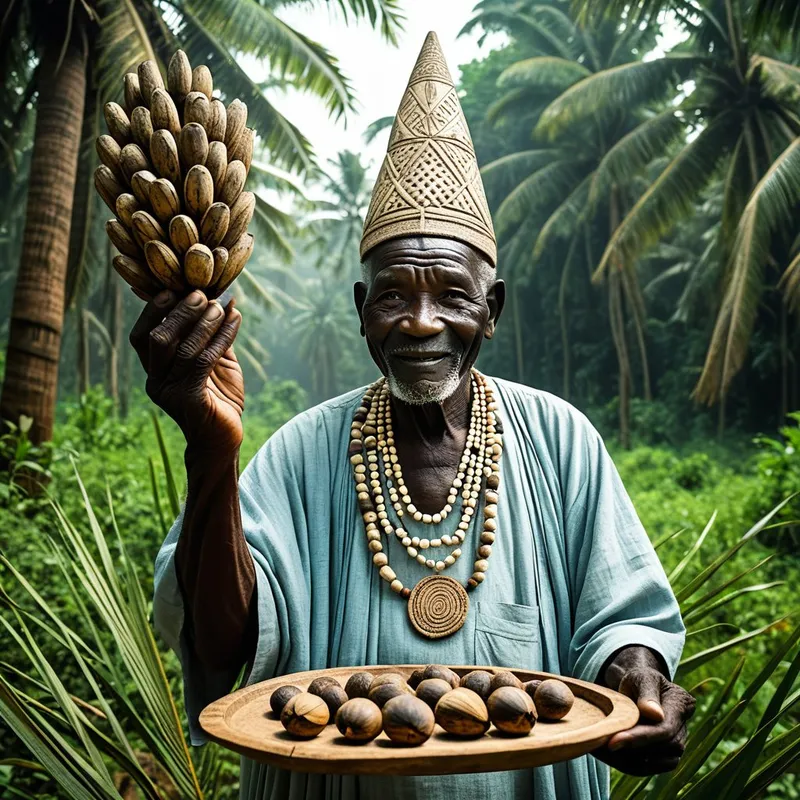
Bones in Ifá Divination Myth Meaning & Symbolism
A myth of how the first diviner, seeking lost wisdom, sacrificed his own bones to become the sacred instruments of Ifá, the voice of destiny.
The Tale of Bones in Ifá Divination
Listen. There was a time when the wisdom of Ifá was not yet in the hands of humanity. It resided in the realm of Olodumare, a perfect, silent knowledge, a map of all destinies written in a language of pure light. On Earth, people stumbled. They planted seeds in barren soil, loved the wrong hearts, built homes on shifting sands. They cried out for guidance, but the heavens were mute.
Into this silence walked a man named Orunmila. He was not a king, but a seeker. His eyes held the weariness of unanswered questions. He journeyed to the foot of the great Iroko tree, the axis between earth and sky. For sixteen days and sixteen nights, he fasted. He drank only dew. His prayers were not words, but a deep, resonant longing that vibrated in his chest, a sound like a hollow gourd yearning to be filled.
On the seventeenth dawn, as the world hung between darkness and light, a voice spoke. It was not a sound for the ears, but a knowing that blossomed in his mind. It was Ifá itself. "The map you seek is here," it intoned. "But to read it, you must become its instrument. The tools are not of wood or metal. They are of memory. They are of sacrifice."
Orunmila understood. The wisdom was a pattern, a rhythm of sixteen fundamental principles. To cast this pattern on Earth required a vessel that carried the memory of life itself—its structure, its fragility, its enduring core. He looked at his own hands, at the frame that held his spirit. The answer was a terrible grace.
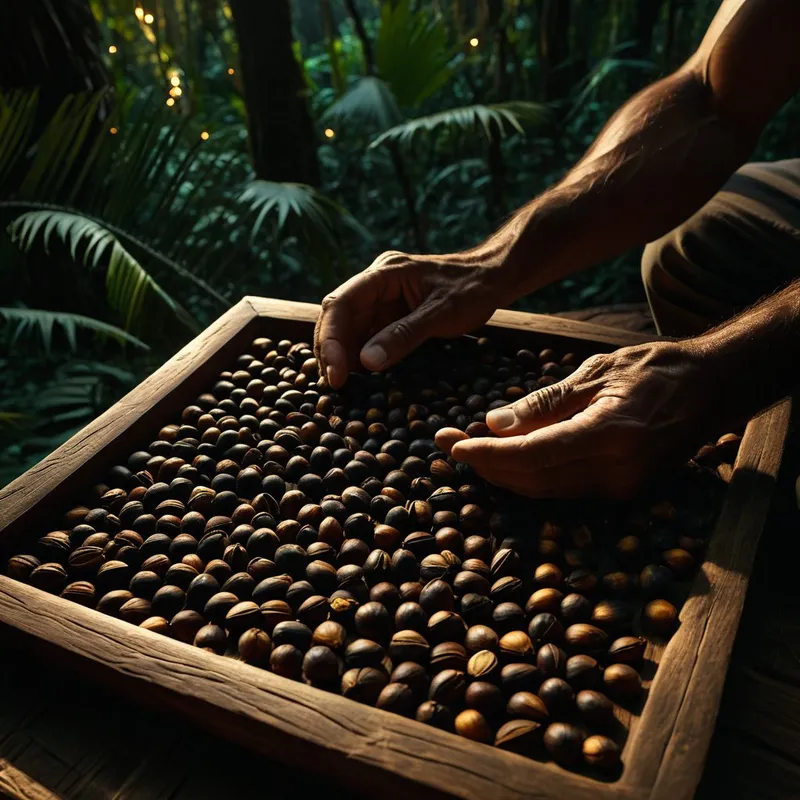
Without ceremony, he drew a sharp, consecrated shell. The pain was a fire that cleansed all doubt. From his own finger, he took the bone. He repeated this act, a profound and silent liturgy, until he held sixteen small, white pieces of himself. As he held them, they did not feel like loss. They hummed. They grew warm, transforming, smoothing into sixteen perfect ikin—palm nuts dark and glossy as the night sky.
He then took the dust from the opon Ifá where he sat, mixed it with his own blood and tears, and smeared it upon a flat tablet of wood. Where his fingers traced, lines appeared—the sacred odu of Eji Ogbe, the pattern of beginnings.
With his breath ragged but his spirit vast, Orunmila cast the ikin upon the opon. They fell not as bones, but as stars falling into a constellation. They spoke. They narrated the story of the first rain, the first quarrel, the first healing. The silence was broken. The wisdom had found its voice, and its voice was the sound of a man who had given his own foundation to become a bridge for all who would come after.
Cultural Origins & Context
This myth originates from the Yoruba spiritual corpus, carried across the Atlantic in the memories and resilience of the enslaved. It became a cornerstone of African Diasporic traditions like Santería or Candomblé, and the distinct practice of Ifá-Orisha. The story is not merely folklore; it is a foundational narrative for the Babalawo, the "Father of Secrets."
Transmitted orally through ritual recitation, poetry (ese Ifá), and direct initiation, its societal function is multifaceted. It sacralizes the divination instruments, transforming them from objects into relics of a primordial sacrifice. It establishes the diviner not as a mere technician, but as one who must internalize Orunmila’s sacrifice—offering their own ego and assumptions to become a clear vessel. The myth legitimizes the system itself, framing it as a hard-won gift of consciousness to humanity, paid for with the very substance of the first sage.
Symbolic Architecture
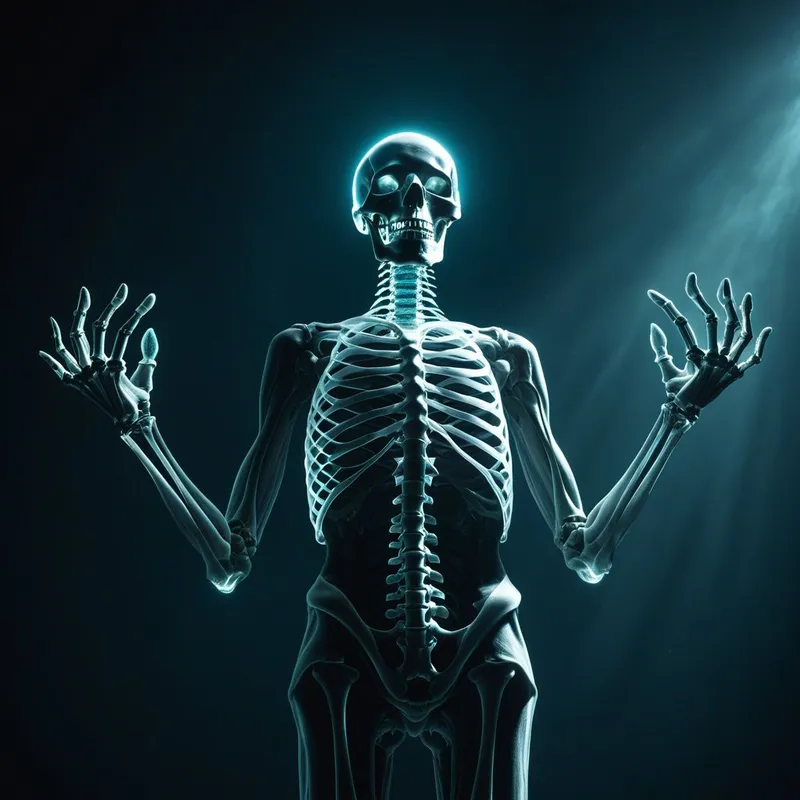
The myth is a dense symbolic map of consciousness. The "bones" represent the essential, non-negotiable structure of the self—the core truths, the ancestral inheritance, the psychic architecture that remains after all that is superfluous is stripped away.
To consult the bones is to consult the bedrock of the self. The sacrifice is not of life, but of the illusion of a separate, intact identity.
Orunmila’s act is the ultimate paradox of wisdom: one must deconstruct the personal to access the transpersonal. His individual bones become the universal ikin. The sixteen pieces correspond to the sixteen principal Odu, the complete matrix of existential possibilities. The opon Ifá becomes the world, the field upon which destiny is plotted. The myth thus encodes the very principle of divination: that the answers we seek about our path (our destiny, or ayanmo) are not external, but are revealed through a sacred engagement with our own deepest, often hidden, structure.
The Dreamer's Resonance
When this myth pattern surfaces in modern dreams, it often signals a profound process of psychic re-founding. Dreaming of finding bones, sorting bones, or having one’s own bones removed or transformed indicates a somatic confrontation with the "ground of being." The dreamer is not dealing with superficial emotions, but with the foundational pillars of their psyche.
This can feel like a dismantling. There may be dreams of architectural collapse, of digging in earth, or of holding smooth, heavy stones. Psychologically, this is the Self demanding an audit. What ancestral patterns (bones) are still supporting you? Which have become brittle? The process is one of distinguishing the essential from the accumulated. It is a call to sacrifice the comfort of a poorly-built identity to discover the authentic, load-bearing truth beneath. The anxiety in such dreams is the fear of dissolution, but the myth promises that this dissolution is in service of becoming a clearer instrument for one’s own destiny.
Alchemical Translation
The alchemical journey modeled here is the transmutation of the personal complex into the transpersonal tool. In Jungian terms, it is the heart of individuation: the ego’s sacrifice to the greater Self.
The modern seeker’s "bones" are their fixed narratives, their core wounds, their unexamined inheritances. The "divination" is the act of casting these fragments onto the tray of conscious examination to see what pattern they truly form.
The first stage is mortificatio—the painful acknowledgment of one’s own structural limits (Orunmila’s fasting and realization). The second is the sacrificium—the willing offering up of that familiar structure (the removal of the bones). The third is albedo and rubedo—the bleaching by spirit and the fiery infusion of meaning, where the bones become the gleaming, potent ikin (transformation). The final stage is coniunctio—the sacred marriage where the transformed self (the diviner) can now interact with the pattern of the whole (the Odu) to generate guidance.
For the individual, this means that our most profound insights and our capacity to guide ourselves and others do not come from acquiring something new, but from courageously offering up our oldest, most fundamental pieces to be reconsecrated by a wisdom greater than our own. We do not find our destiny by building a taller tower of achievements, but by respectfully consulting the ancestral, bony truth of who we already are, and allowing it to speak in the language of constellations.
Associated Symbols
Explore related symbols from the CaleaDream lexicon: