
Bone and Shell Adornments Myth Meaning & Symbolism
A myth where a being's sacrifice transforms bone and shell into sacred adornments, teaching the alchemy of turning suffering into beauty and identity.
The Tale of Bone and Shell Adornments
Listen. In the time before time, when the world was soft clay and the sky was a blanket still being woven, there walked a being who was neither wholly of the earth nor the sea. Some called them Long Walker, for their journey had no end. Their body was the color of twilight, and in their eyes shone the cold light of the stars and the warm memory of the sun.
Long Walker carried a silence within them, a hollow place where the wind whistled a lonely tune. They walked the high deserts where the sun bleached the stones to bone, and they walked the shores where the great waters sighed and left gifts of shell upon the sand. They felt the starkness of the bone, a memory of structure, of life that had been. They felt the iridescent curve of the shell, a memory of protection, of a life withdrawn. Both were beautiful. Both were dead.
This hollow within Long Walker grew, until one day, standing at the meeting place of desert and ocean, the silence became a cry. It was not a cry of anger, but of profound offering. They looked to the four directions, then to the sky father and the earth mother, and they spoke a vow into the wind. "I am made of memories that have no home. Let my substance become a home for meaning. Let my form be unmade, so that a new form may be made for others."
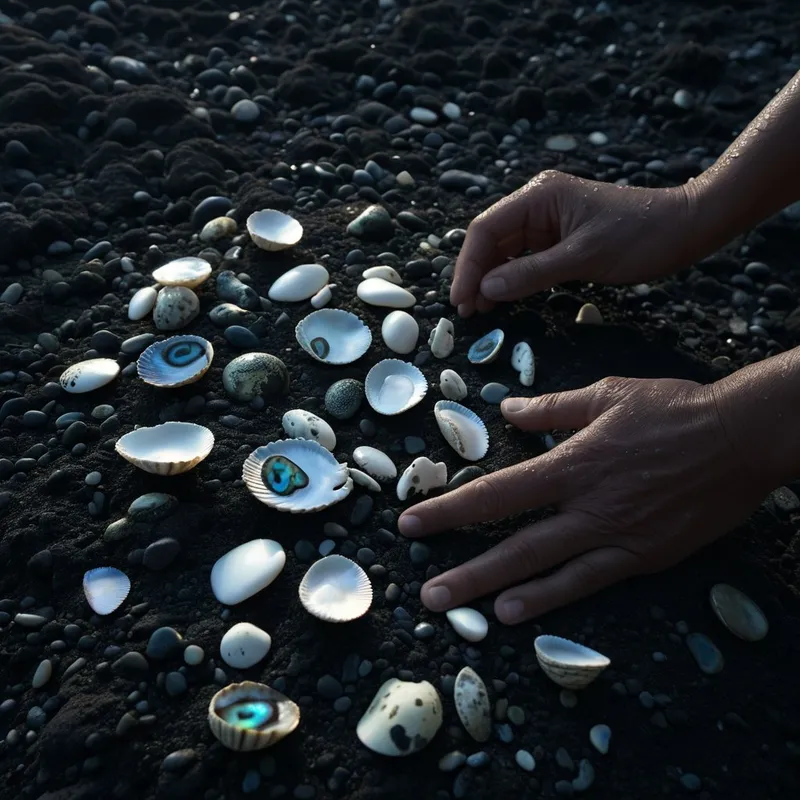
And so, Long Walker began to gather. Not as a collector, but as a mourner. They gathered the sun-bleached ribs of the antelope, the delicate vertebrae of the bird, the strong femur of the bison. They gathered the whorled conch, the fragile scallop, the abalone holding the rainbow in its heart. They built a great pile at the sacred junction.
Then, they did not sing a song of power. They sang a song of letting go. As they sang, their own form began to soften at the edges. The boundary between their skin and the air, between their spirit and the matter of bone and shell, began to blur. The first tear that fell from their eye did not wet the sand; it fell upon a fragment of bone and sank into it, leaving a mark like a tiny river delta. The second tear fell upon a piece of shell, sealing its cracks with a pearl-like luminescence.
This was the alchemy. It was not fire, but sorrow. It was not force, but surrender. Long Walker’s essence—their journeys, their loneliness, their silent observations—flowed into the inert fragments. The bones, which had known only the structure of one life, began to remember the possibility of connection. The shells, which had known only the solitude of one creature, began to remember the song of the whole ocean.
As the last note of their song faded, Long Walker was gone. Where they had stood was only the shimmer of memory in the air. But upon the ground, the pile of bone and shell was transformed. Holes had appeared, as if drilled by patience itself. They were arranged not in a heap, but as if waiting to be lifted. The bones gleamed with a soft, inner light, no longer stark but sacred. The shells glowed with a deeper, watery fire, holding not just reflected light, but the light of the vow.
The first people to find them did not see trash. They saw a language. They saw a story of sacrifice and becoming. With sinew and fiber, they bound the pieces together. Bone met shell in a harmonious clash of realms. Worn against the skin, the adornments did not just hang; they spoke. They whispered of the Long Walker’s journey, of the beauty forged from surrender, and of the truth that the most potent adornments are not taken, but given.
Cultural Origins & Context
This myth, in its countless local variations, belongs to the vast oral tapestry of Indigenous American traditions. It is not a single, fixed story from one nation, but a profound archetypal narrative that surfaces across different cultures, from the Pueblo peoples of the Southwest to various nations of the Great Plains and beyond, often connected to the origins of sacred regalia and personal medicine objects.
It was traditionally told not as entertainment, but as instruction—a foundational narrative for understanding the relationship between the individual, the community, and the material world. Elders and knowledge-keepers would recount it during ceremonies preparing for a hunt, a vision quest, or the making of ceremonial attire. Its telling was an act of transmitting ethical and spiritual principles: that nothing from the earth or animal world is to be taken lightly, that beauty has a cost, and that identity is constructed from meaningful relationships with the sacrifices of other beings, both human and more-than-human.
The societal function was multifaceted. It provided a sacred origin story for the practice of creating and wearing adornments, elevating them from decoration to a dialect of spiritual communication. It encoded ecological wisdom, teaching respect for animal remains and natural materials by framing their use as a continuation of a sacred exchange begun by a primordial being. Most importantly, it modeled the process of transforming personal suffering or void (the "hollow" of Long Walker) into a gift for the community—the core of many Indigenous values.
Symbolic Architecture
At its heart, the myth is a map of psychic alchemy. Bone represents the enduring structure of the Self—our core principles, our ancestral inheritance, the unyielding truths of our experience. It is what remains after the flesh of temporary emotion and identity has fallen away. It is stark, factual, and foundational.
Shell represents the protective persona and the hidden, sensitive soul. It is the beautiful, curated face we show the world, but also the inner, iridescent self that retreats for safety. It belongs to the realm of emotion, intuition, and the unconscious—the watery depths.
The great work is not to choose bone over shell, but to allow the tears of conscious suffering to drill the holes through which they may be strung together.
Long Walker is the archetypal psyche in a state of existential crisis. Their "hollow" is the modern condition of alienation, the feeling of being disconnected from meaning. Their gathering is the conscious act of introspection—collecting the fragmented experiences of our lives (our personal "bones" and "shells") that feel dead or disconnected. The transformative act is not an act of willful creation, but of sacred dissolution. Long Walker’s sacrifice symbolizes the ego’s necessary surrender. We do not "fix" our fragments by force; we offer our very awareness—our tears, our conscious attention—as the solvent that redeems them. The resulting adornments symbolize the individuated Self: a unique, beautiful, and functional whole created from redeemed fragments, worn as identity.
The Dreamer's Resonance
When this myth surfaces in modern dreams, it often appears during a profound phase of identity reconstruction. To dream of finding or handling bone and shell adornments suggests the dreamer is in the process of gathering the disparate, perhaps painful, parts of their history and personality. The bones may represent old hurts, core beliefs, or family patterns that feel rigid. The shells may represent hidden talents, vulnerabilities, or aspects of the self that have been protected or withdrawn.
A dream of breaking such adornments may indicate resistance to this integration, a fear of the vulnerability required. A dream of receiving them from a shadowy or ancient figure points to acceptance of guidance from the deeper unconscious. The somatic sensation often reported is one of weight—not a burdensome weight, but a dignified, anchoring heaviness on the chest or around the neck, as if the dream body is acclimating to the gravity of a new, more authentic self. The psychological process is one of re-membering: literally, putting the members of the self back together into a coherent, wearable story.
Alchemical Translation
For the modern individual navigating a fragmented world, the myth of Bone and Shell Adornments is a manual for individuation. Our culture offers endless, shiny "shells" (social media personas, consumer identities) and rigid, dogmatic "bones" (fixed ideologies, unexamined life scripts), but rarely teaches the sacred art of stringing them together with the sinew of personal meaning.
The first step is the Gathering. This is the inward turn, the inventory of one's life. What are the stark, undeniable truths (bones) of your experience? What are the beautiful, hidden, or protected parts (shells) you have withdrawn from the world?
The second is the Hollowing. This is the courageous admission of the void, the loneliness, or the suffering that exists between these fragments. This is not a failure, but the sacred space where transformation occurs. It is the modern equivalent of Long Walker's cry.
The third is the Offering. This is where willful self-help fails and psychic alchemy begins. It is the surrender of the ego's plan to "fix itself." One must offer one's own conscious awareness—the "tears"—to the process. This means holding the fragments in mindful, non-judgmental attention, allowing feeling to permeate memory.
The adornment is not the goal; the wearing is. The integrated self must be lived, felt against the skin, and allowed to speak its story into the world.
The final Stringing happens almost autonomously, from the deeper Self. Patterns of connection emerge. A painful childhood memory (bone) finds meaning as the foundation for a deep empathy (shell). A hidden sensitivity (shell) becomes the protective strength (bone) for a creative pursuit. The result is not a perfect, seamless whole, but a unique and sacred assemblage—your identity, no longer a burden of fragments, but an adornment of earned wisdom. You become both the Long Walker who sacrificed and the people who wear the meaning, completing the sacred circle of transformation.
Associated Symbols
Explore related symbols from the CaleaDream lexicon: