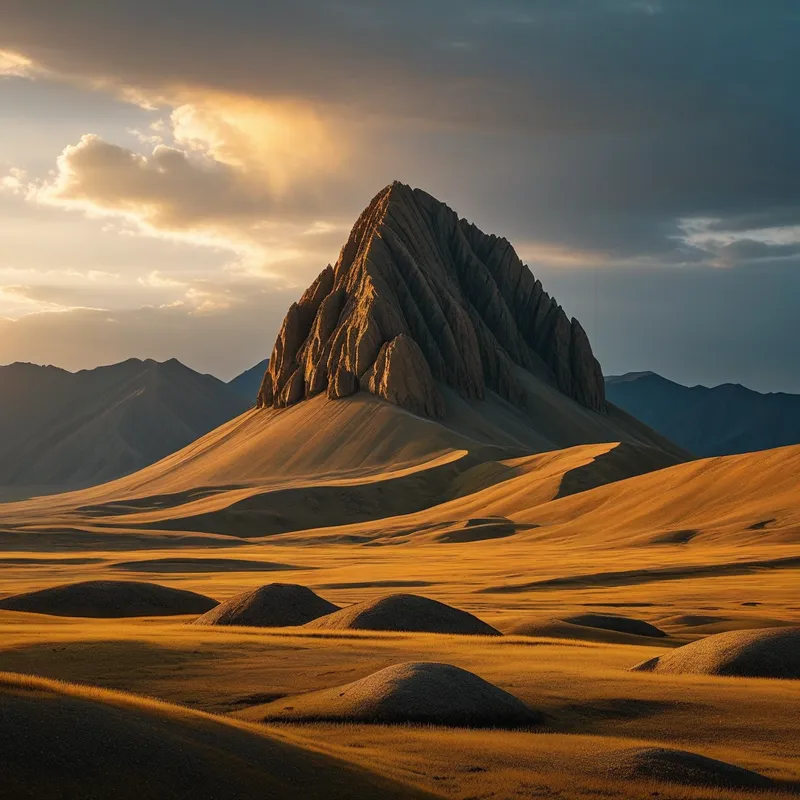
Bogd Khan Mountain Myth Meaning & Symbolism
A myth of a sacred mountain spirit who became the eternal protector of the land, embodying the unbreakable bond between the Mongolian people and their sovereign landscape.
The Tale of Bogd Khan Mountain
Listen. Before the wind learned the names of all the grasses, when the sky was a younger, deeper blue, the land south of the great Khari-Khorin lay restless. It was a place of raw power, where earth spirits stirred and the bones of the world pressed close to the skin of the steppe. The people who camped in its shadow spoke in hushed tones. They felt a presence, vast and watchful, but it was formless—a pressure in the air, a weight in dreams.
Then came a khan, a leader of iron will and fiery heart. He saw this potent land not with fear, but with ambition. “Here,” he declared, his voice cutting the wind, “I will build my court. Here, I will hunt the forests thick with game, and my power will be as rooted as the ancient stones.” His nobles murmured, feeling the land’s silent protest. The shamans cast their shoulder-blade oracle bones, and the cracks spoke of a great spirit, a Lus Savdag, older than human memory, who claimed this domain.
The khan, driven by the pride of kings, would not be swayed. He ordered the trees felled for his palace. His people, bound by loyalty and fear, took axe to trunk. The first cuts were made. And the mountain awoke.
It did not roar. The silence that fell was deeper than any sound. The air grew heavy, tangible. From the very soil, from the bedrock, a consciousness focused. The spirit of the place, insulted, rose in its defense. It was not a beast, but the land itself becoming will. The workers’ axes turned blunt against wood suddenly hard as iron. A deep, grinding tremor passed through the earth, not to destroy, but to demonstrate. Springs dried up. Game vanished from the woods. A profound stillness, thick with disapproval, settled over the slopes.
The khan, in his tent, felt the sovereignty of his own spirit challenged by a sovereignty far older. His commands were empty echoes against the silent, immovable will of the mountain. He was not facing an enemy to conquer, but a truth to recognize. In that crushing, humbling silence, his ambition burned away, leaving a cold, clear understanding. He had not come to command this place. He had come to meet it.
He ordered all work to cease. Alone, he climbed the slopes, not as a conqueror, but as a supplicant. He made offerings of milk and airag to the wind. He spoke no demands, only apologies and respect, acknowledging the mountain as the true lord, the Bogd, of this land. He vowed that neither he, nor any leader after him, would ever violate its slopes with axe or fire. He would protect it, and in return, he asked the mountain to protect his people.
The tension in the air dissolved. The wind returned, gentle now. The mountain’s spirit, appeased by this act of true recognition, accepted the pact. The khan descended, transformed. He proclaimed the mountain a sacred Ikh Khoroo, an eternal sanctuary. And so, the spirit of the mountain and the spirit of the ruler merged in purpose. The khan gained the wisdom of the enduring earth, and the mountain gained a voice and a protector in the human realm. It became Bogd Khan Uul—the Holy Ruler Mountain—not a subject of the empire, but its sacred, eternal guardian, watching over the cradle of Mongolian civilization with the patience of stone and the vigilance of a king.
Cultural Origins & Context
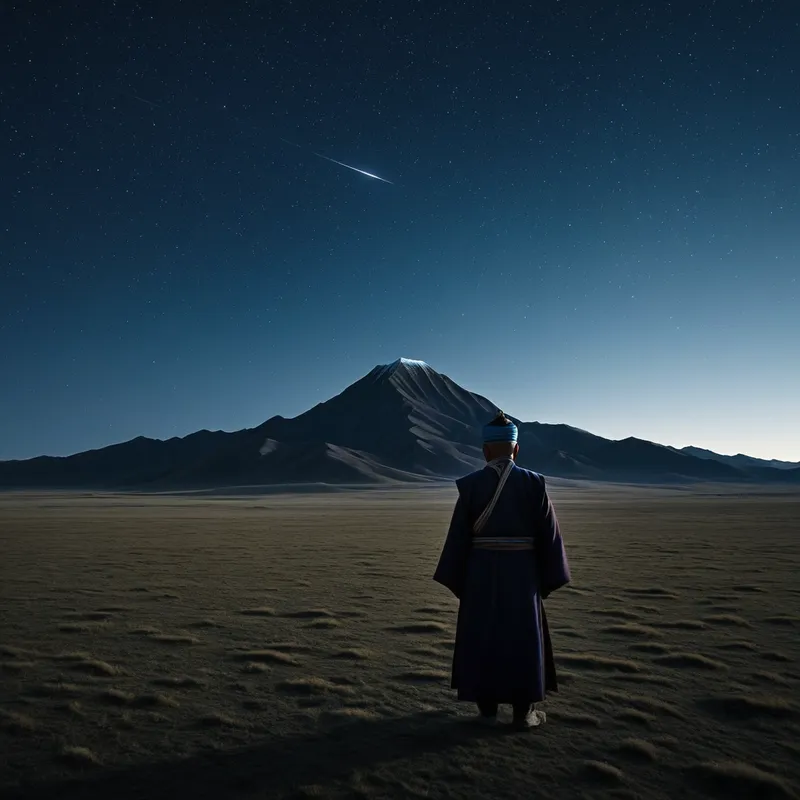
This myth is rooted in the deep Tengerism of the Mongolian worldview, where the landscape is alive with spirits (Lus, Savdag). Bogd Khan Uul, the mountain guarding the southern approach to present-day Ulaanbaatar, is one of the world’s oldest officially protected nature reserves, decreed as such in the 12th century. The myth likely evolved as an etiological narrative, explaining the mountain’s sacred, inviolable status and codifying early conservation law.
Passed down orally by shamans and storytellers, its function was multifaceted. It was a legal charter, forbidding logging and hunting. It was a theological lesson, teaching that human authority is secondary to the sovereignty of the natural world. And it was a political allegory, modeling the ideal ruler not as a dominator, but as one who enters into a sacred covenant with the land and its spirits, deriving legitimate power from respectful stewardship rather than sheer force.
Symbolic Architecture
At its core, the myth is a profound dialogue between two archetypal forces of Order. The human khan represents the conscious, active, willful principle of governance. The mountain spirit represents the unconscious, eternal, and foundational principle of the Earth. The conflict arises from the ego’s attempt to impose its order upon the deeper, pre-existing order of the Self.
The true ruler is not he who conquers the mountain, but he who is conquered by its spirit and in that surrender, finds his true mandate.
The khan’s initial hubris is the ego’s inflation. The mountain’s response—a silent, paralyzing assertion of its own law—is the Self enforcing its boundaries. The resolution is not victory for one side, but the birth of a sacred union. The mountain becomes Bogd Khan (Holy Ruler), and the khan becomes the mountain’s steward. This symbolizes the integration of the ego with the Self, where personal ambition is alchemized into transpersonal responsibility. The protected forest becomes a symbol of the Temenos, the inviolate psychic core.
The Dreamer's Resonance
When this myth pattern stirs in modern dreams, it often manifests as an encounter with an immovable, majestic, and intimidating natural formation—a vast mountain, a colossal tree, a silent, deep lake. The dreamer may feel a compulsive need to climb it, mine it, or build upon it, only to be met with subtle, profound resistance: tools fail, paths vanish, an overwhelming atmosphere of “no” presses down.
Somatically, this can feel like a heavy pressure on the chest or a grounding stillness—the body sensing the psyche’s need to stop doing and start listening. Psychologically, this is the moment when an individual’s willful plans (career paths, relationships, self-image projects) bump against the deeper, sovereign laws of their own nature. The dream is presenting the inner “Mountain Spirit”—the core, innate personality and its non-negotiable values. The ensuing frustration or awe in the dream signals the beginning of a necessary negotiation with one’s own inner authority.
Alchemical Translation
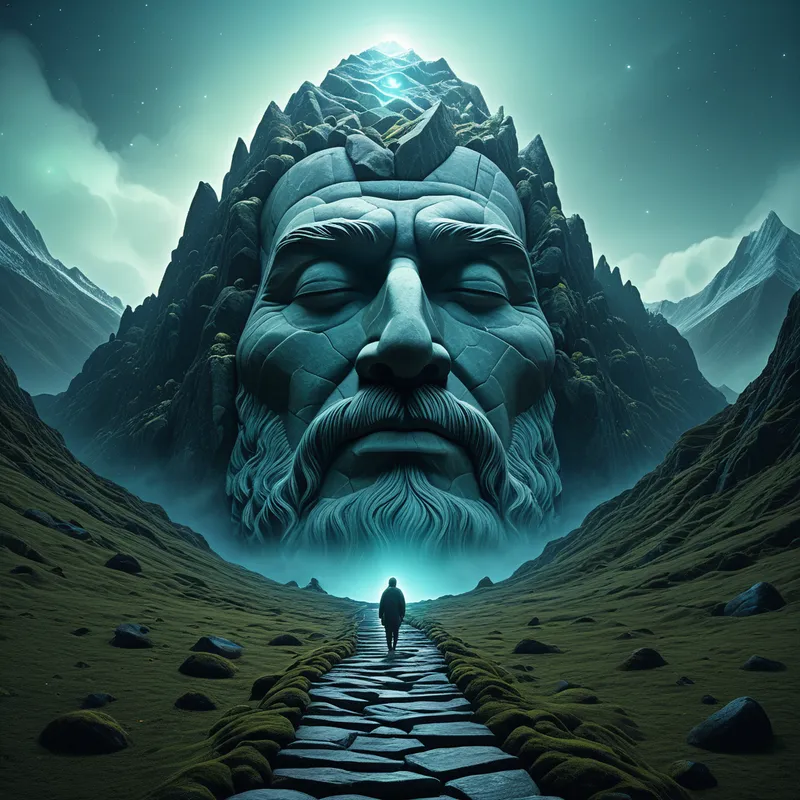
The individuation process modeled here is the alchemy of sovereignty. We all contain an inner “khan”—our driving, ambitious, executive ego. We also contain an inner “Bogd Khan Mountain”—the ancient, immutable spirit of our deepest Self, the bedrock of our being. The modern neurosis is the khan who never meets the mountain, who builds his identity on sand, unaware of the granite beneath.
The first alchemical stage is Violation: the ego, in its one-sided development, seeks to exploit psychic resources (energy, time, instincts) without respect. This leads to the Confrontation: the Self enforces a psychic drought, a depression, a creative block—the silent, grinding tremor that halts progress.
The transmutation begins not in triumph, but in the humbling recognition of a greater law within.
The crucial operation is the Ascent in Humility: the ego must climb down from its throne of will and approach the Self as a petitioner. This is the act of sincere introspection, of listening to the body, of honoring limits and innate dispositions. The Offering is the sacrifice of the ego’s prideful agenda. The resulting Covenant is the birth of authentic identity: the ego agrees to serve and protect the integrity of the Self, and in return, the Self grants the ego the unwavering authority and resilience of the mountain. The individual no longer acts from fragile ambition, but from grounded purpose. They become the protected sanctuary and its guardian simultaneously.
Associated Symbols
Explore related symbols from the CaleaDream lexicon:
- Mountain — The central symbol of immutable spirit, sovereign consciousness, and the enduring, foundational Self that must be recognized, not conquered.
- Sacrifice — The khan’s sacrifice of his prideful ambition, which is not a loss but an offering that forges the sacred covenant between human will and natural law.
- Order — The myth is fundamentally about the clash and eventual reconciliation between two orders: human-imposed order and the innate, sacred order of the land/psyche.
- Earth — Represents the physical and psychic ground of being, the ultimate source of authority and the entity with which the ruler must align.
- Protection — The core function of the covenant; the mountain protects the people, and the people (through the khan’s law) protect the mountain, symbolizing the psyche’s self-regulating integrity.
- Holy Mountain — The mountain as a Axis Mundi, a place where the human and the divine (or the ego and the Self) establish direct communication and treaty.
- Ruler — The archetype embodied by both the khan and the mountain spirit, representing the quest for legitimate, grounded authority and stewardship over one’s inner and outer realms.
- Stone — Symbolizes the eternal, patient, and unforgiving nature of the inner law; the hard truth of the Self that cannot be bargained with, only respected.
- Spirit — The animating consciousness of the land, representing the numinous, alive quality of the unconscious psyche that demands relationship, not domination.
- Temple — The mountain itself becomes a natural temple, a protected temenos that exists as both a geographical fact and a psychological state of sacred, inviolate space.