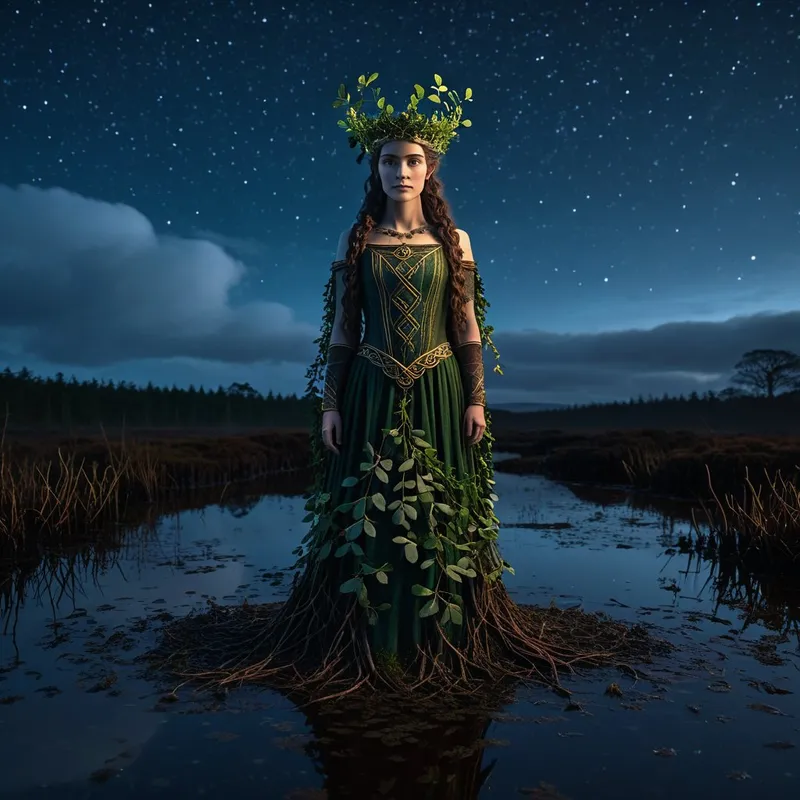
Bog Bodies Myth Meaning & Symbolism
A sovereign figure is ritually offered to the bog, a sacred marriage of flesh and earth to ensure the land's fertility and the tribe's continuity.
The Tale of Bog Bodies
Listen. The wind does not whisper here in the bog; it holds its breath. The water is not clear, but the colour of strong tea and old blood, a mirror that shows only the slow, patient sky. This is the belly of the earth, the thin place where the world of tribe and fire meets the world of root and silent depth.
In a time when the oak was king and the river a silver road, the people of the tuath felt a chill in the summer sun. The cattle grew thin, their milk sour. The grain in the field stood pale and hesitant. The rí, whose name is lost to the peat, walked the boundaries of his kingdom and felt its sickness like a fever in his own blood. The druids gathered, their faces grave in the firelight. They read the flight of crows and the entrails of a sacred white bull. The message was a single, heavy word: the Sovereignty Goddess was displeased. The sacred marriage was broken. The land and its ruler were no longer one flesh.
A choice lay upon the rí, heavier than any torc of gold. The old compact, written in the language of bone and loam, demanded a renewal. Not the blood of a slave or a captive, but the ultimate gift: the sovereign self. To wed the goddess truly, to become the land itself, one must enter her completely.
On a day when the mist clung to the alders like a shroud, a procession wound its way to the heart of the bog. The rí, clad in a simple tunic, his hair braided with mistletoe, walked with a calm that stilled the weeping of his kin. At the bog's edge, the druids chanted the old songs, their voices weaving a bridge between worlds. They offered him a last meal of barley bread and a draft of dark, fermented ale—the sustenance of the people he would save.
He waded into the cold, clinging embrace of the peat. The black water rose to his chest, to his throat. He did not struggle. He opened his eyes to the grey sky and let the bog take him—not as a thief takes a life, but as a lover receives a gift, as the earth accepts a seed. His last breath was not a sigh, but a release. His body sank, cradled by the acidic, anaerobic embrace. The water closed over his head. The bubbles ceased. A profound silence fell, broken only by the distant cry of a curlew.
And in that silence, something shifted. The chill left the air. The water in the bog pool seemed to shimmer with a deeper, more vital darkness. The people returned to their homes, their hearts a tumult of grief and awe. In the days that followed, the cattle grew fat. The grain ripened to a robust gold. The land was fertile once more. The rí was gone, yet he was everywhere—in the richness of the soil, in the strength of the harvest, in the very continuity of the tribe. He had not died. He had been translated.
Cultural Origins & Context
The so-called "Bog Bodies"—the astonishingly preserved human remains found in peatlands across Northern Europe, particularly in Ireland, the UK, and Denmark—are not characters from a single, codified myth. They are the stark, physical evidence that became myth. The Celtic world-view, particularly in the Iron Age, did not separate the political from the spiritual, nor the human from the natural. Kingship was a sacred contract, a hieros gamos between the rí and the Sovereignty Goddess.
These acts of ritual deposition, as interpreted by archaeologists and scholars like Miranda Aldhouse-Green, were likely the ultimate enactment of this contract. The individuals—often young men of high status, sometimes with signs of ritualistic care like manicured nails and last meals, alongside evidence of violent, ceremonial death—were not executed as criminals. They were offered. The bog was not a dumping ground, but a sacred votive repository, a direct channel to the chthonic powers. It was a liminal space, neither dry land nor open water, perfectly suited for a transaction between the human community and the numinous forces governing fertility and order. The myth we weave around them today is a reconstruction of the profound psychological and cosmological narrative that made such an act not only thinkable, but necessary and sacred.
Symbolic Architecture
At its core, the Bog Body myth is a supreme allegory of sacrifice as generative act. It dismantles the modern notion of sacrifice as mere loss, reframing it as the essential nutrient for cyclical renewal.
The body does not belong to the individual, but is the temporary vessel of the tribe's soul. To give it back to the earth is to complete the circuit of life.
The bog symbolizes the unconscious itself—dark, preservative, and teeming with latent life. Its acidic waters that tan the skin and hold time at bay represent the psyche's own preservative and transformative powers, which can immobilize traumatic or sacred contents, keeping them potent but unchanged for centuries. The sovereign who enters it performs the ultimate act of ego-surrender. He relinquishes personal identity, autonomy, and life itself to become one with the larger, impersonal body—the land, the tribe, the cosmic order. His "death" is, symbolically, a marriage. His disintegration into the peat is an act of supreme fertilization.

The Dreamer's Resonance
When this myth stirs in the modern psyche, it often surfaces in dreams of profound immersion or burial. To dream of sinking into mud, peat, or thick, dark water is not necessarily a nightmare of suffocation. It can be the soul's enactment of a necessary descent. The somatic feeling is one of immense pressure, of being held in a cold, inescapable embrace.
Psychologically, this signals a process where a part of the dreamer's identity—often a role, a responsibility, or a cherished self-image (the "inner sovereign")—must be ritually offered up. It is the feeling that to move forward, something central must be "put to death" or surrendered to a darker, unknown process within. The dream bog is the place where the persona is dissolved, where the ego's control is willingly relinquished to the preservative yet transformative waters of the unconscious. One awakens with a sense of eerie calm or profound gravity, carrying the knowledge that a deep, non-negotiable psychic transaction has been initiated.
Alchemical Translation
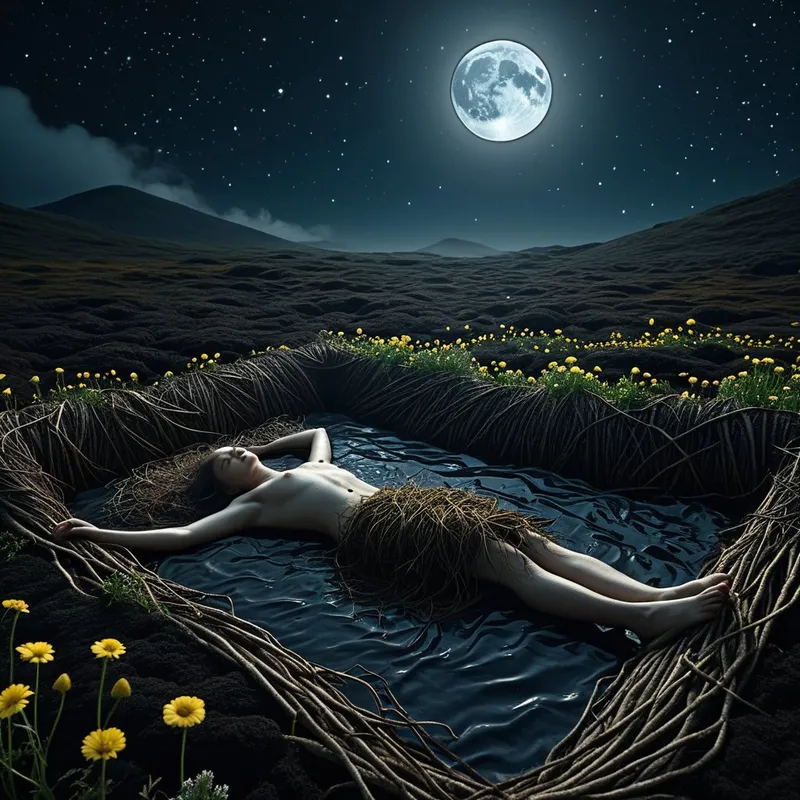
The alchemical journey mirrored in this myth is the nigredo—not as a failure, but as the essential first phase of individuation. The modern individual is perpetually tasked with being the "ruler" of their own life. Yet when this inner kingship becomes rigid, disconnected from the instinctual and spiritual ground (the Sovereignty Goddess), a psychic famine ensues: depression, meaninglessness, creative sterility.
The cure is not to fight the darkness, but to offer one's conscious attitude to it. The bog is the crucible where the lead of the ego is submerged to begin its mysterious transformation.
The alchemical translation demands we identify what "sovereign" aspect must be offered. Is it the need for total control? A rigid self-concept? A role that has become a prison? One must consciously "walk into the bog"—enter a period of withdrawal, introspection, and surrender. This is the ritual. The "death" is the dissolution of an old way of being. The preservation in the peat is the psyche's holding of this essential material in a state of potential, preventing its simple decay into nothingness. The eventual "fertility of the land" that follows is the new life that emerges: renewed creativity, authentic purpose, and a sense of being fundamentally in accord with one's own nature and the world. The individual does not get the old self back. They become, like the bog body, a preserved testament to the transformation, and like the renewed land, a vessel for new growth. They achieve sovereignty not through control, but through sacred surrender.
Associated Symbols
Explore related symbols from the CaleaDream lexicon: