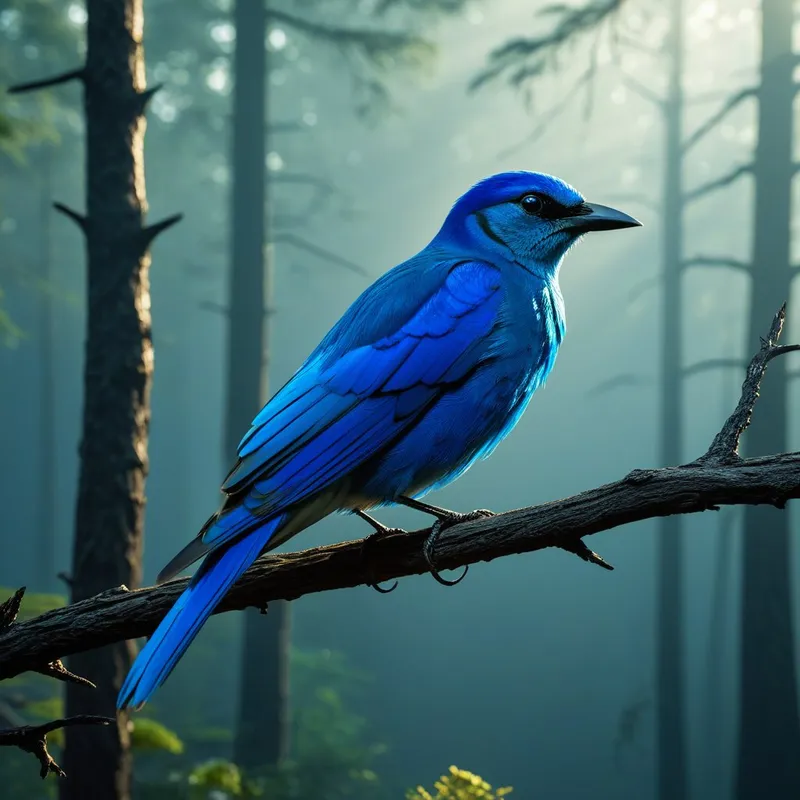
Bluebird Myth Meaning & Symbolism
A once-dull bird, through a trial of fire and water, becomes the first bluebird, embodying the soul's transformation from sorrow into radiant, joyful song.
The Tale of Bluebird
In the time before color, when the world was dressed in the hues of clay, bark, and shadow, there lived a bird whose feathers were the color of dust. He was a quiet soul, this bird, moving through the Haudenosaunee forests with a song as grey as his plumage. While the cardinal held a ember of red and the finch a flash of gold, he held only the shade of forgotten things. A sorrow clung to him, a dullness that even the sun could not burnish. He looked at the lake, seeing only a mirror of his own drabness, and his heart ached for a beauty he could not name.
He carried this ache to the council of the animals. He stood before the wise ones—the bear of deep earth, the hawk of far sight, the turtle of ancient time—and poured out his lament. “I am nothing but a shadow among you,” he whispered, his voice rustling like dry leaves. “I have no song that lifts the heart, no color that pleases the eye. What am I for?”
The elders listened, the fire of their council popping in the stillness. It was the Great Hare, or perhaps the voice of the fire itself, that finally spoke. “Little brother,” the voice crackled, “color is not given. It is earned in the crucible of the spirit. If you wish to be other than what you are, you must pass through the very heart of change. You must enter the sacred fire, and from there, plunge into the waters of the deepest lake.”
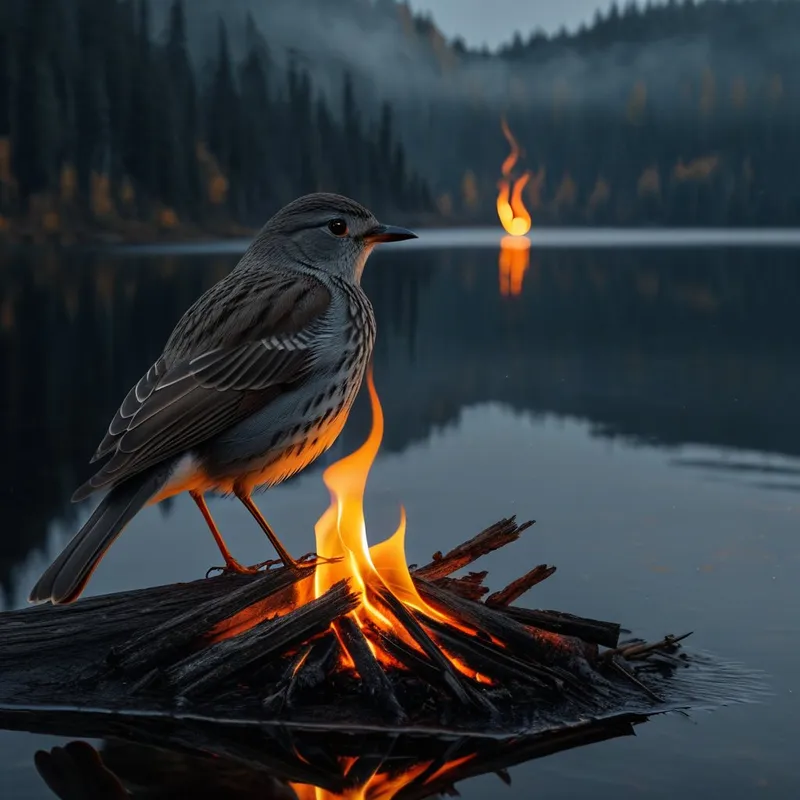
A silence fell, heavier than before. To enter the fire was to invite annihilation. Yet, the bird felt the weight of his grey life more keenly than any fear of flames. With a resolve that straightened his small frame, he thanked the council. He flew to a clearing where a ritual fire, built of sacred woods, burned with a pure, hot light. The flames licked the twilight, hungry and bright.
Without a cry, he flew directly into the center of the blaze.
The heat was an instant, consuming world. His dull feathers did not burn, but were scorched, blackened, transformed into a shell of crackling charcoal. He felt not pain, but a profound stripping away, a purification so total it bordered on oblivion. He was a living cinder, a heart beating inside a husk of ash. And from this state of utter reduction, he pushed himself out of the fire, a smoking, blackened ember with wings.
His strength was nearly spent, but the law of the trial was not complete. Beating his aching, sooty wings, he dragged himself through the air toward the cold, placid mirror of the lake. As the blackened bird hit the water, a great hiss rose like a sigh from the world. Steam enveloped him. The lake’s embrace was a shock of cold that sealed the fire’s work.
And then, a miracle of transmutation. The charcoal shell washed away, sloughing off like a dark dream. As he broke the surface, shaking the water from his wings, the first rays of the new sun caught him. Where there had been grey, then black, now shone a color never before seen. It was the blue of the sky after a cleansing storm, the blue of the deepest, most tranquil pool. He was radiant. He was new. He opened his beak, and from his throat poured a song—not a grey rustle, but a liquid, joyful warble that seemed to thank the fire, the water, the sky itself. He was the first Bluebird, and his color was a gift born of incredible courage.
Cultural Origins & Context
This myth belongs to the rich oral tradition of the Haudenosaunee, a confederacy of nations including the Mohawk, Oneida, Onondaga, Cayuga, Seneca, and later, Tuscarora. Their homeland spans the northeastern woodlands of what is now called North America. Such stories were not mere entertainment; they were the foundational texts of a worldview, told by elders and storytellers during the long winter nights or around communal fires. They served as both cosmological explanation and ethical instruction, embedding lessons about the natural world, community values, and the relationship between perseverance and reward.
The Bluebird story functions as an etiological myth, explaining the origin of the bird’s beautiful coloration. But in true Haudenosaunee fashion, it transcends simple causality. It is a parable of personal transformation, deeply aligned with a cultural ethos that values endurance, respect for the elements (fire and water are powerful spirits), and the belief that true worth comes through a tested spirit. The bird’s journey from lament to active quest mirrors the individual’s responsibility to seek improvement and harmony, not just for oneself, but as a part of the interconnected web of life.
Symbolic Architecture
At its core, the myth of Bluebird is a masterclass in the symbolism of psychic transformation. The bird in its initial state represents the unactualized self, the soul burdened by a nameless melancholy, a sense of being unfinished or unseen. Its grey color is the hue of depression, stagnation, and latent potential—life lived as mere function, without vibrancy.
The fire does not destroy the essence; it forges the form. The true self is not born from comfort, but from the courageous confrontation with what seems like annihilation.
The sacred fire is the archetypal symbol of ordeal, sacrifice, and purification. It is the necessary crisis, the dark night of the soul that burns away the superficial identity—the “dull feathers” of conformity, shame, or inherited sorrow. The bird emerges not as a phoenix in glory, but as a “cinder,” representing the essential, stripped-down core of being after ego-attachments are scorched away. This is a state of profound vulnerability, but also of raw truth.
The subsequent plunge into the lake’s waters symbolizes the deep unconscious, the realm of emotion, intuition, and rebirth. If fire is the active, masculine principle of will and ordeal, water is the receptive, feminine principle of healing and integration. The union of these opposites—the alchemical solve et coagula (dissolve and coagulate)—completes the transformation. The blue that emerges is the color of clarity, peace, spiritual attainment, and authentic joy. The new song is the voice of the individuated self, no longer lamenting, but celebrating its hard-won place in the cosmos.

The Dreamer's Resonance
When this mythic pattern stirs in the modern dreamer, it often signals a profound somatic and psychological initiation. To dream of being a dull, grey bird, or of feeling drab and overlooked, points to a deep-seated sense of inauthenticity or a depressive state where one’s inner light feels extinguished.
Dreams of fire in this context are rarely about literal fear. They may manifest as a burning house (the old self-structure dissolving), a ritual bonfire, or even a comforting, warm hearth that somehow feels necessary. This is the psyche preparing for, or undergoing, a necessary “burning away”—perhaps of an old identity, a toxic relationship pattern, or a career that no longer fits. The somatic sensation might be one of intense heat, pressure, or anxiety that feels purgative rather than purely destructive.
The water immersion in dreams often follows: plunging into a dark lake, being caught in a rainstorm, or finding a serene pool. This can correlate with a release into grief, a deep emotional cleansing, or a surrender to therapeutic processes. The emergence from this water feeling renewed, or the vision of something blue and radiant—a stone, a light, a piece of cloth—is the first glimpse of the new Self taking form. The dreamer is experiencing the archetypal journey of the orphan moving through its ordeal toward a state of authentic being.
Alchemical Translation
For the individual on the path of individuation, the Bluebird’s journey is a precise map of psychic transmutation. The initial “grey” state is the nigredo of alchemy—the blackening, the leaden feeling of the unexamined life, the primal matter full of potential but lacking order.
The voluntary flight into the fire is the active, conscious choice to engage with one’s shadow, to enter therapy, to face a life crisis with awareness rather than avoidance. This is the albedo and citrinitas processes—the whitening and yellowing—where the ego is scorched and purified by the heat of self-confrontation. One becomes the “cinder”: ego defenses are down, old narratives are ash, and what remains is the vulnerable, essential psyche.
The plunge into the lake is the sacred marriage of the conscious will (fire) with the unconscious wisdom (water). From this union, the true color of the soul is born.
The final immersion in the healing waters is the rubedo—the reddening, or here, the “bluing.” It is the integration phase. Insights from the ordeal are metabolized by the unconscious; tears are shed; silence is kept. The new color—the brilliant blue—is the lapis philosophorum, the philosopher’s stone of the Self. It represents the achieved state where one’s inner nature (blue = depth, truth, spirituality) and outer expression (the radiant plumage, the joyful song) are in perfect harmony. The modern individual completes this alchemy not by changing their feathers, but by having the courage to be scorched and washed clean, emerging not as someone new, but as who they were, fundamentally, all along. The bluebird does not find its joy; it becomes it.
Associated Symbols
Explore related symbols from the CaleaDream lexicon: