Blue Bird of Happiness Myth Meaning & Symbolism
A celestial messenger, the Blue Bird, must be sought beyond the world's edge, teaching that true happiness is not possessed but witnessed in fleeting moments of grace.
The Tale of the Blue Bird of Happiness
Listen, and let the mists of time part. In the days when the world was young and the veil between heaven and earth was thin, there lived a great emperor. His name is lost to the wind, but his sorrow is remembered. He ruled a vast and prosperous kingdom, yet a cold shadow dwelt in his heart. His palaces of jade felt like tombs of ice; the music of his court was the clatter of stones to his ears. A profound melancholy, a longing for a thing he could not name, had settled upon his spirit like a permanent frost.
One night, as he walked the empty corridors of his mind, an ancient sage, a man whose beard was white as the first snow and whose eyes held the depth of still lakes, appeared to him. The sage spoke not of politics or war, but of a mystery. "Great Lord," he whispered, his voice like dry leaves, "your ailment is of the soul. You seek happiness as a man seeks a lost coin in a dark room. But happiness is not a thing to be held. It is a messenger, a fleeting visitor from the realm of Wuji. It takes the form of the Blue Bird of Happiness."
The emperor, his heart a flicker of desperate hope, demanded, "Where does this bird dwell? I will command my armies to bring it to me!"
The sage shook his head, a sad smile on his lips. "You cannot command a sunbeam or imprison a scent. The Blue Bird resides beyond the Mount of the World's End, in the gardens of the Xi Wang Mu. It is a creature of the moment, of grace. To see it is to be blessed. To chase it is to ensure it forever flies ahead of you."
But the emperor, gripped by the human hunger to possess, would not be swayed. He summoned his three most loyal and skilled sons. To the eldest, he gave a net woven from threads of moonlight. To the second, a cage forged from silent silver. To the youngest, he gave only a question: "Observe, and return with truth."
The brothers embarked on their quest. The eldest climbed treacherous peaks, his net ever cast, capturing only clouds and eagles. The second traversed scorching deserts, his silver cage gleaming emptily in the sun. They searched for years, their hearts hardening with frustration, their mission twisting into a grim obsession with the object, not the essence.
The youngest prince traveled differently. He walked slowly. He helped villagers mend their roofs, listened to the songs of farmers, sat by rivers and simply watched the water flow. He did not seek the bird; he sought to understand the landscape of happiness. After many seasons, he found himself at the foot of the fabled Mount of the World's End. Exhausted, not from travel but from the release of his striving, he sat beneath a ancient, blossoming peach tree. He was not thinking of the bird. He was simply being—breathing, existing in the quiet majesty of the place.
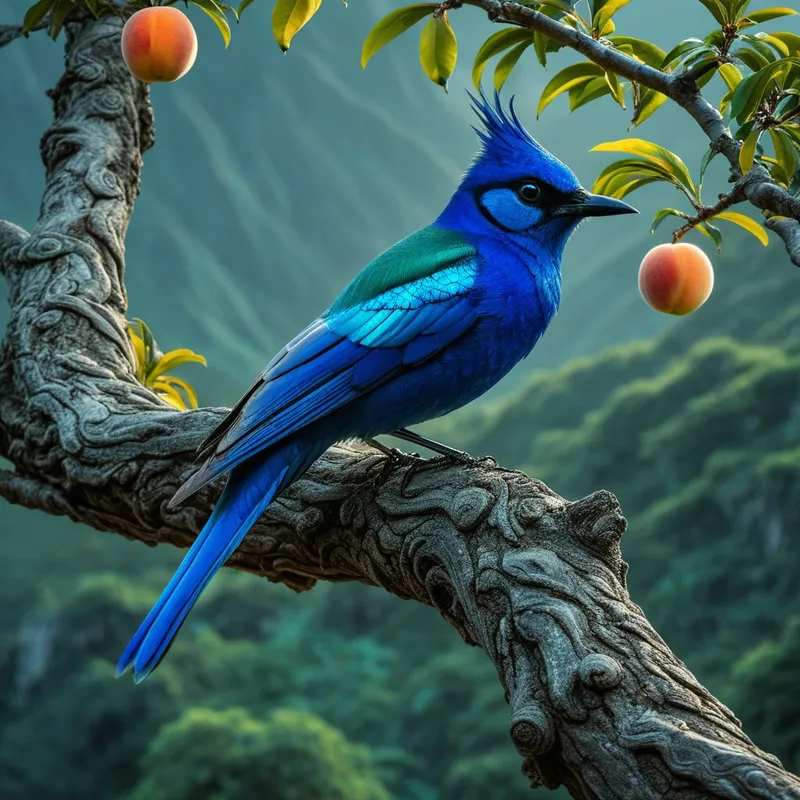
And then, it happened. A soft, cerulean light dappled the grass before him. He looked up. There, on a branch heavy with immortal peaches, preened a bird of impossible beauty. Its feathers were the blue of a twilight sky reflected in a deep lake, shot through with hints of violet and silver. It did not sing a grand song, but emitted a soft, resonant hum that vibrated in the prince's bones, a sound of pure, unadulterated peace. It looked at him, and in its dark, intelligent eye, he saw not a prize, but a reflection of his own tranquil soul. For a long, suspended moment, they shared the same space. Then, with a flutter that sounded like a sigh of contentment, the Blue Bird took wing, vanishing into the golden haze of the mountain mist.
The prince returned home empty-handed. When his brothers and father demanded to know if he had captured the bird, he simply said, "I did not capture it. I witnessed it. And in that witnessing, I was filled. The bird does not come to the one who grasps, but to the one who is ready to see."

Cultural Origins & Context
The myth of the Blue Bird of Happiness is not anchored to a single, canonical text like the Shan Hai Jing, but is a fluid folktale that has drifted through the centuries, carried on the breath of storytellers. Its deepest roots tap into the rich soil of Daoist philosophy and the vibrant imagery surrounding Xi Wang Mu. In her mythical paradise, the Blue Bird (Qing Niao) is often depicted as one of her celestial messengers, a being that bridges the divine feminine realm of immortality and the mortal world.
This story was not the property of the imperial court but belonged to the people. It was told by grandmothers at hearthsides, by traveling minstrels in market squares, and by monks in temple courtyards. Its societal function was profound yet simple: it was a narrative antidote to existential despair and the folly of material obsession. In a culture with deep strains of Confucian striving and achievement, this myth served as a crucial counterbalance. It whispered that the highest prize—happiness, peace, connection to the divine—could not be earned through effort alone, but required a specific state of being: openness, receptivity, and alignment with the natural, effortless flow of the Dao.
Symbolic Architecture
The myth is a perfect symbolic vessel for a universal psychological truth. The Blue Bird itself is not happiness, but its emissary. It represents those fleeting, perfect moments of grace, joy, and inner peace that visit us unexpectedly. It is the glimpse of profound beauty, the moment of deep connection, the sudden, quiet certainty that all is well. Its blue color connects it to the sky (spirit, the transcendent) and the deep sea (the unconscious, the emotional depths).
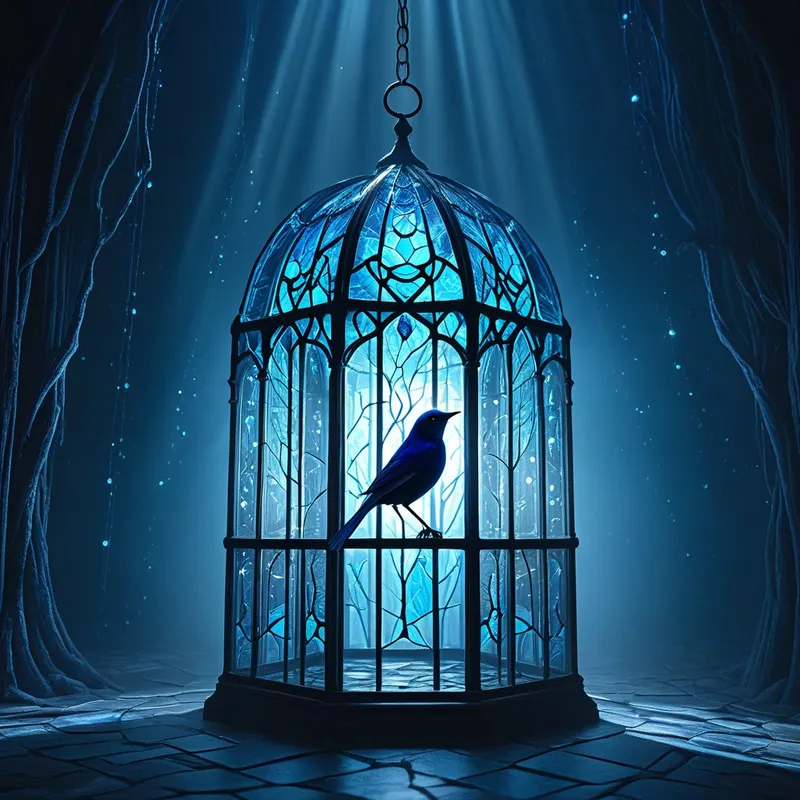
The Blue Bird does not live in a cage of circumstance, but in the open sky of a prepared heart.
The Emperor symbolizes the ego-consciousness that believes fulfillment is an external object to be acquired, a destination to be reached through force of will. His melancholy is the soul's hunger when it is disconnected from its own source. The Three Sons represent three attitudes of the psyche towards this quest. The first two—with their net and cage—are the functions of grasping and possessing, the heroic ego's tools that fail utterly in the realm of the spirit. The Youngest Prince embodies the surrendered ego, the attitude of Wu Wei. His journey is one of unlearning striving. By engaging with the world authentically and releasing his goal, he creates the inner emptiness and stillness necessary for the numinous to appear.
The Mount of the World's End is the boundary of the known psyche, the limit of the ego's map. True transformation always requires a journey to this edge, where conscious control ends and the territory of the Self begins.
The Dreamer's Resonance
When this myth pattern stirs in the modern dreamer, it often signals a critical juncture in the relationship between striving and being. To dream of desperately chasing a beautiful, elusive blue bird speaks to a soul exhausted by the pursuit of external validation—the perfect job, the ideal relationship, the defined state of "happiness." The somatic feeling is one of frantic energy, breathlessness, and aching emptiness upon waking.
Conversely, to dream of sitting quietly and having the blue bird alight nearby indicates a profound shift. The psyche is integrating the lesson of receptivity. The dreamer may be in a period of recovery, convalescence, or deliberate slowing down, where the compulsive "doing" of life has ceased. The bird's visit is a reward from the unconscious, a confirmation that peace is found not in achievement, but in presence. The somatic residue is one of deep calm, warmth in the chest, and a feeling of being "filled" without knowing from where.
Alchemical Translation
For the modern individual navigating the path of individuation—becoming who one truly is—the myth models the alchemical process of solutio (dissolution) and coagulatio (re-forming). The initial state is the "lead" of the emperor's melancholy: a hardened, identified ego suffering from spiritual malnutrition.
The quest is the necessary dissolution. The brothers' failures represent the breaking down of the old, heroic attitude. The ego's tools (willpower, strategy, acquisition) are dissolved in the acids of failure and futility. The youngest prince's journey is the true solutio: a willing dissolution of the seeking, goal-oriented self into the stream of simple, authentic experience.
The alchemy of happiness is not in turning lead to gold, but in realizing the leaden pursuit itself obscures the gold that already shines in moments of unlooked-for grace.
The encounter with the bird is the unio mystica, the mystical union, if only for a moment. It is a direct experience of the Self (the total, integrated psyche) gifting a moment of wholeness to the conscious ego. This is the "gold."
The return represents coagulatio: the re-forming of the personality around this new central truth. The prince does not bring back the bird (one cannot live in a permanent state of peak experience), but he brings back the knowledge of its existence and the conditions for its visitation. The transformed individual no longer chases happiness as a final destination. Instead, they cultivate the inner garden—through mindfulness, authenticity, and engagement with life as it is—knowing that the Blue Bird visits such gardens of its own accord. Happiness ceases to be a noun to be owned and becomes a verb of being, a quality of attention that allows the fleeting messengers of joy to be seen, honored, and released, their blue light lingering long after their form has vanished into the mist.
Associated Symbols
Explore related symbols from the CaleaDream lexicon: