Blodeuwedd Myth Meaning & Symbolism
A woman crafted from flowers to be a wife, who betrays her husband and is transformed into an owl, embodying the untamed feminine spirit.
The Tale of Blodeuwedd
Listen, and hear the tale of a woman who was not born, but made. In the deep green heart of Gwynedd, a curse lay upon a hero. Lleu Llaw Gyffes, the Bright One of the Skillful Hand, bore a fate woven by his own mother: he could never have a wife of the race of women who walk the earth.
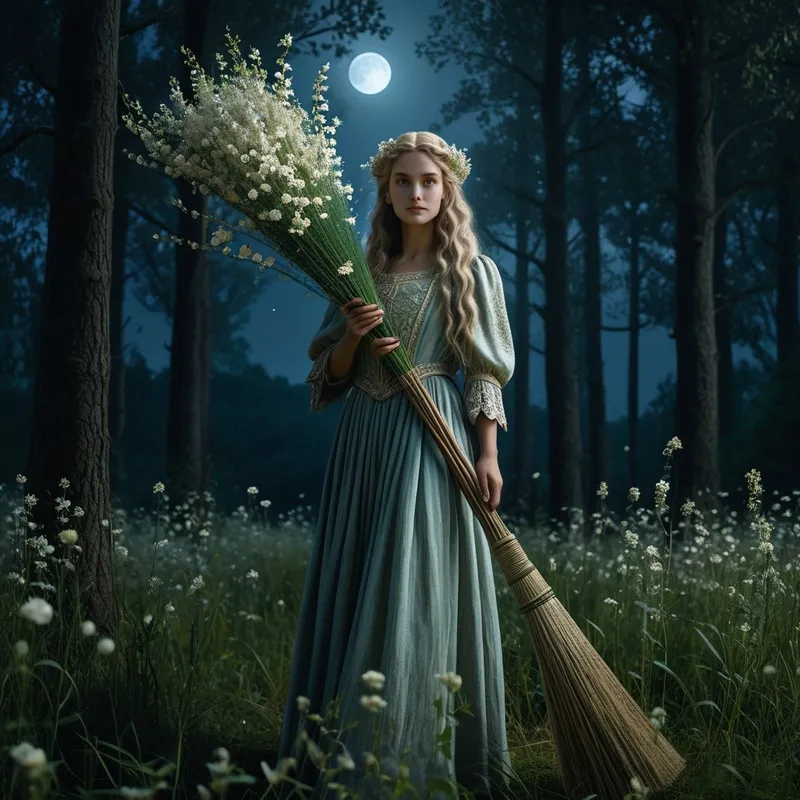
His uncles, the great Gwydion the enchanter and Math the son of Mathonwy, looked upon his loneliness and saw a wrong to be righted. They would not break the curse, but they would bend the world around it. They walked the land, not as hunters of beast, but as gatherers of essence. From the high places, they took the blossoms of the oak, for sovereignty and endurance. From the meadows, they plucked the flowers of the broom, for purity and sweeping change. From the lowlands, they gathered the petals of the meadowsweet, for love and honeyed grace.
Under the silent stars, with words of power older than the hills, they conjured not with fire and force, but with intention and form. They wove the blossoms together, petal by petal, stem by stem. And from this bouquet of the wild earth, a woman arose. She was Blodeuwedd, more beautiful than a spring dawn, with the scent of a hundred meadows in her hair and the colors of the world in her eyes. She was given to Lleu, and for a time, the hall of Mur y Castell knew peace and beauty.
But a thing made of wild flowers cannot be content within stone walls built for a king. When Lleu was away, a stranger came to the gates: Gronw Pebr, Lord of Penllyn, hunting a stag. When his eyes met Blodeuwedd’s, it was not like meeting a person, but like recognizing a kindred wildness. In that glance, the spell of her making found its true purpose—not for duty, but for desire. Their love was as swift and fierce as a summer storm.
Yet a king, even one cursed, cannot be simply abandoned. A wife of flowers cannot simply flee. So, with honeyed words born of meadowsweet, Blodeuwedd coaxed from Lleu the secret of his death—a riddle of impossible circumstances: he could only be killed by a spear crafted for a year, only while neither mounted nor on foot, only under a roof that was not a roof, and only by a riverbank. Gronw forged the spear. And Blodeuwedd, with a heart now thorned, tricked her husband into enacting the riddle. As Lleu stood with one foot on a goat's back and the other on the edge of a bath-tub, under a canopy that was not a house, by the bank of the Cynfal, Gronw cast the spear.
Lleu, struck, gave a terrible cry and transformed into an eagle, flying wounded into the sky. Believing him dead, the lovers took his throne. But Gwydion, searching the land, found a wounded eagle dropping rotten flesh onto an oak. With song and tenderness, he called his nephew down and restored him to human form. Justice followed. Gronw was offered the same impossible stance for his punishment. He accepted, and Lleu’s spear pierced the stone shield he held, killing him.
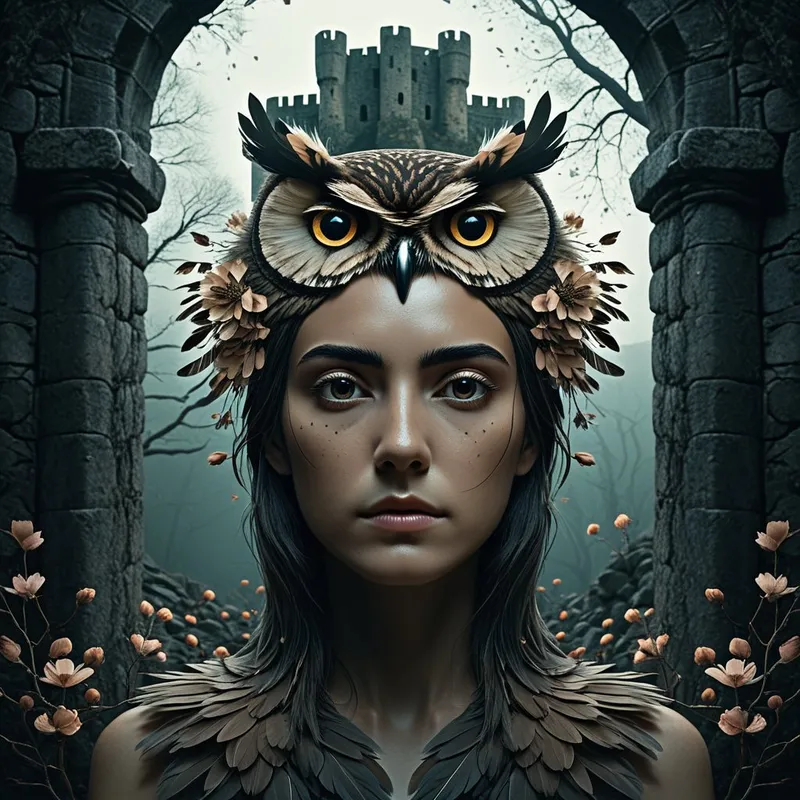
And Blodeuwedd, the woman of flowers? Gwydion found her fleeing. He did not strike her down. Instead, he spoke a different magic, a transformation of essence. “I will not kill you,” he said. “I will do worse. For your shame, you shall not show your face to the light of day, for it is the light that betrayed you. And all the flowers that were your making shall be your enemies.” With a wave of his hand, the blossom-skin fell away. Her form shrank, twisted, feathered. Her beautiful eyes widened into great discs to see in the dark. Where there was meadowsweet, now there were silent wings. “You shall be called Blodeuwedd no longer, but Tyliwyth Teg. And all who see you shall know you for what you are.” And she flew, a shadow against the moon, the owl, forever exiled to the night, a creature of haunting cries where once there was the scent of blossoms.
Cultural Origins & Context
This haunting narrative is preserved in the Mabinogion, specifically in the fourth branch, Math fab Mathonwy. These tales were compiled in medieval manuscripts like the Llyfr Gwyn Rhydderch and the Llyfr Coch Hergest, but their roots dig deep into the pre-Christian Celtic soil of Wales. They are the remnants of a vibrant oral tradition, told by bards (fili) in the halls of chieftains.
The myth served multiple societal functions. On one level, it is a powerful etiological story, explaining the natural enmity between flowers (which bloom by day) and the owl (a creature of the night). On a deeper level, it explores profound cultural anxieties about sovereignty, marriage alliances, and the untamable aspects of the natural world—and by extension, the human psyche. Blodeuwedd, as a created being, represents a bride from outside the tribe, a political alliance made flesh. Her rebellion is the ultimate nightmare of that system: the foreign bride who destroys the kingdom from within. The tale warns of the dangers of attempting to control life and love through pure artifice (magic), reminding listeners that the wild essence of nature and personhood cannot be permanently bound to a prescribed fate.
Symbolic Architecture
Blodeuwedd is not a villainess, but a profound symbol of the autonomous soul forced into an inauthentic container. Her story is an archetypal map of a psyche in conflict with its own creation.
She is the anima fashioned by societal and familial magic—beautiful, compliant, and utterly without a past of her own.
Her composition is key: oak (enduring structure), broom (cleansing, but also resilience in harsh soil), and meadowsweet (sweetness, attraction). She is made to be the perfect, fragrant support for a king’s sovereignty. Yet, these are wild plants. Their essence is freedom, not domestication. When Gronw appears, he does not corrupt her; he activates her. He is the catalyst for her latent wildness, the call of her own inherent nature away from the role she was conjured to play.
Her transformation into an owl is not merely a punishment, but a brutal, poetic restitution to her true state. The owl is a creature of wisdom, prophecy, and the moon—a symbol of the feminine principle in its dark, knowing, and detached aspect. She is stripped of her false, day-lit beauty and given the gift of night-sight. She becomes a creature of the threshold, the penates between the human world and the shadowy otherworld, forever witnessing the secrets of both.
The Dreamer's Resonance
When this myth stirs in the modern dreamer, it signals a profound somatic and psychological reckoning. To dream of wilting flowers that transform into birds of prey, of beautiful facades crumbling to reveal watchful, nocturnal eyes, is to encounter the Blodeuwedd process within.
Somatically, this may manifest as a deep fatigue with a “constructed” life—a career, relationship, or identity that feels expertly made but fundamentally not one’s own. There is a claustrophobia within the stone hall of the persona. The body may feel like an assemblage of parts (the blossoms) rather than an integrated whole. Psychologically, it is the eruption of the repressed “Gronw”—not necessarily a lover, but any powerful, instinctual force (creativity, rage, desire for solitude) that threatens the stability of the carefully built life. The dreamer is in the moment of betrayal—not of another, but of the inauthentic self. The rising action is the terrifying, irresistible pull toward what one truly is, even if it destroys the world one knows.
Alchemical Translation
The alchemical journey of Blodeuwedd is a model for the nigredo and albedo of individuation—the descent into darkness and the emergence of a purer, if colder, form.
The first creation, from flowers to woman, is the prima materia of the ego—fashioned from the expectations and magic of others (parents, culture). It is beautiful, but it has no core.
The betrayal and the murder of Lleu (the ruling conscious principle) represent the necessary death of the old, adapted personality. This is a chaotic, guilt-laden, and destructive phase—the nigredo. The king must be wounded and fly away as an eagle (a symbol of the spirit seeking perspective) for the transformation to occur.
Gwydion’s final act is the key to the alchemical translation. He does not destroy her; he transmutes her. He performs the albedo, the whitening. He strips away the colorful, solar, pleasing form (the persona) and reveals the essential, lunar, silent being beneath. The owl is the spirit liberated from its decorative prison. It is a lonely, often misunderstood existence, but it is authentic. It sees in the dark. It knows its own nature.
For the modern individual, the myth does not counsel betrayal and murder, but it fiercely advocates for the recognition of one’s own “wild flower” essence. It asks: What in you was made to please a kingdom that is not your own? And what nocturnal wisdom, what keen-eyed truth, awaits when you have the courage to let that false blossom fall away, even if it means becoming a voice in the darkness, calling your own name?
Associated Symbols
Explore related symbols from the CaleaDream lexicon: