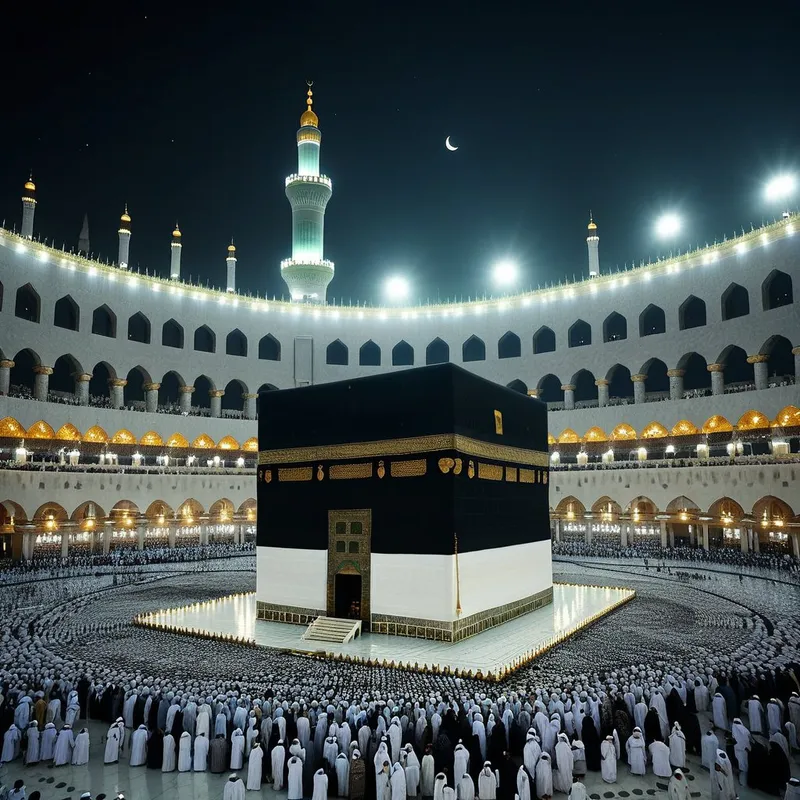
Black Stone Myth Meaning & Symbolism
A celestial stone, fallen from paradise blackened by humanity's sins, now set in silver, marking the sacred point of return and divine forgiveness.
The Tale of the Black Stone
In the time before time, when the earth was still soft from the breath of the Divine, a stone descended from the gardens of paradise. It was not like the stones of the earth. It was whiter than milk, brighter than the dawn, a fragment of celestial light given solid form. It held within it the coolness of the first morning and the memory of a covenant spoken before the foundations of the world.
The angel Jibril brought it to the first man, Adam, as he stood weeping at the site of his fall, a barren valley under a relentless sun. "Build," the angel whispered, and Adam, with the guidance of the angels, began to raise the first House—a simple cube of stone and faith—upon the command of the Allah. The white stone was set into its eastern corner, a beacon of the primordial pact between Creator and creation, a point of return for the wandering human heart.
Centuries flowed like sand. The House stood, was lost, was forgotten, buried under the dunes of neglect and idolatry. The stone remained, cradled in the earth, its luminous white slowly absorbing the grief of the world. It drank the tears of Ibrahim as he left his wife Hajar and infant son in that desolate place. It absorbed the sighs of Isma'il as he grew, a stranger in his own land. When the command came to rebuild the House, father and son worked together, their hands calloused, their faith rebuilding the ancient altar stone by stone.
But a gap remained. The structure needed a final, cornerstone to seal its sanctity. Ibrahim sought a stone of distinction. It was then that Jibril returned, leading him to the very hill where the stone had lain waiting. And it was black. Not the black of basalt or night, but a profound, absorptive black—the black of all the sins, the doubts, the broken promises of humanity that had been laid upon it since the days of Adam. It had become a witness. Ibrahim, in reverence, placed it with his own hands. The House was complete.
Generations passed again. The Kaaba became surrounded by idols. The Black Stone was just one among many, though still touched with lingering awe. Then came the Prophet Muhammad, peace be upon him, in the Year of the Elephant and beyond. In his youth, when the tribes quarreled violently over who would have the honor of placing the Stone after rebuilding the Kaaba's walls, it was he who proposed the solution. A cloak was spread; the Stone placed upon it; each clan's chief held a corner. Together they lifted it, and the young Muhammad set it in its final resting place with his own hands—a act of unity forged around the fractured, blackened heart of their history.
Cultural Origins & Context
The narrative of the Al-Hajar al-Aswad is woven from Hadith and tafsir. It is not a single, canonical myth in a scriptural sense, but a living story passed down through oral tradition and scholarly commentary, enriching the ritual context of the Hajj and Umrah. Its tellers were the scholars and pilgrims themselves, who saw in the Stone not an object of worship, but a profound sign.
Its societal function is multifaceted. Historically, it anchors the sanctity of the Kaaba to a primordial, pre-Islamic past, linking the Islamic revelation directly to the monotheism of Abraham and the innocence of Adam. Ritually, it provides a tangible, somatic starting point for the Tawaf—the pilgrim's circular journey of return. Psychologically, it transforms a meteoritic rock into a collective symbol of human fallibility and divine grace, a focal point where theology meets the human need for a physical connection to the sacred.
Symbolic Architecture
The Black Stone is a paradox made manifest. It is a fragment of paradise, yet it is black. It is whole, yet it is fractured (held together by its silver casing). It is touched, yet it is transcendent.
The stone is the self that remembers its origin but bears the patina of its journey.
Its whiteness symbolizes the original, uncorrupted fitrah—the innate human disposition toward recognizing the Divine. Its blackness is not a stain of evil, but a testament. It represents the accumulated weight of human error and forgetfulness, willingly absorbed. It is the collective shadow of humanity, made visible and sanctified by its very location at the heart of the sacred. The silver band that holds its pieces together is the covenant of faith—the divine mercy that binds our fractured selves into a meaningful whole.
The act of touching or kissing it during Tawaf is thus deeply symbolic. It is not idolatry, but an acknowledgment. The pilgrim touches the symbol of their own forgiven imperfections, aligning their flawed, earthly journey with the celestial point of origin and return. The Stone marks the axis mundi—the center of the world—where the vertical axis of the divine meets the horizontal plane of human history.

The Dreamer's Resonance
When this myth appears in modern dreams, it rarely manifests as a literal stone. More often, it is a dream of a lost, foundational object—a family heirloom blackened with tarnish, a childhood home with one darkened cornerstone, a precious gem that is somehow both radiant and light-absorbing. The dreamer may be searching for it, trying to clean it, or afraid to touch it.
Somatically, this dream pattern correlates with a process of confronting one's own "patina"—the accumulated experiences, regrets, and compromises that feel like a darkening of one's original spirit. The psychological process is one of reconciliation with one's own history. The dreamer is being called to stop trying to scrub the stone back to a hypothetical, pristine white. Instead, the unconscious proposes the alchemy of the myth: to see the blackness not as a defilement, but as an integral part of the artifact's sacredness. The tension is between the ego's desire for perfect innocence (the white stone) and the Self's acceptance of the whole, weathered, authentic person (the black stone in silver).
Alchemical Translation
The individuation process modeled here is not one of heroic conquest, but of humble return and integration. The ego is not a hero slaying dragons, but an orphaned pilgrim seeking home.
The great work is not to become pure light, but to become the vessel that meaningfully holds both light and the witness of shadow.
The "prima materia" is the raw sense of being stained or fallen—the guilt, shame, or simple weariness of being human. The "nigredo," the blackening, is not a stage to be avoided but the essential condition. It is the honest acknowledgment of one's faults and history. The "albedo," the whitening, is not achieved by denial, but by understanding that the original whiteness exists within the blackness as its source and truth.
The silver casing is the crucial alchemical agent. It represents the conscious act of holding—the discipline of faith, the container of ritual, the therapeutic narrative, or the compassionate witness—that allows the fractured, blackened parts of the self to be seen as a coherent whole. The final stage is not a return to a naive beginning, but a lapis philosophorum found in the very corner of one's being: the realization that the point of divine connection is precisely where you acknowledge your imperfection. The pilgrim's circular Tawaf around the Kaaba, beginning and ending at the Black Stone, becomes the perfect metaphor for the individuation journey: we endlessly circle the center of our being, touching our flawed humanity at each pass, and in that very act, we are made whole.
Associated Symbols
Explore related symbols from the CaleaDream lexicon: