
Birrul the Owl Myth Meaning & Symbolism
A myth of the owl-spirit Birrul, guardian of sacred law, who teaches that true sight comes from listening to the darkness and honoring the ancestors.
The Tale of Birrul the Owl
In the time before time, when the world was soft and the Dreaming still sang loudly through the land, there was a great silence. It was the silence of the deep night, a blanket woven from the absence of the sun and the hushed breath of a thousand sleeping creatures. In this silence walked the people, but they walked in fear. The dark was a wall, a place of unseen terrors and lost paths. They huddled close to their fires, their world shrunken to the circle of flickering light, and they cursed the darkness that stole their sight.
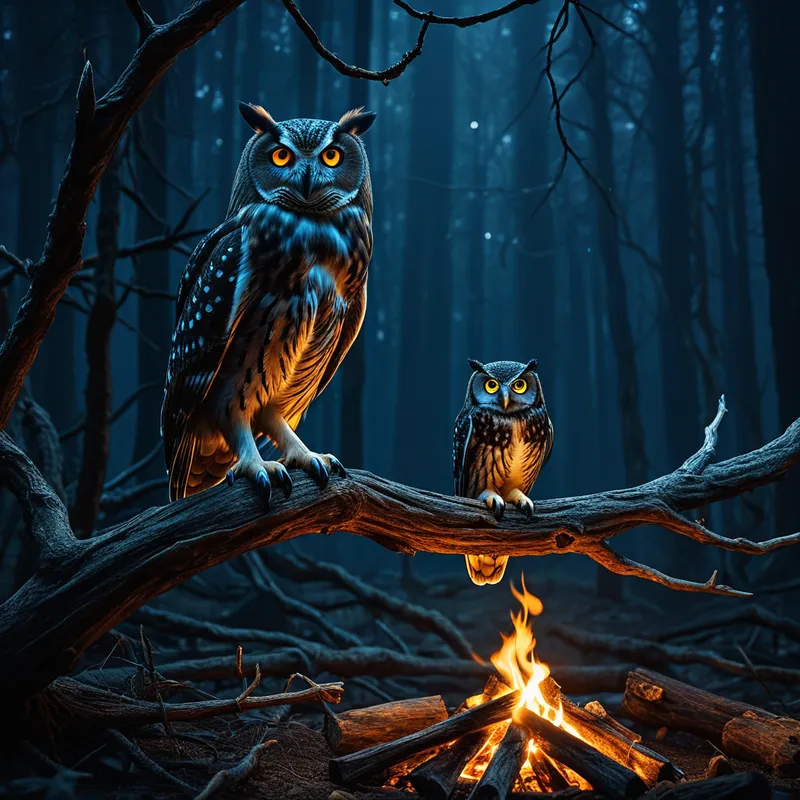
But the darkness was not empty. It was the domain of Birrul. Birrul was not born; he emerged from the first shadow cast by the first rock. His feathers were the color of a moonless sky, his eyes were twin pools that drank the starlight and gave nothing back. Where other ancestral beings shaped rivers and mountains, Birrul shaped perception. He was the keeper of the law that governed the unseen, the guardian of all that happened when the eye of the sun was closed.
The people did not know him. They knew only the panic of a child lost in the scrub after dusk, the dread of a hunter who could not find the way back to camp. One such hunter, a man named Jardi, proud and swift by day, found himself trapped in this swallowing night. His fire had died. The familiar shapes of trees became monstrous. In his terror, he began to run, thrashing against the invisible, his heart a frantic drum against his ribs. He fell, scraping his hands on stone, and a sob of pure despair escaped him.
It was then the silence changed. It became not an absence, but a presence. A soft whump of air, felt more than heard, settled the dust around him. Jardi froze. Above him, on a skeletal branch of a ghost gum, a shape darker than the night itself resolved. Two stars, cold and ancient, looked down at him. It was Birrul.
The owl did not speak with a human tongue. The sound that came from him was the sound of the night itself given voice: the whisper of wind through canyon cracks, the rustle of nocturnal creatures, the distant echo of a rock falling in a gorge. It was a sound that bypassed the ears and vibrated in the bones. In that resonance, Jardi saw. Not with his eyes, but with his whole being. He saw the heat-traces of small animals in the brush, the cool path of a hidden creek, the scent-trails on the air like luminous threads. He saw the land not as a flat picture, but as a living, breathing, singing entity—and he saw his own frantic path as a painful scar upon it.
Birrul showed him the way home, not by pointing, but by making Jardi listen to the land. To the specific croak of a frog that meant water was near, to the pattern of stars that slid behind a particular peak. When Jardi finally saw the glow of his campfire, it was not an end to fear, but a transformation of it. He turned back to the darkness and bowed his head. The great owl was gone, but the new sight remained.
From that night, the people learned. They learned that the dark was not their enemy, but a teacher. Birrul became the spirit of sacred law, the reminder that true vision often comes when outward sight is removed, and that the deepest truths are carried on the silent wings of memory and respect.
Cultural Origins & Context
The narrative of Birrul belongs to the vast and intricate tapestry of Aboriginal Australian Dreamtime stories. These are not mere "myths" in a Western folkloric sense, but living narratives that encode law, ecology, genealogy, and morality. The specific custodianship of the Birrul story varies among language groups, often associated with clans whose totem is the owl or a related nocturnal bird.
Passed down orally over countless generations, this story was traditionally shared by Elders around campfires, not as entertainment, but as vital instruction. Its telling was situational. It might be shared with children to ease fear of the dark, with hunters to teach tracking and environmental awareness, or with the community to reinforce the concept of Country as a sentient, communicative being. The story functioned as a psychological and practical toolkit, preparing individuals to navigate both the physical landscape and the spiritual landscape of rules and relationships that govern life. It anchored the value of listening, patience, and humility—virtues essential for survival in a harsh environment and for maintaining the social and cosmic order.
Symbolic Architecture
At its heart, Birrul is an archetype of shadow wisdom. He represents the aspects of reality and the self that are not illuminated by the conscious ego (the "daylight" mind) but which hold essential, guiding truth.
The owl does not fight the night; it becomes its eyes. So too must we learn to see with the parts of ourselves we fear to acknowledge.
The darkness Birrul rules is not evil, but the fertile unknown—the unconscious, ancestral memory, and the mysteries of death and transition. His gift of "sight" is the faculty of intuition, of hearing the subtle cues of the body (soma) and the whispers of the psyche. The hunter Jardi’s frantic running symbolizes the ego’s panic when its primary tools (daylight logic, control) fail. His fall and surrender are the necessary breakdown before breakthrough. Birrul’s intervention is the emergence of a deeper, more integrative intelligence from the psyche itself.
The law Birrul guards is the natural and moral order of the Dreaming. It is the immutable pattern beneath the surface of things. To break this law is to become lost, as Jardi was. To learn it is to find one's way, not just through the bush, but through life.

The Dreamer's Resonance
When the pattern of Birrul stirs in the modern dreamscape, it often signals a confrontation with the "dark night of the soul." The dreamer may find themselves lost in a labyrinthine forest at night, paralyzed in darkness, or acutely aware of a large, watching owl. This is not a nightmare to be dismissed, but a somatic call to a different mode of perception.
Psychologically, this dream marks a transition where conscious striving has hit a wall. The ego is exhausted. The process underway is one of receptivity replacing effort. The dreamer is being asked to stop running, to sit in the discomfort of not-knowing, and to listen. The somatic sensations—the chill of the night air, the pounding heart slowing, the intense focus on sound—mirror the body’s shift from sympathetic (fight-or-flight) to a more parasympathetic, aware state. The owl’s presence, however intimidating, is the dream-self’s representation of an innate, ancestral wisdom rising from the depths to guide the way forward. It is the wisdom of the shadow, offering navigation through a life transition, grief, or creative block that cannot be solved by daylight thinking alone.

Alchemical Translation
The myth of Birrul models the alchemical stage of Nigredo, the blackening, and its transcendence. Jardi’s journey is the individuation process in miniature.
First, there is the hubris of the daylight self, believing it can navigate all of reality with its familiar tools. Then, the inevitable descent into the nigredo: the loss of light, panic, and the feeling of being utterly lost in one’s own life. The critical turn is the surrender. Jardi stops running. He falls. In alchemical terms, the materia must dissolve before it can be reconstituted.
The transmutation begins not with finding a new light, but with learning to see in the dark that already exists.
Birrul is the personification of the Self (Jung’s term for the total, integrating psyche) acting as a psychopomp. He does not rescue Jardi from the dark; he initiates him into its mysteries. The new "sight" is the coniunctio oppositorum—the conjunction of opposites. It is the integration of the conscious (day) with the unconscious (night), of thinking with intuition, of fear with respect. The return to the campfire is not a return to the old, ignorant state. It is the return of the integrated individual, who now carries the dark wisdom within him. He has been psychologically transmuted. The external fire now complements, rather than defiantly opposes, the internal night-sight. He has learned the law of his own deeper being.
Associated Symbols
Explore related symbols from the CaleaDream lexicon:
- Bird — In this myth, the bird is the sacred messenger and embodiment of a specific, nocturnal consciousness, representing wisdom that comes from a perspective beyond the human.
- Darkness — Represents the fertile unknown, the unconscious mind, ancestral memory, and the necessary condition for the development of inner vision and deep listening.
- Dream — The entire narrative is an expression of the Dreaming, the foundational layer of reality where such ancestral laws are formed and from which all true guidance emerges.
- Fear — The initial, paralyzing fear of the dark is the catalyst for the entire journey; it must be faced and transformed into respectful awe for growth to occur.
- Journey — The myth is a classic map of the psychic journey from ignorance through crisis to wisdom, specifically a night-journey into the depths of the self.
- Law — The central theme Birrul guards; the immutable, sacred order of nature and spirit that one must learn and align with to live in harmony.
- Memory — Birrul’s wisdom is the memory of the land and the ancestors, accessed not through recollection but through deep, somatic listening to the present moment.
- Shadow — Birrul himself is a masterful representation of the Jungian shadow—not as evil, but as the holder of denied wisdom and potential that guides from the periphery of awareness.
- Sight — The ultimate gift, transformed from external, daylight vision to an internal, holistic perception that uses all senses and intuition to "see" the patterns of life.
- Spirit — Birrul is an ancestral spirit, a personification of a fundamental force of nature and psyche, reminding us that the world is ensouled and communicative.
- Star — The cold light in Birrul’s eyes and the night sky he flies through represent the distant, guiding patterns (laws, fate, destiny) that are only visible in the dark.
- Vision — The climax of the story is not an action, but a profound shift in perception—a vision of the interconnected, living world granted through surrender.