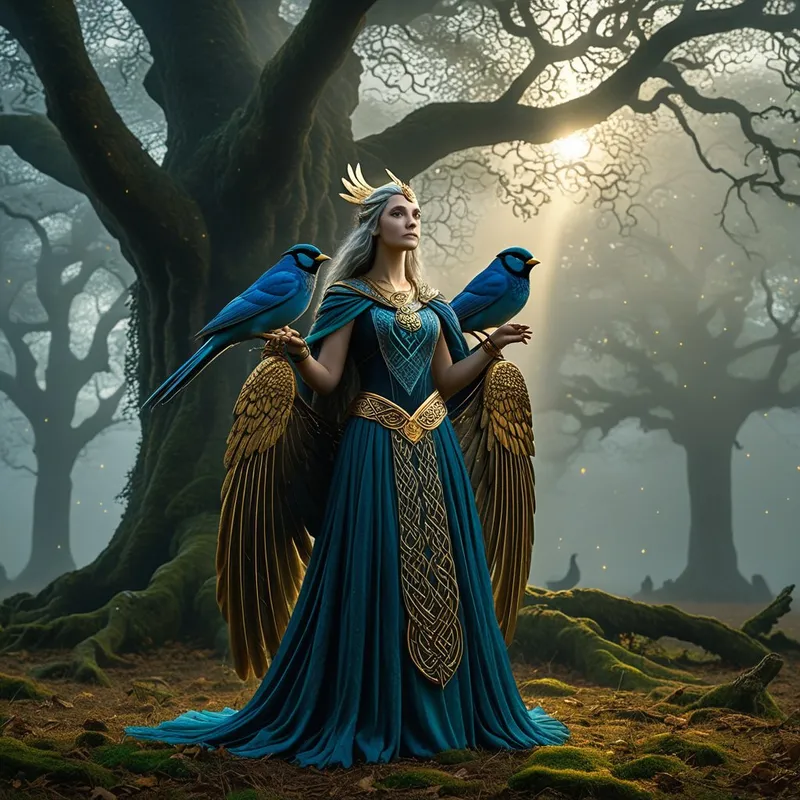
Birds of Rhiannon Myth Meaning & Symbolism
Enchanted birds whose song lulls the living to sleep and awakens the dead, serving as guides between worlds for the goddess Rhiannon.
The Tale of the Birds of Rhiannon
Hear now a tale from the mist-wrapped hills, from a time when the veil was thin and the Otherworld breathed against the skin of this one. It begins not with joy, but with a silence so deep it was a wound upon the land.
In the court of Bendigeidfran, a giant-king whose head would one day watch over London, a feast had turned to ashes. His beloved brother, Manawydan, sat in a grief that had no bottom, for their brother had been slain in a war born of a great wrong. Seven survivors remained, adrift in a hall that echoed with absence. Among them was Rhiannon, whose very name meant “Great Queen,” a figure who had walked the path between worlds, who had been accused and vindicated, who knew the shape of sorrow.
The world was grey. Food had no taste, drink no comfort. Sleep was a forgotten country. For seven years they wandered, carrying a sacred, silent burden—the head of their king, which spoke prophecies and kept them company. But the weight of their loss was a stone upon every heart.
Then, one evening, as they sat in a hall in Grassholm, a longing seized them. A longing for a sound they had never heard, yet whose absence they felt in their bones. Manawydan, his voice rough with years of quiet, spoke it aloud: “Is there not a song that can lift this gloom? Is there not a melody that can make us forget our grief, if only for a night?”
And as if summoned by the very shape of his yearning, a change came upon the air. It grew thick, sweet, and heavy with the scent of apple blossoms in a land where no apples grew. A light, not of sun or moon, gathered at the windows.
Then, they came.
Three birds alighted upon the thatch of the hall. Their feathers were not of any earthly hue—they held the sheen of a forgotten sunset, the glimmer of deep ocean water, and the cool fire of a star. These were the Birds of Rhiannon.
They opened their beaks, and a song poured forth. It was not a single melody, but a layered harmony of all longing and all solace. It was the whisper of waves on a far shore and the crackle of the hearth-fire; the cry of a newborn and the sigh of the dying. It was a song that sang of the Otherworld itself, of Annwn, where sorrow is but a story told beside a never-drying well.
As the song washed over them, the seven survivors felt the iron bands around their hearts soften and melt. Their eyelids grew heavy, not with exhaustion, but with a profound, welcoming peace. One by one, they slipped into a slumber deeper and more restorative than any they had known in seven long years. For the living, the song was a lullaby of forgetting, a blessed anesthesia for the soul’s raw wounds.
But the song had another power, known only in older, darker tales. It is said that the Birds of Rhiannon could sing the dead awake. That their music could call a spirit back across the grey marshes, could stir the ashes in the urn and rekindle the spark. For the dead, their song was a summons, a clarion call back to the warmth of memory and story. They were the keepers of the threshold, their melody the very sound of the veil parting.
And so they sang, through that night and perhaps for a hundred others, healing the living with sleep and whispering to the dead of home.
Cultural Origins & Context
The myth of the Birds of Rhiannon is preserved in that cornerstone of medieval Welsh literature, the Mabinogion. They appear most notably in the branch of Branwen ferch Llŷr, a tale of catastrophic war, trauma, and fragile survival. Their brief, luminous appearance is not the climax of an action, but the emotional and spiritual resolution to a saga of immense suffering.
This was not a myth for children or a simple folktale. It was a sophisticated narrative belonging to a bardic tradition that served as the memory, psychology, and cosmology of the Celtic peoples. The bard was not merely an entertainer but a fili, a seer who navigated the layers of reality. The story of the birds would have been recited in halls, their function mirroring that of the birds themselves: to process collective trauma, to guide the listeners through a narrative of loss, and to offer a glimpse of restorative, otherworldly grace. The myth acknowledges that some wounds are so deep they are beyond human remedy, requiring an intervention from the mythical realm—the psychic reality where archetypes hold healing power.
Symbolic Architecture
The Birds of Rhiannon are pure symbol, an embodiment of liminal potency. They are not pets or simple familiars; they are an extension of the goddess’s own sovereignty over the in-between spaces.
They represent the sound of the soul itself—a harmony that can only be heard when the noise of the ego and the agony of the world are finally stilled.
Their triadic nature is profoundly Celtic, echoing the triple goddess and the omnipresent triskelion. Three is the number of dynamic balance, of process (beginning, middle, end; past, present, future). These three birds sing a chord, not a single note, suggesting that healing is complex, layered, and requires multiple tones or perspectives.
They are creatures of air (song, spirit, message) yet they bring the gifts of earth (sleep, rest, embodied release) and mediate with the underworld (awakening the dead). They are the antithesis of the banshee’s wail; where one heralds death with terror, the other meets grief with a soporific, transformative beauty. Psychologically, they symbolize the autonomous, healing function of the psyche—what Jung called the transcendent function—which arises spontaneously from the depths when conscious endurance is exhausted. They are the numinous experience that arrives unbidden to re-order a shattered world.
The Dreamer's Resonance
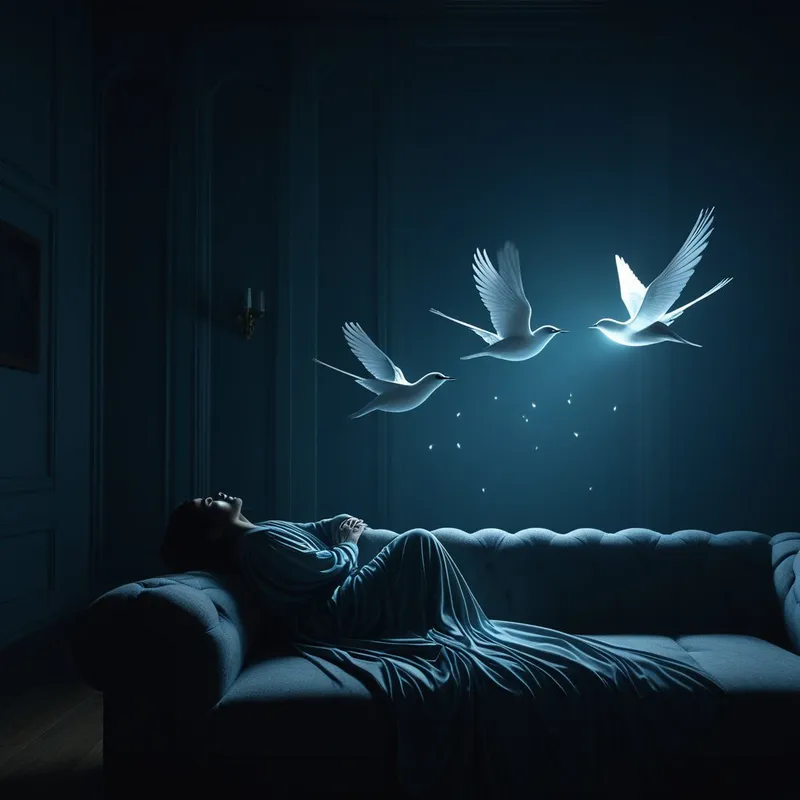
When the pattern of this myth stirs in a modern dream, the dreamer is likely in a state of profound psychic exhaustion or post-traumatic stasis. The conscious mind has fought, analyzed, and borne the weight until it is numb. The dream-ego may find itself in a barren, silent landscape or a hollow, communal space (the empty hall).
The appearance of magical, singing birds—or any overwhelmingly beautiful, non-threatening auditory-visual phenomenon—in such a context signals the unconscious activating its own healing protocol. It is the psyche prescribing its own medicine. The somatic experience upon waking may be one of deep, unexpected relief, a lightness, or a curious detachment from a pain that previously felt all-consuming. The dream is performing the birds’ lullaby, granting the soul the “seven years’ sleep” it needs to begin integration. To dream of trying to find the source of a beautiful, unseen song is to yearn for this transcendent function, to seek the Rhiannon within who can dispatch these healing emissaries.
Alchemical Translation
The journey of the seven survivors in Branwen is a precise map of the individuation process following a catastrophic nigredo—the blackening, the utter dissolution of the conscious personality by tragedy. They wander, carrying their “head” (their guiding, now internalized wisdom-principle), but they are functionally dead inside, unable to partake of life’s nourishment.
The call for the song is the crucial, active moment of the albedo—the whitening. It is the ego, in its utter poverty, finally articulating its need for the numinous. It is a prayer to the Self.
The Birds’ arrival represents the answer from the Self, the archetypal core of the psyche. Their song is the conjunctio, the sacred marriage of opposites: it puts the living to sleep (consciousness is quieted) and awakens the dead (the lifeless, traumatized parts of the soul are revived). This is psychic transmutation. The ego’s relentless, wounded vigilance is anesthetized, while the frozen, “dead” complexes within are thawed and brought back into the flow of psychic life.
For the modern individual, the myth instructs that after great suffering, the goal is not immediate “happiness” or forgetting. It is first this enchanted sleep, this surrender to a healing force that one does not control but must sincerely invite. It is about creating the hall—the inner container of acknowledgment and yearning—where such a song can land and work its ancient, restorative magic. We must become like Manawydan, brave enough to name our need for a beauty beyond our own making, and then wait, in faithful silence, for the birds to come.
Associated Symbols
Explore related symbols from the CaleaDream lexicon: