
Bindu Myth Meaning & Symbolism
The myth of the divine Bindu, the single point from which all creation emerges and into which all consciousness must ultimately return.
The Tale of Bindu
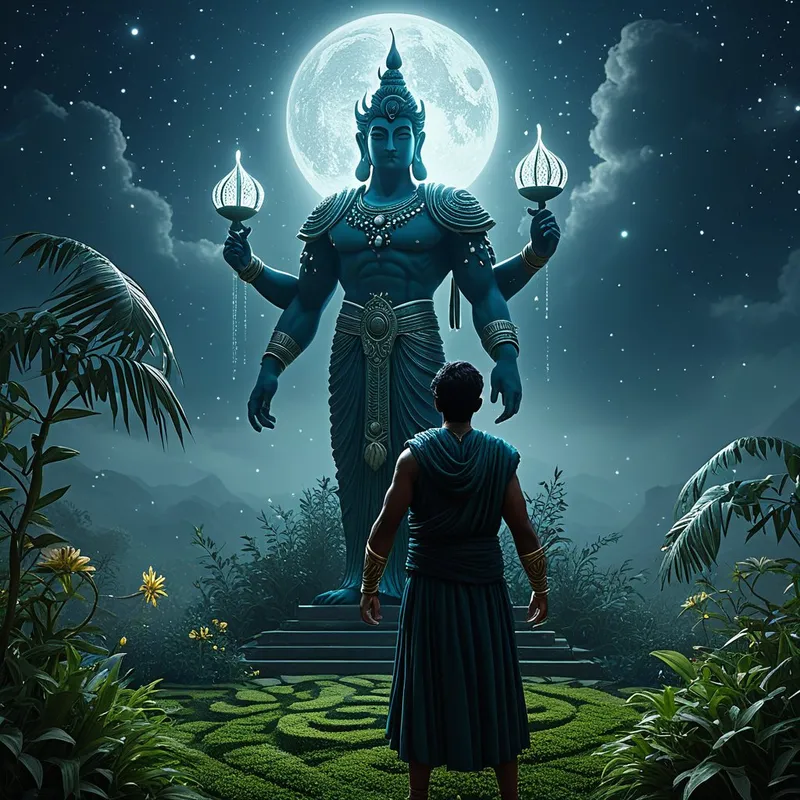
In the time before time, when the universe was a single breath held in the throat of the infinite, there existed a stillness so profound it was a kind of music. From this silence, the desire to be many arose—a cosmic sigh that manifested as a point of pure potential. This was the Bindu, the first and most secret of all forms. It was not a thing, but the possibility of all things. A shimmering, dimensionless pearl containing within its luminous heart the blueprints of mountains, oceans, stars, and the flutter of a sparrow’s wing.
The great churning of the cosmic ocean, the Samudra Manthan, had just subsided. From its turbulent depths, the pot of immortal nectar, Amrita, had been won by the Devas. But the nectar was not a simple drink; it was a concentrated essence of consciousness itself, and it yearned for a vessel worthy of its transformative power. As the Devas rejoiced, a single, perfect drop of this Amrita fell from the pot. It did not splash. It hung in the air, a tear of the divine, a Tirtha suspended between heaven and earth. This was the Bindu made manifest—a sacred, tangible locus of infinite creative energy.
The sage Narada, the celestial wanderer, found it. He beheld the Bindu, glowing with a soft, inner light, pulsating with the rhythm of a yet-unborn world. He knew its power. To protect it from the ever-warring forces of the cosmos—from the greed of the Asuras and even the possessiveness of the Devas—he undertook a great vow. He would carry this point of creation on a blade of sacred Kusha grass. He would walk the worlds, never setting it down, becoming its living, moving sanctuary.
But the weight of the infinite is not a physical burden; it is a psychological one. Narada’s journey became an odyssey of the soul. The Bindu’s light cast long shadows, revealing his own latent attachments and pride. In a moment of weariness, of mental lapse—a split-second where the sage’s consciousness flickered from the eternal to the temporal—he sought to place the Bindu down. The moment the drop touched the earth, a miracle and a catastrophe unfolded simultaneously. The Bindu did not vanish. It multiplied. It became a sacred lake, a reservoir of that primordial creative energy, giving rise to a new Tirtha. But in that act, the singular, unified point was disseminated. The one became the many. The concentrated essence was now a field of potential, accessible yet diffuse. Narada stood at the shore of the lake he had created, his heart a mix of awe for the blossoming creation and a profound, silent grief for the lost singularity he was sworn to guard.
Cultural Origins & Context
The concept of the Bindu is not the subject of a single, canonical epic but is a profound metaphysical principle woven into the fabric of Sanatana Dharma. Its roots are in the Vedas and Upanishads, where the quest to define the ultimate, indivisible source of reality is paramount. It finds elaborate expression in Tantra and Advaita Vedanta, where the Bindu is the focal point of the Om and the still center of the Sri Yantra.
The mythic narrative involving Narada and the spilled Amrita appears in various Puranas, serving as an etiological story for specific sacred geographies, like the Bindu Sarovar lake. It was passed down not just by priests but by storytellers, yogis, and artists. Its societal function was dual: to explain the sanctity of particular pilgrimage sites and, more importantly, to provide a contemplative map for the adept. It modeled the journey of consciousness from fragmentation back to source, teaching that even the wisest are tested by the burden of the ultimate truth they seek to carry.
Symbolic Architecture
The Bindu is the ultimate symbol of the unmanifest becoming manifest. It is the cosmic egg, the seed syllable, the first thought, and the final point of dissolution.
The Bindu is the silence before the word, the emptiness that holds all form. It is the interface between the absolute Brahman and the relative world of Maya.
Psychologically, it represents the core Self—the indivisible, central point of our being from which all our personality, thoughts, and experiences radiate. Narada, the celestial messenger, symbolizes the restless, discursive mind—the intellect and curiosity that seeks the truth. His task of carrying the Bindu is the ego’s sacred duty to protect and orient itself around this core Self. The spillage is not a mere accident; it is a necessary "fall" into manifestation. It represents the inevitable moment when the mind, no matter how disciplined, cannot sustain the sheer intensity of pure, undifferentiated consciousness. The ego must falter so that creation can happen. The lake that forms is the psyche itself—a vast, reflective reservoir where the singular truth of the Self is now refracted into the myriad experiences, complexes, and archetypes that constitute our inner world.

The Dreamer's Resonance
When this myth stirs in the modern unconscious, it often manifests in dreams of profound responsibility and delicate fragility. One might dream of carrying a priceless, glowing gem or a vial of luminous liquid across a treacherous landscape, gripped by the fear of dropping it. The somatic sensation is one of acute tension in the hands and chest—a literal bearing of weight.
This dream pattern signals a critical phase in psychological development where the dreamer has touched, or is being asked to hold, a nascent, integrated sense of self. It is a new, fragile wholeness emerging from a period of chaos or analysis (the churned ocean). The anxiety of "dropping" it reflects the ego’s terror of losing this hard-won cohesion, of fragmenting back into old patterns, anxieties, or diffused identities. The dream is a somatic rehearsal of the psyche’s most sacred task: the containment and protection of its own nascent center. The eventual "spill" in the dream, if it occurs, is not a failure but often a relief, leading to a surprising transformation—the single point becomes a nurturing, expansive space (a lake, a garden), indicating the Self’s energy successfully integrating into the broader field of the personality.

Alchemical Translation
The myth of the Bindu is a precise alchemical map for the process of individuation—the journey toward psychic wholeness. The initial state is the unconscious unity of the unmanifest Bindu. The churning of the ocean is the necessary, often painful, engagement with the contents of the personal and collective unconscious—our conflicts, repressed desires, and shadow material (the Devas and Asuras within us).
The alchemical vessel is not the pot that holds the nectar, but the conscious awareness of the seeker—the Narada-mind—that agrees to carry the transformative substance.
Winning the Amrita is the emergence of a transcendent function, a new perspective that can reconcile opposites. The Bindu-drop is the crystallized insight, the "philosopher’s stone" of the soul, the first solid experience of the integrated Self. The long journey of carrying it is the difficult work of living from this new center, of allowing it to inform daily life without being corrupted by inflation (pride) or drained by old complexes (weariness).
The crucial alchemical moment is the "spillage." In psychological terms, this is the sacrifice of the ego’s perfect, isolated control over this sublime state. The adept must willingly let the concentrated experience of the Self "fall" into the ordinary world—into relationships, work, creativity, and vulnerability. This is not a loss but the multiplicatio, the multiplication of the stone. The singular, private enlightenment becomes a fertile lake that nourishes the entire landscape of one’s life. The Bindu is no longer a secret treasure to be guarded, but a living, creative source. The pilgrimage site is no longer external; it is the psyche itself, now sanctified and made whole, a Tirtha where the individual soul meets the ocean of the universal.
Associated Symbols
Explore related symbols from the CaleaDream lexicon: