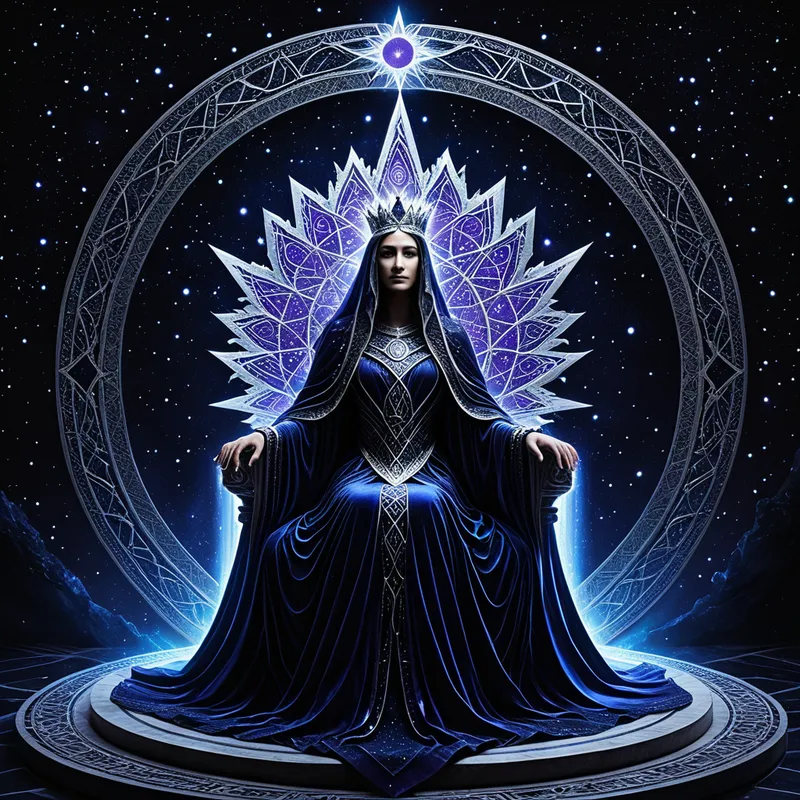
Binah Divine Understanding Myth Meaning & Symbolism
The story of Binah, the Great Mother of the Tree of Life, who receives the raw light of wisdom and births the structured worlds through sorrowful, loving comprehension.
The Tale of Binah Divine Understanding
Listen, and let your soul descend. Before time was measured, before form took shape, there existed only the Ein Sof, boundless and without end. From its perfect, unknowable unity, a desire arose—a desire to be known. And so, the first contraction, the Tzimtzum, created a void, a womb of potential.
Into this holy darkness, a ray of the Infinite Light, the Or Ein Sof, pierced the silence. It was pure, undifferentiated, a brilliance so intense it would shatter any vessel that tried to hold it. It was the flash of Chokhmah, the Father, the seed of all thought.
But a seed alone cannot grow. It requires soil, depth, a matrix to receive it. And so, from the resonance of that first point of wisdom, She emerged: Binah. She is the vast, dark cup, the palace of the Queen, the supernal mother. She did not flee from the blinding, chaotic light of Chokhmah. She turned her face toward it, and with infinite, sorrowful love, she opened herself.
She received the point. She did not merely see it; she understood it. She comprehended its implications, its consequences, its structures. In her dark womb, the singular, piercing insight of the Father was multiplied, differentiated, given form and relationship. The "what if" of Chokhmah became the "how" and "why" within Binah. This understanding was not a joyous epiphany, but a profound, tearful process. For to understand a thing is to see its limits, its end, its necessary sorrows. It is said the supernal mother weeps for the world that must now be born from this act of comprehension.
From her, the seven lower Sephirot flowed like children from a mother's side. The unformed light was now contained, colored, and structured. The raw power of insight was translated into the architecture of worlds. She is the constriction that makes creation possible, the womb that holds the seed until it is ready to be born into manifestation. Her name, Binah, means understanding, and her act is the divine, primordial act of listening, receiving, and giving meaningful form to the wordless voice of the source.

Cultural Origins & Context
The myth of Binah is not a narrative told around fires, but a map of consciousness inscribed in the heart of Jewish mystical tradition, known as Kabbalah. It emerged in medieval Spain and Southern France, with its seminal text, the Zohar, appearing in the 13th century. This was not a populist folklore but a deeply guarded, oral and written tradition passed among small circles of initiates.
The myth was studied, contemplated, and experienced through intense meditation on the Tree of Life. Rabbis and mystics would ascend this tree in their minds, using the myth of the Sephirot as a ladder to approach the divine. The story of Binah, therefore, served a dual societal function: it was a theosophical explanation for the mechanism of creation ex nihilo, and more importantly, it was a practical psychological model for the aspirant. To "enter Binah" was to cultivate a capacity for deep, receptive understanding, to move beyond flashy insight into sustained, structured comprehension—a necessity for both spiritual and intellectual leadership.
Symbolic Architecture
Binah represents the archetypal principle of the containing, structuring, and gestating mind. She is the cosmic womb, the vessel that makes the infinite finite. Psychologically, she symbolizes the move from inspiration (Chokhmah) to integration.
Understanding is the dark soil where the seed of insight must be buried to grow. It is the necessary, often painful, process of giving form to chaos.
She is associated with the divine feminine, specifically the stern, judicial aspect of the mother who sets boundaries and laws. Her color is black, not as absence, but as the fertile darkness that contains all potential. She is the left pillar of the Tree of Life, the pillar of Severity, which provides the necessary constraint for creation. In her, the brilliant, masculine flash of "Aha!" is cooled, examined, and developed into a coherent philosophy, a viable plan, a living system. She is the intelligence of limits, the comprehension of consequence, and the deep, silent knowing that comes not from thinking, but from being.
The Dreamer's Resonance
When this myth stirs in the modern unconscious, it often manifests in dreams of profound containment and inner processing. One might dream of a vast, dark, intelligent space—a library at night, a deep cave, a silent ocean trench. There is a sense of being within a great mind that is sorting, cataloging, and making sense of raw experience.
Somatically, this can feel like a deep, resonant pressure in the chest or skull, a humming vibration, or a warm, heavy stillness. Psychologically, the dreamer is likely undergoing a process of digesting a life-altering insight or a traumatic truth. The flash of realization has occurred (the Chokhmah moment), and now the psyche, in its Binah function, must hold that realization. This is the stage of grief, of sober assessment, of connecting the dots. Dreams of intricate machinery working silently, of complex puzzles solving themselves, or of a nurturing but stern feminine presence guiding them through a labyrinth all speak to the soul's work in the palace of Understanding.

Alchemical Translation
The journey to Binah is the alchemical stage of solutio and coagulatio—dissolution into the primal waters and re-coagulation into a new, more conscious form. For the individual seeking wholeness (individuation), the myth models a critical transition.
First, one must have the flash of insight—the recognition of a core complex, a destiny, or a shadow. This is the gift of Chokhmah, the wandering fool's moment of clarity. But this insight alone is useless, even dangerous, if it is not taken into the vessel of Binah. The individual must then consciously enact Binah's role: they must become the receptive, containing space. This means turning toward the painful or dazzling truth and holding it in sustained awareness without acting out or repressing it.
The transmutation occurs in the dark crucible of patient attention, where the gold of the Self is separated from the dross of reaction.
This is the work of therapy, meditation, journaling, or any disciplined practice of reflection. It is giving form to the formless through understanding. The "child" born from this union of insight (Father) and understanding (Mother) is a stable, structured aspect of the personality—a new skill, a healed relationship, a creative work, or a durable sense of meaning. One moves from being a conduit of chaotic inspiration to becoming an architect of one's own soul.
Associated Symbols
Explore related symbols from the CaleaDream lexicon:
- Mother — The archetypal container and source of form, representing Binah's role as the supernal womb that gestates and gives birth to the structured worlds.
- Cup — The sacred vessel that receives and holds the divine influx, symbolizing Binah's function as the receptive container for the light of Chokhmah.
- Ocean — The deep, dark, boundless waters of the unconscious mind, reflecting Binah's vast, fluid intelligence that comprehends through feeling and depth.
- Darkness — Not as void, but as the fertile, potential-filled matrix necessary for gestation and the formation of distinct entities from unified light.
- Womb — The primal space of transformation where the seed of insight is nourished, differentiated, and prepared for its journey into manifestation.
- Tree — The Tree of Life itself, whose trunk and branches are born from and sustained by the nourishing, structuring power of the supernal mother, Binah.
- Understanding — The core cognitive and spiritual process that Binah embodies: the move from raw data to meaningful structure, from insight to integrated knowledge.
- Vessel — Any form that provides limit and shape to the infinite, representing the critical Kabbalistic concept that creation requires tzimtzum (contraction) into vessels.
- Water — The element of Binah, symbolizing the flowing, adaptive, and deep nature of true comprehension, which cools and gives form to the fire of wisdom.
- Circle — The symbol of containment, wholeness, and the cyclical nature of gestation, birth, and return that originates in Binah's divine palace.