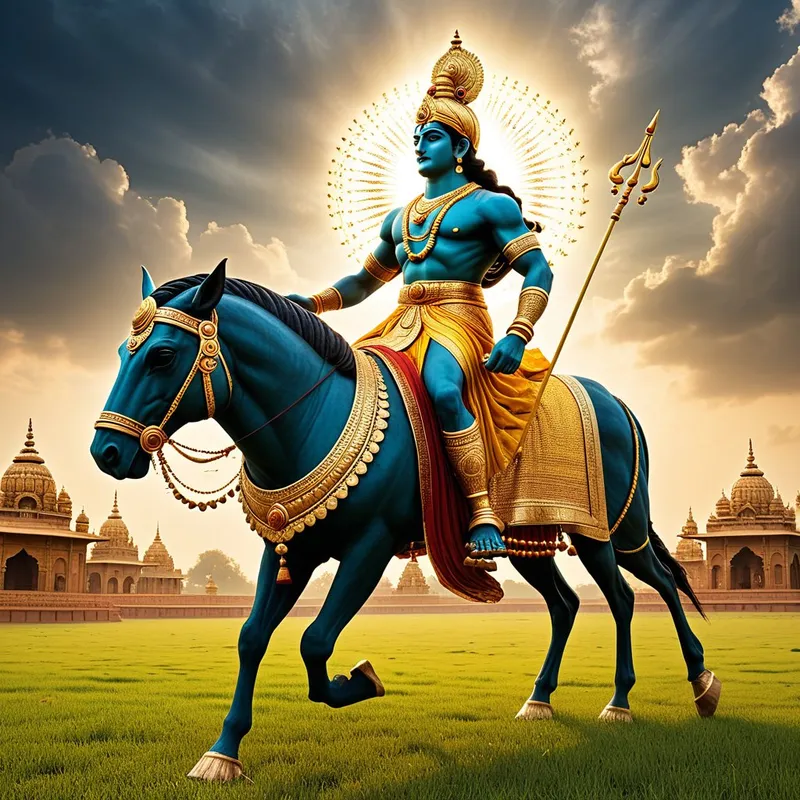
Bhagavad Gita Myth Meaning & Symbolism
A warrior's paralyzing crisis on a sacred battlefield becomes a cosmic dialogue on duty, the soul, and the nature of reality with his divine charioteer.
The Tale of Bhagavad Gita
Dawn bleeds into the sky over Kurukshetra. The air, thick with the scent of wet earth and oiled leather, hums with the silence of a hundred thousand men holding their breath. Conch shells scream, drums thunder, and the earth trembles beneath the tread of elephants and the wheels of chariots. Two colossal armies, the Pandavas and the Kauravas, stand mirrored—a sea of spears, banners, and familial hatred made manifest.
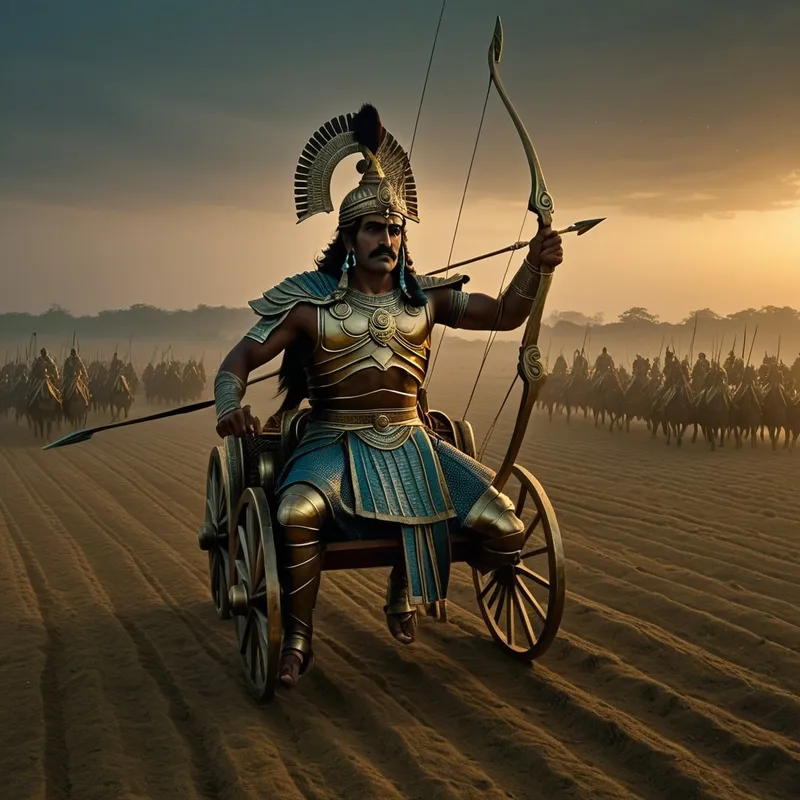
In the no-man’s-land between them, a single chariot halts. Its horses, white as moonlight, stamp nervously. Within it stands Arjuna, the world’s greatest warrior, his fingers tracing the familiar curve of his divine bow, Gandiva. But his heart is a stone in his chest. He turns to his charioteer, his dear friend and cousin, Krishna. "Take me to the center, Krishna," he says, his voice tight. "Let me see those for whom I must draw this string."
Krishna, dark-skinned and serene, guides the chariot forward. And there, in the terrible clarity of the morning light, Arjuna sees them. Not faceless enemies, but faces he loves. Grandfathers who told him stories. Teachers who taught him the sacred arts. Uncles who bounced him on their knees. Beloved cousins with whom he shared his youth. A wave of nausea crashes over him. His limbs grow heavy, his bow feels like a mountain in his hand. The righteousness of his cause dissolves into ash on his tongue. What is a kingdom won with the blood of one’s own family? What is duty when it demands you slaughter the very foundations of your world?
His strength deserts him. He sinks to the floor of the chariot, his glorious weapons clattering around him. "I will not fight," he whispers, then declares it to the sky. "Better to live a beggar than a king stained with the blood of my kin. I am paralyzed by pity. My duty is a maze, and I am lost within it. I am your disciple, Krishna. Guide me. Tell me, what should I do?"
And so, on that hallowed battlefield, with war poised to erupt around them, the chariot becomes a sanctuary, a classroom of the soul. Krishna does not command. He begins to speak. His voice is not of this field; it is the sound of rivers flowing, of stars singing in their courses. He speaks of what does not die. He tells Arjuna of the Atman, the eternal Self, which is neither born nor slain. The body is but a garment, worn and discarded. The wise do not mourn for what is everlasting, nor for what is temporary.
But Arjuna’s confusion deepens. If the Self is eternal, why act at all? Why not renounce this horrific duty? Krishna’s teaching unfolds like a lotus. He speaks of Dharma—one’s sacred obligation according to one’s nature and station. For a warrior, to fight a righteous war is his Dharma. To abandon it from fear or false compassion is not holiness, but cowardice and dereliction of the cosmic order. "Perform your prescribed duty," he says, "for action is superior to inaction."
Yet, how to act without being ensnared by the results? Krishna reveals the path of selfless action, Karma Yoga. Offer every act as a sacrifice to the Divine. Be a witness to your own actions. Do your duty with excellence, but relinquish all claim to success or failure. Be like the lotus leaf, untouched by the water in which it rests.
The dialogue soars. Krishna unveils the paths of devotion (Bhakti) and knowledge (Jnana). He describes himself as the taste in water, the light in the sun and moon, the syllable Om in all sacred speech. He is the thread upon which all worlds are strung like pearls.
Arjuna, overwhelmed, makes a final request. "If you think me capable of beholding it, O Lord, reveal to me your immortal, cosmic Form."
Then, Krishna grants him the divine eye. And Arjuna sees. He sees the Vishvarupa—a form infinite, containing all gods, all worlds, all time past and future. He sees the mouths of this boundless being, and within them, he sees the very warriors he hesitated to fight being drawn in, their lives already consumed. The cosmos births and dies in the blink of this Form’s eyes. Arjuna trembles, his hair standing on end. He bows his head, hands folded. "I have seen what no mortal has seen before. I was ignorant, calling you 'Krishna,' my friend. You are the primal God, the ancient Being, the ultimate refuge of this universe."
Compassionately, Krishna withdraws the vision and returns to his familiar, human-like form. The terrible awe subsides, leaving a profound, unshakable clarity. Arjuna’s paralysis is gone. His grief and confusion have been burned away in the fire of wisdom. He picks up his bow, Gandiva. His duty is no longer a burden, but a sacred offering. His voice is steady now. "My delusion is destroyed. I have regained my memory through your grace, O Krishna. I stand firm, my doubts dispelled. I will act according to your word."
The conch shells sound again. The chariot moves forward. The war begins. But for Arjuna, and for all who hear this song, the true battle has already been won within.
Cultural Origins & Context
The Bhagavad Gita is not a standalone text but a pivotal episode within the immense epic, the Mahabharata</abmarata. Its authorship is traditionally ascribed to the sage Vyasa, who is said to have composed the epic. Historically, it is believed to have taken its current form between the 5th and 2nd centuries BCE, though its oral roots and philosophical core are far older.
It was passed down through the sacred oral tradition, recited by Brahmin scholars and storytellers. Its societal function was multifaceted: it was a philosophical treatise for contemplatives, a guide to righteous conduct for the ruling and warrior classes (Kshatriyas), and a devotional scripture for the masses. It served as a synthesizing force, weaving together the paths of ritual action, philosophical knowledge, and heartfelt devotion into a cohesive spiritual roadmap for a complex society. It answered a perennial human need: how to live an engaged, ethical life in the world while striving for ultimate liberation (Moksha).
Symbolic Architecture
The Gita is a dense map of the human psyche. The battlefield of Kurukshetra is not merely a geographical location; it is the inner field of the human body and mind, the Kshetra, where the eternal battle between higher and lower impulses, duty and desire, wisdom and ignorance, is perpetually waged.
The chariot is the human body. The senses are the horses. The mind is the reins. The intellect is the charioteer. But who is the passenger? The Self, the Atman, is the true lord of the chariot.
Arjuna represents the individual human soul (Jivatman) in a state of profound crisis. His paralysis is the "dark night of the soul" that precedes any genuine awakening. His attachment to personal outcomes, his grief, and his confusion symbolize the ego's entanglement in the web of Karma.
Krishna is far more than a friend or god; he is the symbolic representation of the supreme Self, the Paramatman, the inner guide, the divine consciousness that already resides within but is obscured by the ego's turmoil. He is the charioteer—the true intellect and wisdom that must take control of the wayward senses and mind to guide the soul to its destiny.
The vision of the Vishvarupa is the ultimate psychological shock therapy. It represents the direct, overwhelming perception of reality as it is—an interconnected, ceaselessly transforming process of creation and destruction, where all individual lives are part of a vast, impersonal cosmic dance. It shatters the illusion of a separate, significant ego acting in a solid, permanent world.
The Dreamer's Resonance
When this mythic pattern stirs in the modern dreamer, it signals a profound somatic and psychological crossroads. One may dream of being paralyzed before a crucial presentation, unable to speak in a room full of familiar-yet-alien faces. Or of sitting in a vehicle, aware of a looming collision, while a calm companion gives inexplicable instructions.
The somatic experience is often one of heavy lethargy, a feeling of being "frozen," coupled with acute anxiety in the chest or gut. Psychologically, this is the ego's confrontation with a necessary but terrifying duty of consciousness. The "battlefield" is any life situation—a career change, ending a relationship, confronting a family truth, embracing a creative calling—where one's comfortable identity and attachments must be sacrificed for a larger, more authentic life. The dreamer is experiencing their own "Arjuna's despair," a crisis where old values collapse and the path forward seems morally or emotionally impossible. The psyche is summoning the inner Krishna, the deeper wisdom, to intervene before the Self retreats into permanent avoidance or neurosis.
Alchemical Translation
The Gita models the complete alchemical process of individuation—the transmutation of the leaden, conflicted ego into the golden, integrated Self. Arjuna's initial state is the nigredo, the blackening, the despair and dissolution of the ego's certainties.
The first alchemical step is not to act, but to stop and question from the depths of one's being. The chariot must halt in the middle of the field.
Krishna's discourse represents the albedo, the whitening, the illuminating wisdom that clarifies the nature of reality and the psyche. The teaching on Karma Yoga is the core transmutative formula: one must learn to engage fully with the world ("act") while internally remaining non-attached to the persona's cravings for reward, recognition, or security. This is the sacred paradox—fierce engagement with simultaneous inner detachment.
The vision of the Vishvarupa is the rubedo, the reddening, the fiery, overwhelming encounter with the totality of the unconscious, the Self in its awesome, impersonal majesty. It burns away the last vestiges of the ego's petty self-importance.
The final resolution—Arjuna picking up his bow, saying "I will act"—is the citrinitas, the yellowing, the dawn of a new consciousness. The ego has not been destroyed; it has been redeemed and repurposed. It now serves as a willing instrument of the Self. Duty is no longer a burden imposed from without, but a sacred expression of one's essential nature flowing from within. The individual is now a conscious participant in the cosmic order, performing their unique role with clarity, skill, and peace. The war within has ceased, and from that inner unity, effective action in the world becomes possible. The psyche has achieved a state of inner sovereignty, where one is, in the Gita's own words, "established in wisdom, whose work is all poured into the sacrifice, is freed from all Karma."
Associated Symbols
Explore related symbols from the CaleaDream lexicon: