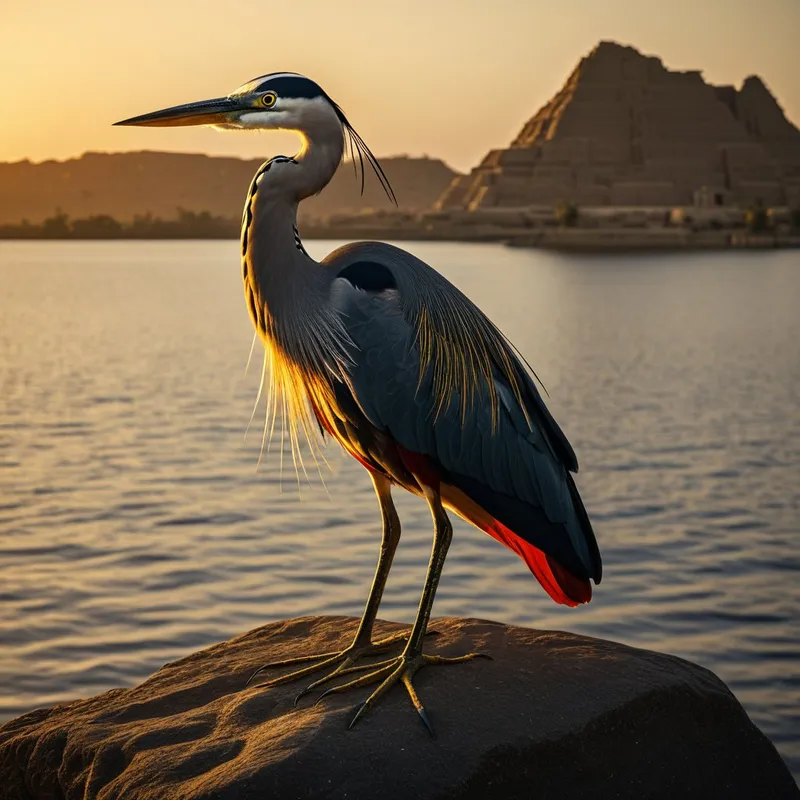
Bennu Myth Meaning & Symbolism
The self-created Bennu bird, rising from the primordial waters at dawn, embodies the first light, cyclical renewal, and the soul's indestructible essence.
The Tale of Bennu
Before time had a name, there was only Nun—a silent, boundless ocean of potential, dark and deep. No wind stirred its surface; no light pierced its depths. It was the great, dreaming void. Then, from within that endless night, a sound was born. Not a song, but a single, piercing cry that cleaved the silence. It was the voice of the Bennu.
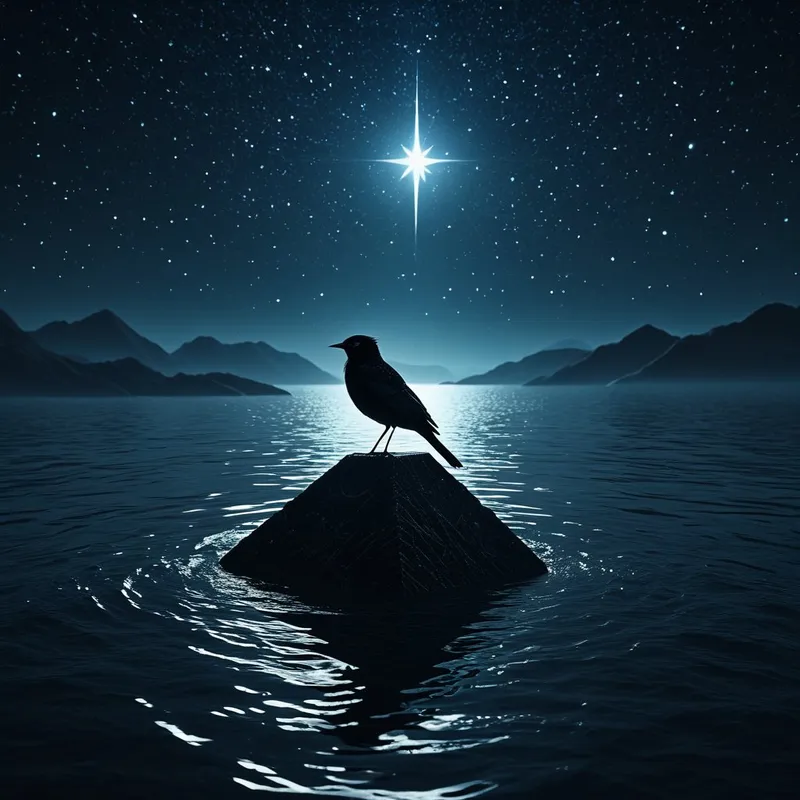
From the formless waters, a mound of earth arose—the first land, the benben stone. And upon it, the Bennu alighted. Its feathers were the colors of a sky that did not yet exist: the fiery gold of a sun yet to be born, the deep purple of twilight, the scarlet of life-blood. It was alone, yet it contained all possibility. It had not been born of a mother or a father; it had willed itself into being, a spark of consciousness igniting in the dark.
The Bennu stood upon the benben stone, feeling the first solidity beneath its feet. It looked east, across the unmoving waters, and opened its beak. Its cry was not an echo, but an origin. That sound vibrated through the substance of Nun, setting potential into motion. And then, it waited. It waited through an eternity compressed into a moment, its entire being focused on the eastern horizon.
As it waited, it gathered within its breast all the light that was not yet in the world—the memory of dawns unseen, the promise of days unlived. Then, as if in answer to its own primordial call, a rim of light appeared on the edge of nothing. The first dawn. The Bennu stretched its magnificent wings, and as it did, the light caught its feathers and exploded across the waters. The sun, Khepri, was pushed into the sky, not by a god’s hand, but by the announcement of the Bennu’s presence. Creation had begun, not with a battle, but with a perched bird and a patient, world-shattering cry.
And so the great cycle was set. The Bennu knew that even the sun must tire, must sink back into the waters of Nun at the end of its day. And so, at the end of a vast epoch, when its radiant form grew weary with the weight of ages, the Bennu would build a nest of fragrant myrrh and cinnamon upon the sacred benben stone. There, it would sing a final, beautiful song of all it had witnessed. Then, setting itself aflame with the sheer intensity of its own spirit, it would be consumed. From the ashes and the sweet-smelling smoke, a new Bennu would emerge—identical in essence, renewed in form—to alight once more upon the stone and cry out for the next dawn of the world.
Cultural Origins & Context
The myth of the Bennu is woven into the very fabric of the Egyptian understanding of time and divinity. Its primary cult center was at Iunu (Heliopolis), the "City of the Pillar," which housed a sacred benben stone. This direct association places the Bennu at the theological heart of the solar cult. It was not merely a symbol but an active, divine participant in the daily regeneration of the cosmos.
The myth was passed down through priestly hymns, temple rituals, and funerary texts like the Book of the Dead. To speak of the Bennu was to invoke a guarantee of renewal. For the Pharaoh, it was a symbol of eternal kingship and resurrection. For the common person, it represented the imperishable Ba-soul, that part of the self which could navigate beyond death. The myth functioned as a cosmological anchor, assuring society that the fundamental order of the universe—Maat—was maintained through perpetual, cyclical rebirth, modeled by this self-created bird.
Symbolic Architecture
The Bennu is a master symbol of autogenesis—the act of self-creation. It represents the primordial spark of individual consciousness arising from the undifferentiated waters of the unconscious (Nun). It does not fight for its existence; it declares it with a cry. This is the archetypal moment of awakening, the "I Am" that precedes all action.
The true self is not made, but remembered. It is the ancient, self-born entity that perches upon the first solid truth you find in the chaos of your becoming.
Its association with the sun and the benben stone ties it to the concepts of ascension, enlightenment, and the enduring center. The benben stone is the axis mundi, the world pillar. The Bennu, by alighting upon it, becomes the living connection between the watery depths of potential and the fiery heights of actualized spirit. Its cyclical death by fire and rebirth from ashes is not a tragedy but a necessary ritual of purification. It symbolizes the complete consumption of the old form—the outmoded identities, exhausted ways of being—so that the essential core, the indestructible "seed" of the soul, can be reconstituted.
The Dreamer's Resonance
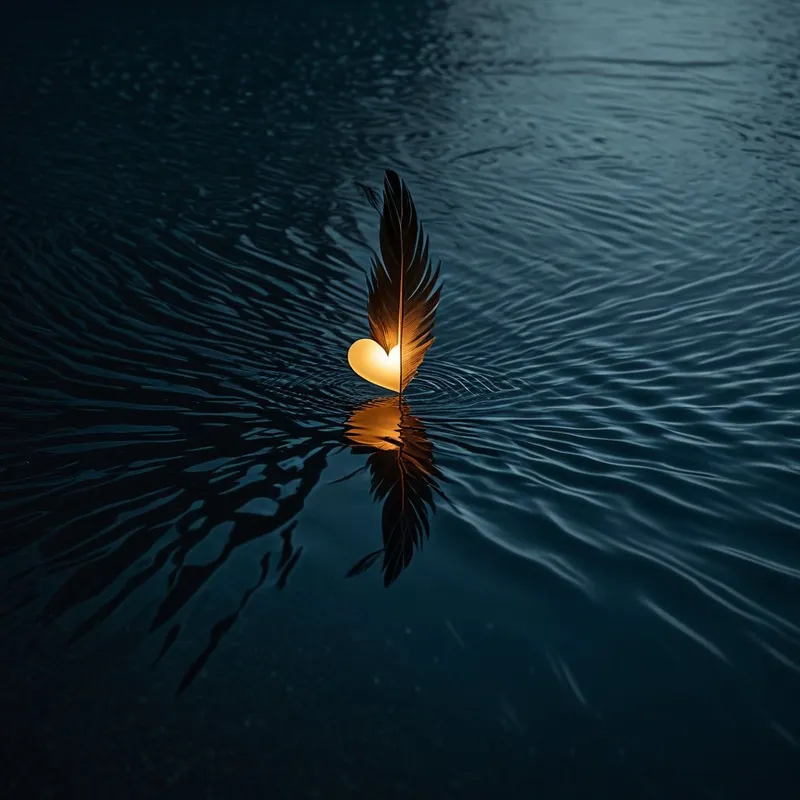
To dream of the Bennu is to dream from the soul's forge. Such dreams often occur during profound life transitions: the end of a career, the dissolution of a long-held identity, the aftermath of a crisis that has burned one's old world to the ground. The dreamer may not see the bird directly, but feel its presence in potent symbols: a single, radiant feather found in ashes; the intense, focused warmth of a light source that is not the sun; or the profound, echoing silence that follows a world-defining cry.
Somatically, this can feel like a deep, cellular exhaustion paired with a strange, incandescent energy at the core. Psychologically, it is the process of the "sacred regression": a necessary return to the formless, creative waters of Nun (the unconscious) to gather the raw material for a new self. The dreamer is in the nest of myrrh, surrounded by the fragrant memories of what was, preparing for the alchemical fire that will separate spirit from spent form.
Alchemical Translation
The myth of the Bennu provides a non-linear map for the process of individuation—the psychological journey toward wholeness. It begins not with a quest outward, but with a profound inward turn to the primordial mound, the benben stone of the Self. This is the act of finding one's own ethical, psychological, and spiritual center amidst the chaos of life.
The first alchemical stage is solutio: dissolution into the waters of Nun. This is the surrender of ego-control, allowing old structures to soften and dissolve. From this, the coagulatio occurs: the emergence of the benben stone, the first solid intuition of one's true nature. Upon this, the Bennu—the nascent Self—perches.
The phoenix-fire is not destruction, but the ultimate act of discernment. It burns away everything that is not essence, leaving only the golden, indestructible pattern of the true form.
The critical, transformative fire is the calcinatio: the intense, often painful, process of burning away the dross of persona, societal expectation, and trauma. This is the building of the fragrant nest and the willing immolation. The modern individual undergoes this in the crucible of analysis, deep introspection, or life crisis. The rebirth (sublimatio) is not a return to a previous state, but an ascent to a new level of integration. The new Bennu is the same eternal essence, now inhabiting a renewed, more authentic vessel, ready to sing the world into being once more. The myth teaches that creation is a continuous, cyclical act of courageous self-definition and sacred renewal.
Associated Symbols
Explore related symbols from the CaleaDream lexicon: