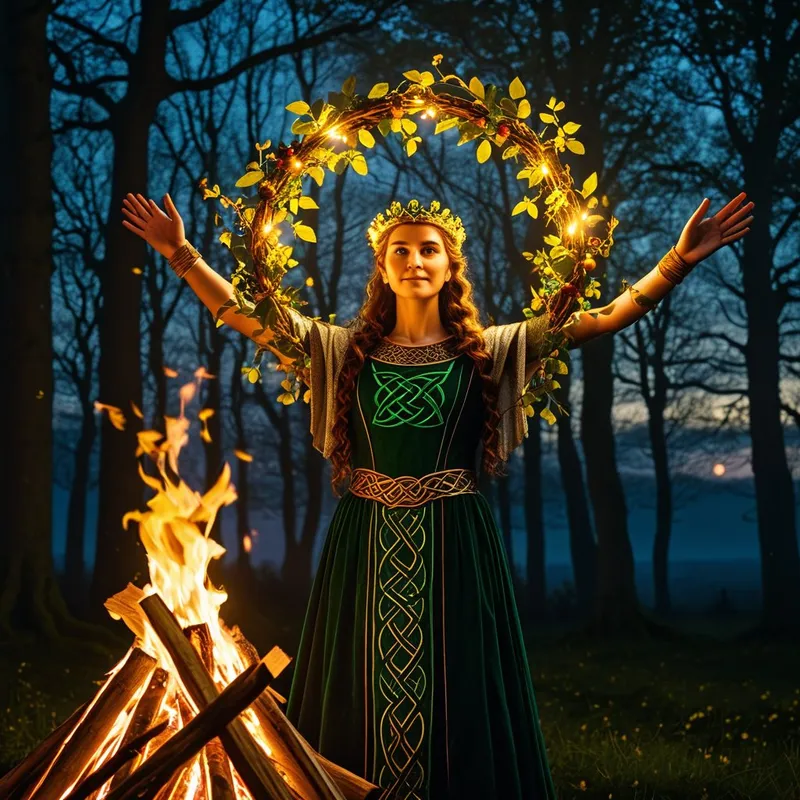
Beltane Wreaths Myth Meaning & Symbolism
A tale of the May Queen and the Green Man, whose union is sealed by a sacred wreath, weaving the worlds of spirit and matter into one vibrant whole.
The Tale of Beltane Wreaths
Listen, and hear the tale whispered on the smoke of the first fire of summer.
[The world](/myths/the-world “Myth from Tarot culture.”/) was caught between breaths. In the realm of the Tuatha Dé Danann, the spirits of the greenwood grew restless. The Flidais of the wild herds had withdrawn her bounty, and the genii locorum slept fitfully in their barrows. [The veil](/myths/the-veil “Myth from Various culture.”/) between [the world](/myths/the-world “Myth from Tarot culture.”/) of the living and the [Sídhe](/myths/sdhe “Myth from Celtic / Irish culture.”/) was thin, but it was a brittle, silent thinness. Life was potential, not yet promise.
In the heart of the waking forest, he stirred. He was known by many names, but in this breath he was the [Green Man](/myths/green-man “Myth from Celtic culture.”/). His body was the sinew of oak roots, his hair the trailing ivy, his breath the scent of damp earth and crushed fern. But his heart was cold, a seed waiting for the sun’s kiss. He was all potency, with no vessel; all urge, with no union.
From the direction of the waking villages came she who was called the [May Queen](/myths/may-queen “Myth from Celtic culture.”/). Not a goddess, but a mortal maid whose spirit shone with the clarity of a dew-fed dawn. She carried the anxiety of her people in her steps—the fear of barren fields, of empty cradles. She walked to the ancient bile, the [hawthorn](/myths/hawthorn “Myth from Celtic culture.”/) tree that stood between the nine hazels of wisdom.
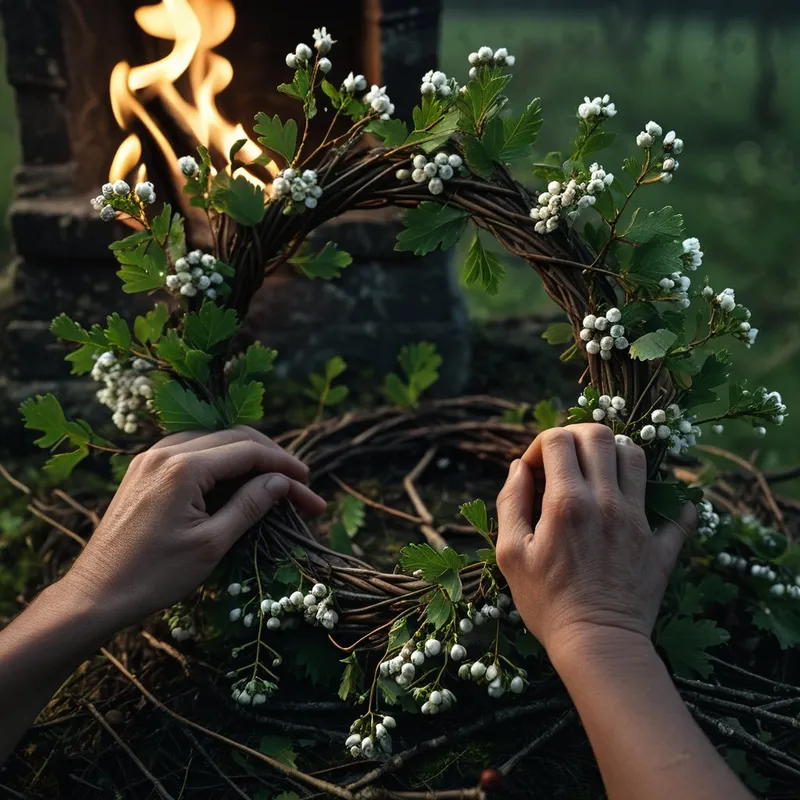
Her task was not to conquer, but to invite. With hands that trembled not from fear but from the weight of the moment, she began to weave. She took the white blossoms of the hawthorn, each a five-petaled star of pure potential. She took the young, supple leaves of the oak, still sticky with sap. As she wove, she did not merely craft an object; she sang a boundary. She sang of the village hearths and the longing for plenty. She sang of the soil’s thirst and the cattle’s lowing. The wreath in her hands became a circle of need, a hoop of human hope.
She carried this circle to the hilltop where the tein-eigin, the need-fire, was to be kindled. [The druids](/myths/the-druids “Myth from Celtic culture.”/) had drawn the old fire from the heart of the oak, and now the new flame leapt, hungry and pure. This was the moment. [The threshold](/myths/the-threshold “Myth from Folklore culture.”/). [The Green Man](/myths/the-green-man “Myth from Global/Universal culture.”/) emerged from the tree line, a shadow given form by the flickering light. He was the untamed forest; she was the cultivated hope. They stood as opposites across the fire.
The May Queen did not flinch. She raised the wreath, this symbol of the human world’s most vulnerable and beautiful desire: connection. She held it over the flames. For a heartbeat, it was a bridge of flowers and leaves spanning the elemental fury. Then, she cast it—not at him, but through the fire. The wreath flew through the pillar of flame, emerging on the other side not consumed, but transformed. It glowed with captured sunlight, each leaf and blossom edged in gold, smelling of smoke and honey.
The Green Man caught it. And in that catch, the contract was sealed. The cold seed in his heart split open. The silent forest sighed into a chorus of birdsong. He placed the wreath upon her head, and where the glowing leaves touched her brow, the boundary dissolved. She was no longer just the May Queen of the village; she was the sovereign of the moment where two worlds met. He was no longer just the wild force; he was the consort to conscious intention. Their union, witnessed by fire, was the myth made manifest. The herds would grow fat, the fields would run gold, and [the wheel of the year](/myths/the-wheel-of-the-year “Myth from Celtic culture.”/) turned firmly toward the light.
Cultural Origins & Context
The myth of the [Beltane](/myths/beltane “Myth from Celtic culture.”/) Wreath is not a single, codified story from an ancient text, but a ritual narrative reconstructed from the fragments of Celtic seasonal practice. The Druids did not write their mysteries; they performed them. This tale is the whispered explanation behind the communal acts witnessed on every hilltop at the start of Bealtaine.
It functioned as the sacred script for a profound societal drama. The wreath-weaving, the lighting of the need-fire, the choosing of a May Queen (or in some traditions, a May King), and their symbolic union were not mere pageantry. They were a collective act of sympathetic magic and psychological [projection](/myths/projection “Myth from Alchemical culture.”/). The community’s fears of famine and sterility were placed upon the ritual participants, and their successful “marriage” acted as a cosmic guarantee of fertility and protection for the coming season. The wreath itself, often made from the first flowering hawthorn and the resilient oak, was a tangible [covenant](/myths/covenant “Myth from Christian culture.”/). It was a charm woven from the very threshold it represented—the hardy, protective oak of the masculine principle and the fertile, blossoming hawthorn of the feminine, bound in a circle with no beginning and no end.
Symbolic Architecture
At its core, the myth is an elaborate map of a sacred threshold. The [wreath](/symbols/wreath “Symbol: A wreath commonly symbolizes completion, cyclical nature, and the binding of different life phases, often associated with celebration or remembrance.”/) is the ultimate [symbol](/symbols/symbol “Symbol: A symbol can represent an idea, concept, or belief, serving as a powerful tool for communication and understanding.”/) of this liminal [space](/symbols/space “Symbol: Dreaming of ‘Space’ often symbolizes the vastness of potential, personal freedom, or feelings of isolation and exploration in one’s life.”/).
The circle is the shape of wholeness, but to pass through it is the act of transformation. The wreath is not a wall; it is a gateway woven from the tension of opposites.
The Green Man represents the raw, unconscious, instinctual forces of [life](/symbols/life “Symbol: The symbol of ‘Life’ represents a journey of growth, interconnectedness, and existential meaning, encompassing both the joys and challenges that define human experience.”/)—the libido, the wild [psyche](/myths/psyche “Myth from Greek culture.”/), the untamed creative [impulse](/symbols/impulse “Symbol: A sudden, powerful urge or drive that arises without conscious deliberation, often linked to primal instincts or emotional surges.”/). He is all potential [energy](/symbols/energy “Symbol: Energy symbolizes vitality, motivation, and the drive that fuels actions and ambitions.”/). The May [Queen](/symbols/queen “Symbol: A queen represents authority, power, nurturing, and femininity, often embodying leadership and responsibility.”/) symbolizes the conscious ego, the structured world of culture, [intention](/symbols/intention “Symbol: Intention represents the clarity of purpose and direction in one’s life and can symbolize motivation and commitment within a dream context.”/), and vulnerable [human](/symbols/human “Symbol: The symbol of a human represents individuality, complexity of emotions, and social relationships.”/) need. She is the [vessel](/symbols/vessel “Symbol: A container or structure that holds, transports, or protects something essential, representing the self, emotions, or life journey.”/) seeking content. The hilltop and the [bonfire](/symbols/bonfire “Symbol: A bonfire symbolizes warmth, community, and the celebration of gatherings, often illuminated by the flame of shared experiences.”/) are the [temenos](/myths/temenos “Myth from Greek culture.”/), the sacred space where these opposites can meet without destroying each other.
The critical alchemical [moment](/symbols/moment “Symbol: The symbol of a ‘moment’ embodies the significance of transient experiences that encapsulate emotional depth or pivotal transformations in life.”/) is not their meeting, but the transformation of the wreath by passing it through the fire. The fire is the catalyzing agent—the [passion](/symbols/passion “Symbol: Intense emotional or physical desire, often linked to love, creativity, or purpose. Represents life force and deep engagement.”/), the conflict, the necessary ordeal. The wreath that emerges is no longer a simple plea; it is a conjunctio, a sacred [marriage](/symbols/marriage “Symbol: Marriage symbolizes commitment, partnership, and the merging of two identities, often reflecting one’s feelings about relationships and social obligations.”/) of materials. It has been tempered. It can now be worn as a [crown](/symbols/crown “Symbol: A crown symbolizes authority, power, and achievement, often representing an individual’s aspirations, leadership, or societal role.”/), a symbol of the new [consciousness](/symbols/consciousness “Symbol: Consciousness represents the state of awareness and perception, encompassing thoughts, feelings, and experiences.”/) born from the [integration](/symbols/integration “Symbol: The process of unifying disparate parts of the self or experience into a cohesive whole, often representing psychological wholeness or resolution of internal conflict.”/) of wild [nature](/symbols/nature “Symbol: Nature symbolizes growth, connectivity, and the primal forces of existence.”/) and human [spirit](/symbols/spirit “Symbol: Spirit symbolizes the essence of life, vitality, and the spiritual journey of the individual.”/).
The Dreamer’s Resonance
When this myth stirs in the modern dreamer, it often manifests as dreams of weaving, of circular portals, or of standing before a great fire or a dense forest with a sense of sacred duty. To dream of carefully, anxiously weaving a circle of plants suggests a psyche attempting to create a container—a new attitude or a conscious structure—for powerful, emerging unconscious contents. The plants chosen are vital: thorny plants speak of necessary boundaries and protection; fragrant flowers point to budding potentials or relationships; evergreen leaves hint at enduring aspects of [the Self](/myths/the-self “Myth from Jungian culture.”/).
Dreams of casting an object through fire and retrieving it transformed are direct echoes of the myth’s central ordeal. This indicates the dreamer is in a psychological process where an old identity, a cherished ideal, or a long-held pattern must be voluntarily subjected to the heat of examination, conflict, or passionate engagement to be redeemed and made usable for a new phase of life. The somatic feeling is often one of intense, fearful anticipation followed by a profound release and a sense of rightness.
Alchemical Translation
For the individual on the path of individuation, the Beltane Wreath myth models the crucial step of relating to the unconscious, not being overwhelmed by it.
The modern “Green Man” may be an erupting complex—a burst of creative fury, a depressive withdrawal into nature, a sexual awakening, or a rage that feels “wild” and untamable. The modern “May Queen” is the conscious personality that tries to manage life, uphold responsibilities, and maintain order, yet feels barren or anxious without a connection to this deeper vitality. [The ego](/myths/the-ego “Myth from Jungian culture.”/)’s temptation is either to repress the wild force (leave the Green Man in the forest) or to be devoured by it (be lost in the woods).
Individuation requires the ego to weave a wreath—a conscious attitude—and then have the courage to pass it through the fire of engagement.
The ritual act is the translation: the ego must acknowledge the wild force, create a symbolic vessel for it (through art, active imagination, or conscious relationship), and then submit that vessel to the transformative fire of honest confrontation. This is the “[sacred marriage](/myths/sacred-marriage “Myth from Alchemy culture.”/).” The result is not the wild force being civilized, nor the ego being made primitive. It is the birth of a third [thing](/myths/thing “Myth from Norse culture.”/): a personality crowned with the tempered wreath, where instinct is guided by consciousness and consciousness is enlivened by instinct. The individual becomes the living hilltop where inner and outer, spirit and matter, creativity and form, are held in fruitful, glowing union. The wheel of the psyche turns, and life moves from barren potential into embodied, flourishing fact.
Associated Symbols
Explore related symbols from the CaleaDream lexicon: