
Begging Bowl Myth Meaning & Symbolism
A sacred vessel of emptiness, offered by the gods to the Buddha, becomes the ultimate symbol of receiving the universe through radical humility.
The Tale of the Begging Bowl
Listen, and let the silence between the words speak. After the great awakening beneath the Bodhi tree, the one who was once Prince Siddhartha walked the dusty roads of the Ganges plain. He was a mendicant now, a teacher, his royal robes exchanged for the simple patched cloth of a wanderer. Yet, in his hand, he carried nothing. He had renounced the palace, the chariot, the jeweled cup. To receive the alms that would sustain his body, he needed a vessel.
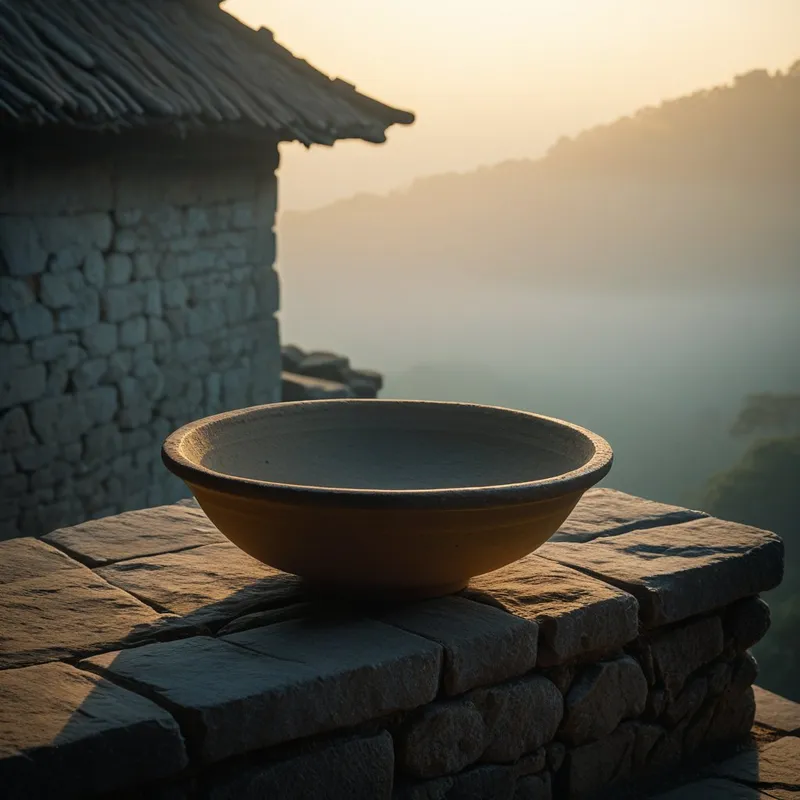
The story whispers that the guardians of the four directions, the great devas, perceived this need. But they saw not a lack, but a sacred opportunity. They did not bring a golden chalice fit for a king, nor a silver urn adorned with lotus blossoms. From the heart of the earth and the essence of the mountains, they fashioned a bowl of the humblest material—stone, some say, dark and unadorned. Others murmur it was formed from the clay of riverbanks, fired not in a kiln but by the sun’s patient gaze.
The four devas descended, their light softening to a gentle glow so as not to dazzle the one who sought no dazzlement. Each presented an identical bowl, a simple, deep vessel. A test was woven into the gift, a final teaching on non-attachment even in receiving. The Buddha, with the clarity of one who sees the substance of all things, accepted the offering. But he would not choose one over the others, for preference breeds clinging. Instead, in a gesture of profound integration, he took all four bowls and placed them one atop the other. And there, by the power of his compassionate intention and the truth of his realization, the four separate vessels fused into one. The seams vanished. The humble bowl remained humble in appearance, but now it was a vessel of unity, containing the offering of all quarters of the cosmos.
From that day forth, this was his patra. At dawn, he would walk silently into a village, standing wordlessly at doorways. Into this bowl, people would place a handful of rice, a piece of fruit, a simple meal. He ate what was given, without discrimination, tasting not just food but the generosity of the giver. The bowl was never full, for he took only what was needed. It was never truly empty, for it held the entire practice: the humility to ask, the grace to receive, the wisdom to know what is enough.
Cultural Origins & Context
This myth, while not found in the earliest canonical texts like the Pali Canon, blossomed in the rich soil of later narrative traditions, particularly the Jataka tales and avadanas. It is a didactic narrative, passed down by monastics to novices and shared with lay communities. Its function was multifaceted: to sanctify the most visible symbol of a monk’s renunciant life, to illustrate the Buddha’s perfected equanimity, and to model the sacred reciprocity between the monastic community (Sangha) and the laity.
The begging bowl, or patra, is the quintessential tool of a bhikkhu. Its daily use is a ritual of vulnerability. By carrying it, the monastic publicly declares dependence on the generosity of others, breaking the ego’s illusion of self-sufficiency. The myth of its divine origin elevates this practical object into a sacred relic, a constant reminder that true sustenance—spiritual and physical—flows from a source beyond the grasping self. It anchors the lofty ideals of emptiness and compassion in the tangible, daily act of holding out a bowl.
Symbolic Architecture
The bowl is an archetypal symbol of the feminine principle, the receptive womb of space from which all form emerges. It is a container, but its power lies in its emptiness.
The bowl’s value is not in what it is made of, but in the void it maintains. It is a shaped piece of nothingness, an architecture for receiving.
The four devas represent the totality of the manifest world—the four directions, the four elements, the complete spectrum of conditional reality. Their offering of four separate bowls symbolizes the fragmented, dualistic perception of ordinary mind, which sees things as separate gifts, separate choices, separate sources. The Buddha’s act of merging them is the alchemy of enlightenment itself: the integration of all apparent dualities into a unified, seamless whole. The one bowl that results is the mind of tathata, reality as-it-is, which receives all experiences without separation or preference.
Psychologically, the bowl represents the conscious ego that has been hollowed out. It is no longer a fortified castle of identity, but an open vessel. The act of “begging” is the ego’s surrender of its arrogance, its admission that it does not—and cannot—generate its own wholeness. It must receive from the deeper, wider Self, from the world, from the unknown.
The Dreamer's Resonance
When the image of a begging bowl surfaces in modern dreams, it rarely appears in its traditional religious context. Instead, it manifests as a profound somatic symbol of a psychological process underway. One might dream of holding out one’s cupped hands, only to find them transformed into a ceramic or wooden bowl. One might dream of a cherished possession—a favorite mug, a trophy, a wallet—cracking open to reveal itself as hollow, as a vessel.
This dream signals a crisis or culmination of the ego’s self-sufficient project. The dreamer is encountering the limits of what they can “grasp,” “achieve,” or “possess.” There is a deep, often uncomfortable, yearning to be filled from the outside, a longing for grace, for help, for meaning that does not originate in one’s own will. It is the psyche’s intuition of humility. The emotional tone can be one of shame (the exposure of need) or profound relief (the permission to finally stop striving). The bowl in the dream asks: What are you truly hungry for? And are you willing to hold out your emptiness to receive it?

Alchemical Translation
The myth of the begging bowl models the final, most counterintuitive stage of individuation: the transmutation of the heroic, striving ego into a receptive vessel for the Self. Our modern cult of individualism champions the self-made person, the ruler, the hero who conquers and acquires. The alchemy of the bowl reverses this direction entirely.
The first step is the kenosis—the emptying. This is the voluntary relinquishment of the ego’s contents: its certitudes, its defended identity, its claim to authorship of its life. This is not annihilation, but the creation of interior space. The second step is the presentation—holding that shaped emptiness out into the world. This is the vulnerability of the ask, the exposure to rejection or grace. The final step is the fusion—the recognition that what is received is not a series of disparate gifts (success, love, insight) from disparate sources, but a unified sustenance flowing from the totality of existence itself, once the barriers of a separate self are dissolved.
Individuation is not about filling the bowl of the self with achievements, but about hollowing the self until it becomes a bowl for the world.
For the modern individual, this translates to a practice of radical receptivity. It is listening more than speaking, allowing more than forcing, gratitude more than entitlement. It is understanding that one’s true work is not to become full, but to become empty enough to contain the mystery. The job of the ego is not to be the source, but to be the perfectly shaped, humble, and willing container for the source that is always already pouring forth. In that emptiness, everything is given.
Associated Symbols
Explore related symbols from the CaleaDream lexicon: