Bees of the Otherworld Myth Meaning & Symbolism
A hero steals honeyed bees from a divine Otherworld well, sparking a cosmic storm and initiating a profound journey of psychic transmutation.
The Tale of Bees of the Otherworld
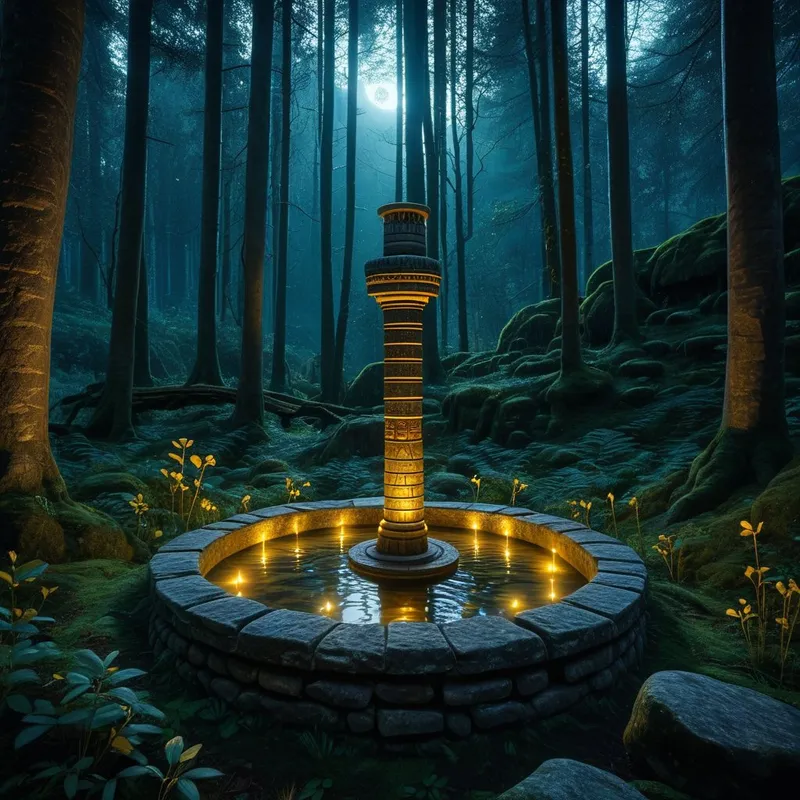
Listen now, and let the fire’s crackle become the rustle of oak leaves in a forgotten time. In the days when the borders between worlds were thin as mist, there existed a well—not of common water, but of vision. It was a Sídhe well, hidden in the deepest grove, where the roots of the great Bile drank from the underworld rivers. Its water was black and still, a lidless eye staring into the heart of things.
From this well, on certain nights when the moon hid her face, a strange humming would arise. Not the sound of water, but of wings. For within its liquid darkness, the Tuatha Dé Danann kept their bees. These were no ordinary creatures. Their bodies shimmered with a bronze light, and the honey they distilled from the flowers of the Otherworld was not mere sweetness, but a condensed form of imbas—the fire of poetic inspiration and prophetic sight. To taste it was to know secrets, to sing truths that could shape reality.
A man, let us call him Fili, heard whispers of this well. He was a seeker, hungry not for gold but for the song that lies beneath all songs. His own words had grown dry, his harp silent. Driven by a longing that was both a prayer and a theft, he journeyed for nine days and nights, following the guidance of dreams and the flight of a single, persistent crane. When he found the well, the air was thick with the scent of meadowsweet and ozone, the humming a tangible pressure against his skin.
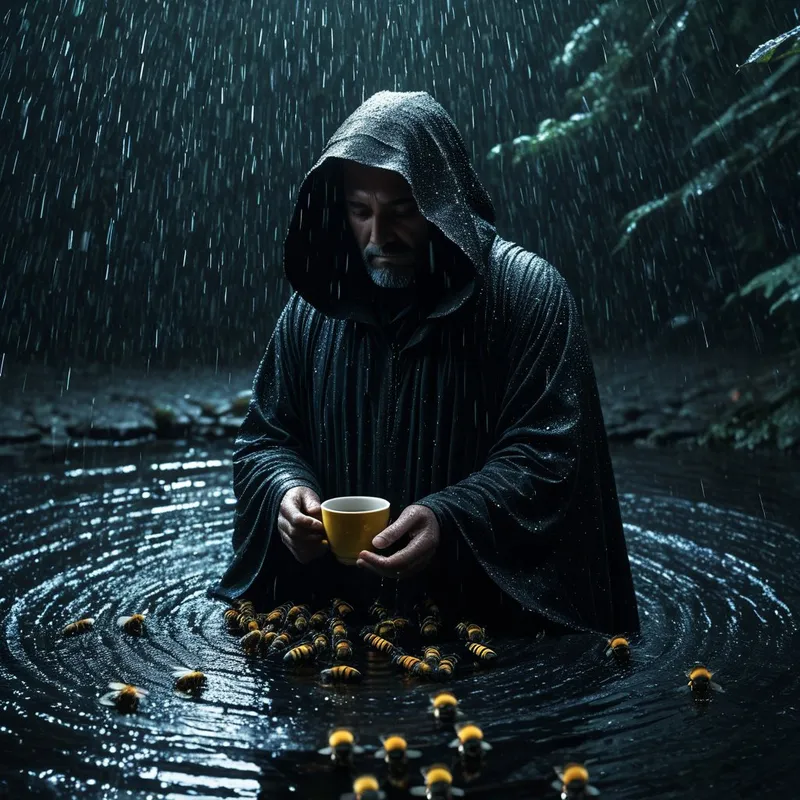
He saw them—a swirling constellation of living gold emerging from the water’s black mirror. Without a vessel, driven by desperate need, he cupped his hands and plunged them into the cold depth. The bees did not sting; they flowed into his palms like liquid light, a buzzing, living treasure. As he lifted his hands, dripping with water and crawling with divine insects, the sky above the grove darkened in an instant. The humming of the bees rose into a shriek of wind. The guardians of the well, the unseen Genii Loci, were awake.
A storm erupted, not of common rain, but of icy fury. It was a rain meant to wash away the transgression, to drown the thief and his stolen light. Fili ran, the bees a burning secret in his clasped hands, the tempest at his heels tearing leaves from the sacred oaks. He ran not toward safety, but toward the world of men, carrying the essence of the Otherworld into the realm of mortal struggle. The myth ends not with his safe return, but with his flight—the critical, perilous act of bearing a fragment of the divine into the human sphere, with all the cataclysm that must follow.
Cultural Origins & Context
This haunting fragment of myth survives not in a single, grand epic, but is woven through early Irish and Welsh lore, particularly in traditions surrounding sacred wells and the poetic arts. It belongs to the Mythological Cycle, echoing in tales like the Metrical Dindshenchas (lore of places) and the wisdom literature of the Filid. These stories were not mere entertainment; they were the cognitive maps of a culture deeply attuned to the animism of the landscape.
The myth was likely told by the Filid themselves, the keepers of memory and craft. For them, it was a foundational parable of their own vocation. The bees symbolized the inspired knowledge (imbas) that comes from the Otherworld—the source of all true poetry, law, and prophecy. The well is the Segais or its many analogues, a point of access to the cosmic knowledge contained in the waters beneath the world. The story served a crucial societal function: it sacralized the poet’s role as a dangerous mediator between realms, and it framed inspiration not as a gentle muse, but as a stolen, electrifying force that inevitably provokes a crisis. It warned that accessing ultimate knowledge disrupts the natural and supernatural order, demanding a price.
Symbolic Architecture
At its core, this myth is an archetypal drama of consciousness seeking its own source. The bee is one of humanity’s oldest symbols of organized, communal industry yielding a transcendent product—honey, a substance that never spoils, a natural alchemy. In the Celtic lens, this is elevated: the bee becomes a psychopomp, a soul-guide between worlds, and its honey is the crystallized nectar of divine insight.
The hero does not receive the gift; he steals it. This is the myth’s first profound truth: the deepest knowledge of the soul is never given freely by the guardians of the status quo, whether they be internal complexes or external dogmas. It must be taken, with all the attendant guilt and terror.
The well represents the unconscious itself—the dark, nourishing, and perilous depths from which the symbols of transformation (the bees) emerge. The storm is the necessary psychic backlash, the eruption of the shadow when a conscious ego attempts to integrate a power far greater than itself. It is the flood of anxiety, disorientation, and old patterns that arises whenever we dare to touch a core, transformative truth about who we are. The flight is the critical phase of bearing that insight through the chaos it creates, refusing to let it be drowned or given back.
The Dreamer’s Resonance
When this myth stirs in the modern psyche, it often manifests in dreams of fraught acquisition and ensuing cataclysm. You may dream of finding a glowing, precious object in a forbidden place—a jewel in a tomb, a book in a sealed room—only for the environment to turn hostile: walls closing in, floods rising, or a furious pursuer awakening. Somatic sensations often accompany these dreams: a buzzing in the ears or body, the taste of something overwhelmingly sweet or metallic, or the feeling of being drenched in a cold, unnatural rain.
Psychologically, this signals that the dreamer is in the act of “stealing their own bees.” They are, perhaps unconsciously, reaching into a deep, tabooed part of their own psyche—a buried talent, a repressed memory, a genuine desire that contradicts their life’s structure—and lifting it toward consciousness. The ensuing “storm” in the dream mirrors the inner turmoil: the fear of change, the guilt of self-assertion, the emotional upheaval that true self-discovery unleashes. The dream is not a warning to stop, but a map of the process. The terror is part of the journey.
Alchemical Translation
The myth of the Bees of the Otherworld is a perfect model for the Jungian process of individuation—the psychic transmutation of the base metal of the persona into the gold of the integrated Self. The operation follows the classic Nigredo.
First, the Calling: a state of spiritual and creative aridity (the dry harp). This dissatisfaction is the soul’s summons to the dangerous well. Second, the Theft (Fírinne): the conscious ego, the Fili, must actively reach into the unconscious (the well) and seize the symbol of transformation (the bees/honey). This is the act of making the unconscious content conscious, a rebellious act against the inner and outer “guardians” who prefer stasis.
The honey is not consumed at the well. The alchemy happens in the flight through the storm. The stolen insight must be preserved and carried through the psychic dissolution it causes.
Third, the Storm: the Nigredo. The old psychic structure breaks down in protest. This is a period of depression, confusion, and feeling besieged. Finally, the Flight: the sustained effort to hold onto the new consciousness while the old world drowns. This is the whitening and reddening (Albedo and Rubedo). The goal is not to escape the storm, but to let it wash away everything that cannot coexist with the stolen gold. The bee, once a creature of the Otherworld, must learn to make its hive in the human heart. The honey of inspiration becomes, through the ordeal, the wisdom of lived experience. The rebel becomes, through the transformative storm, an authentic creator.
Associated Symbols
Explore related symbols from the CaleaDream lexicon: