Bee Priestesses of Avalon Myth Meaning & Symbolism
A tale of sacred beekeepers on the isle of Avalon, whose honey holds prophecy and guides souls to the land of eternal summer.
The Tale of Bee Priestesses of Avalon
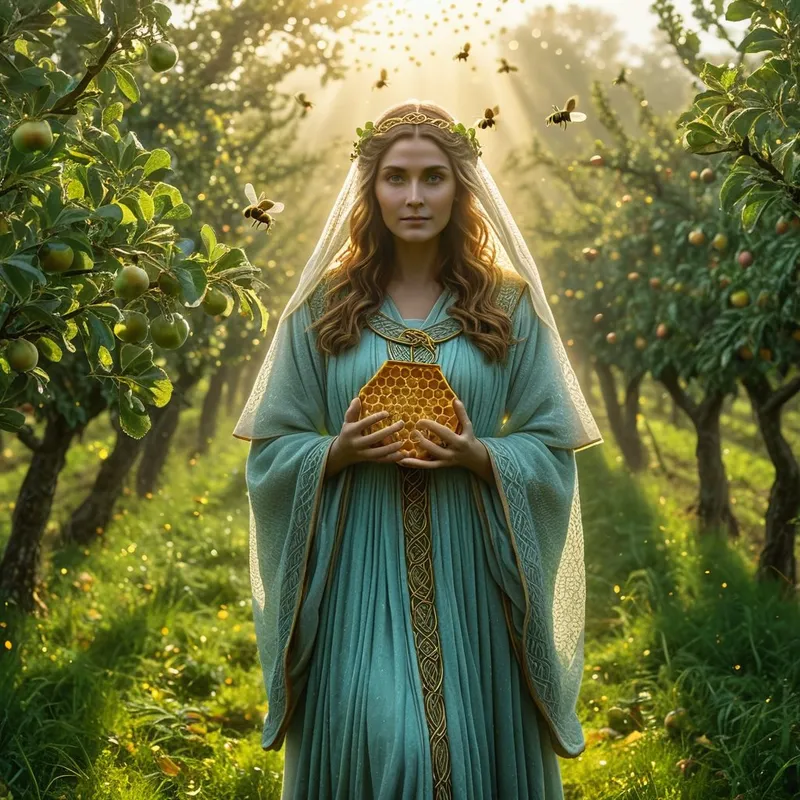
Listen now, and let the mist of memory gather. There is an isle that is not an isle, a place that slips between the veils of the world. They call it Avalon. Here, the apple trees bear silver blossoms and fruit of gold, and the air hums with a sacred, perpetual twilight. It is guarded not by warriors with swords, but by women with quiet hands and knowing eyes—the Bee Priestesses.
Their queen is not of flesh, but of wing and industry: the Great Queen Bee, whose hive is carved from the heartwood of the oldest apple tree. The priestesses are her tenders. They do not command; they listen. They move through the orchards barefoot, feeling the song of the roots beneath the soil. Their work is the honey, but not as you know it. This honey is brewed from apple-blossom nectar and starlight dew, collected in cups of polished yew. It is not merely food; it is memory, prophecy, and passage.
The great work of the priestesses is the Guiding. When a soul is torn from its body—by blade, by sickness, or by the slow unraveling of age—it becomes lost in the Otherworld mists, a frightened ghost on forgotten paths. The priestesses receive these souls on the shores of Avalon. They speak no words of comfort, for words are too solid here. Instead, a chosen priestess offers a single drop of the sacred honey upon the soul’s spectral lips.
That drop contains the essence of the sunlit orchard, the drone of the hive, the taste of home and hearth. It anchors the lost one. Then, the priestess leads the soul to a hidden mere, a lake that reflects no sky but the swirling patterns of the Northern Lights. Upon its waters rests a boat of woven willow and beeswax. As the soul steps in, the priestess places a small honeycomb in its hands. “This is your truth,” she whispers. “Burn it as your lantern.”
The soul sets out across the dark water, and as it goes, it begins to eat the honey from the comb. With each taste, a memory flares: not just of life, but of the life within the life—the moment of courage, the pang of love, the silent prayer. These memories become points of light, and the lights form a path across the water, leading to a far shore where the summer land awaits. The priestess watches from the reeds, her task complete, as another soul finds its way home by the taste of its own sweetness, guided by the labour of the bees.

Cultural Origins & Context
The figure of the Bee Priestess is not found in a single, canonical text, but is woven from threads of Celtic myth, later Arthurian romance, and deep-seated apian lore. The concept finds its roots in the veneration of the bee across Indo-European cultures, seen in the Melissa of Greece and the bee oracles of Ephesus. Within the Celtic sphere, bees were considered messengers between this world and the Otherworld, their buzzing a form of sacred speech.
Avalon itself, first appearing in Geoffrey of Monmouth’s Vita Merlini, is a deeply Celtic conception—an Tír na nÓg reinterpreted through a Brythonic lens. The association of powerful, prophetic women with this isle (like Morgan le Fay and her nine sisters) provides the human vessel for the myth. The priestesshood likely evolved from the roles of female druids or seers (ban-druí), who were often linked to healing, prophecy, and the rituals of death. The myth would have been told not as a formal narrative, but as an explanatory tapestry, shared by bards and wise women to illustrate the sacredness of bees, the role of women as psychopomps (soul-guides), and the belief that death was a journey requiring sacred sustenance. Its societal function was to console, to explain the inexplicable transition of death, and to affirm the natural world as an active participant in the soul’s destiny.
Symbolic Architecture
The myth is a profound symbolic map of the soul’s journey through the liminal. The Bee represents the soul itself—communal, industrious, moving between the flower (the material world) and the hive (the spiritual home). Its sting is the pain of truth; its honey, the sweetness of wisdom earned.
The Priestess is the embodiment of the inner guide, the Anima or wise Self that does not interfere but facilitates. She is not the savior; she provides the tool—the honey—that allows the soul to save itself.
The honey is the alchemical gold of lived experience—the transformed essence of life’s fleeting moments into eternal nourishment.
Avalon, the apple isle, is the Self—the integrated, whole state of being. It is both the point of departure and the final destination, the place of healing and wholeness. The journey across the mere is the dark night of the soul, the confrontation with the unconscious. Eating the honeycomb is the act of re-membering—literally putting oneself back together through conscious integration of one’s own story.
The Dreamer’s Resonance
When this myth stirs in the modern dreamer, it often signals a profound process of psychic navigation. To dream of bees swarming in a calm, purposeful manner may indicate the unconscious organizing itself around a central, nourishing truth. Dreaming of a silent, guiding woman in a misty landscape often appears during life transitions—not just physical death, but the death of an identity, a career, or a relationship.
The somatic experience can be a feeling of humming vibration in the body, or a tangible taste of sweetness upon waking. Psychologically, the dreamer is in the boat on the mere. They are being called to consume their own “honey”—to consciously ingest and integrate their past experiences, especially those coated in pain or shame, to find the nourishment hidden within. The dream is an assurance that guidance is present, not as an external rescuer, but as an inner priestess who offers the means for self-guidance. Resistance to this process might manifest as dreams of sticky, suffocating honey or aggressive bees—the shadow side of the myth where the sweetness feels cloying and the truth feels like an attack.

Alchemical Translation
The alchemical process modeled here is the transmutation of experience into essence. In the vessel of one’s life (the hive), the raw, fleeting events (the nectar) are gathered. Through the often-dark, fermenting work of introspection (the hidden work in the comb), facilitated by the inner guide (the priestess), this raw material is transformed into a stable, golden substance: personal wisdom and integrity.
The modern individual’s “Avalon” is a state of achieved inner peace and self-knowledge. The “Guiding” ritual is the daily practice of shadow work—meeting the lost, fragmented, or traumatized parts of oneself (the lost souls) and offering them the honey of compassion and witness. By tasting and integrating these parts, we light our own path across the internal unknown.
The ultimate triumph is not arrival at a foreign shore, but the realization that the boat, the honey, the water, and the shore are all contained within the hive of the Self.
The Bee Priestess does not lead us out of ourselves, but deeper in. Her myth teaches that our most sacred duty is to tend the inner hive, to transform the chaos of living into the ordered, nourishing sweetness that can guide us through any darkness, proving that the soul’s wisest keeper and most skilled alchemist resides within.
Associated Symbols
Explore related symbols from the CaleaDream lexicon: