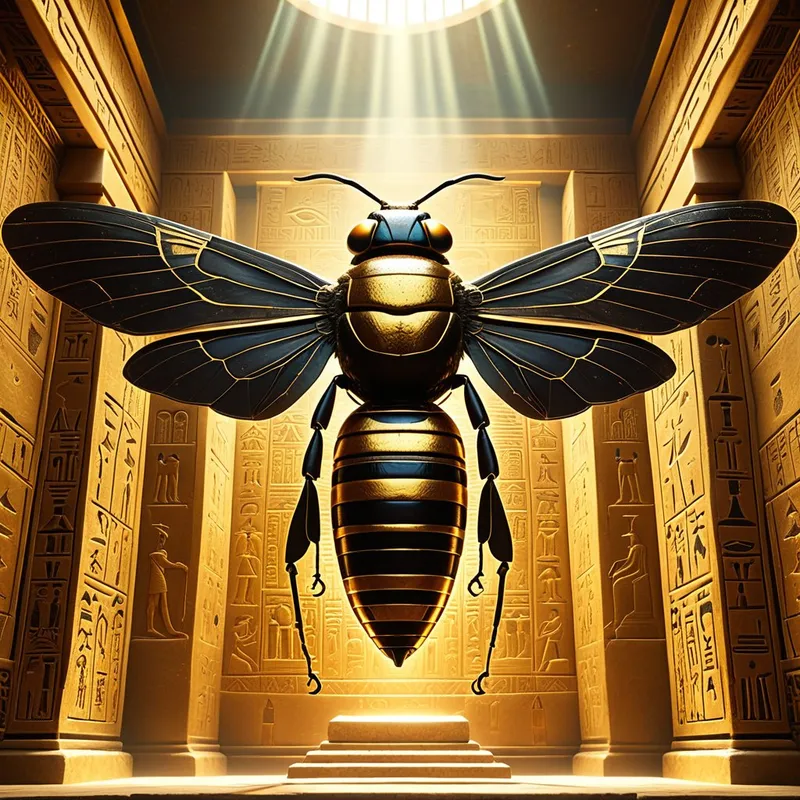
Bee Hieroglyph Myth Meaning & Symbolism
A myth of the first bee, born from the tears of a rebellious sun god, whose sting brings order and whose honey heals the divided world.
The Tale of Bee Hieroglyph
Before the first sunrise hardened into day, when the world was a broth of potential, a silence fell in the Hall of Ma'at. Ra, he whose brow bore the sun, sat upon his throne of light, and his gaze was heavy. He had spoken the world into being, but the sound of his voice still echoed in the formless deep, creating and uncreating in ripples of chaos. Things had names, but they did not know their places. The green shoot did not know to seek the soil, the river did not know its banks.
A murmur arose, not from the gods, but from the stuff of creation itself—a dissonant hum of un-belonging. It was the sound of possibility without purpose. Thoth, with his ibis head bent over a tablet of stars, heard it. Maat herself felt her feather tremble.
Then, from the heart of this dissonance, came a defiance. It was a new sound, a sharp, insistent buzz that cut through the murmur. It was the sound of pure, undirected will. It had no name, this vibration that stung the ears of the gods. It circled the pillars of the hall, a tiny, furious shadow against the glow of Ra’s aura. It was the first rebellion—not of a god, but of an idea that had escaped its conceptual womb too soon: the idea of separate industry.
Ra’s eye, the terrible Eye of Ra, followed its path. His anger was not hot, but cold and precise, the anger of a master architect seeing a line drawn awry. With a thought, he stilled the air. The buzzing thing fell to the alabaster floor, its wings stilled, its form revealed: a creature of dark, polished armor, with a needle of light at its tail.
The silence returned, thicker now. The fate of this first, flawed vibration hung in the balance. Would Ra un-speak it, dissolving it back into the silent broth? He raised a hand, and the gods held their breath.
But then, a miracle. From the corner of Ra’s solar eye, a single tear welled and fell. It was not a tear of sorrow, but of profound, creative strain—the strain of holding infinite possibility in a finite form. The golden droplet fell through the still air and landed upon the fallen creature.
Where it touched, the dark armor gleamed with gold. The stilled wings began to beat, not with chaotic fury, but with a rhythm as regular as a heartbeat. The creature rose. And from its mouth, it did not release a buzz, but a drop of liquid sunlight—thick, fragrant, and sweet. The scent of honey filled the Hall of Ma’at, a scent none had ever known. It was the smell of chaos, transformed. It was the smell of work, made sacred.
Ra spoke, and his voice was the sound of a hive humming in perfect accord. “You are bit,” he declared. “You are the sting that teaches boundaries, and the honey that heals them. Your flight shall be the pattern, your comb the measure, and your labor the prayer that binds the wild earth to my ordered sky.” And so, the first hieroglyph was etched not on stone, but on the very soul of creation: the sign of the bee, the mark of the maker who transmutes the raw nectar of chaos into the golden order of the hive.

Cultural Origins & Context
The bee, as <abbr title="The Egyptian word for 'bee', also a symbol of kingship">bit</abbr>, held a place of profound practical and symbolic significance in ancient Egypt. While a singular, canonical "myth of the bee hieroglyph" as narrated above is a poetic synthesis, its elements are deeply rooted in attested cultural beliefs. The bee hieroglyph itself (𓆤) was used in the royal titulary, most famously in the nswt-bjt title, "He of the Sedge and the Bee," symbolizing the king's rule over both Upper and Lower Egypt. The sedge represented the papyrus of the North, the bee the fertile, industrious lands of the South.
This association with kingship tied the bee directly to the sun god Ra. Bees were seen as tears of Ra, as recorded in later temple texts and natural histories, born from the sun and thus possessing a solar essence. Their honey was "the sweat of Ra," a divine, medicinal, and preservative substance. The mythic narrative functioned not as a single story told in temples, but as a living symbolic complex passed down through iconography, ritual, and the daily reality of apiculture. It explained the origin of a core civilizing principle: the ability to impose fruitful, sweet order (<abbr title="The principle of cosmic order, truth, and justice">Ma'at</abbr>) on the fertile but potentially chaotic bounty of the land (<abbr title="The concept of chaos, disorder, and the undifferentiated">Isfet</abbr>). The beekeepers were practitioners of a sacred craft, and the Pharaoh was the master beekeeper of the nation.
Symbolic Architecture
At its core, the Bee Hieroglyph myth is an allegory for the emergence of consciousness from the unconscious, and of culture from nature. The initial, chaotic buzz is the raw, undifferentiated energy of the psyche—pure potential, but also pure agitation. It is the id, the drive without direction.
The sting is the necessary pain of individuation; the honey is the earned sweetness of a coherent self.
The <abbr title="The supreme sun god and creator">Ra</abbr> figure represents the organizing principle of the conscious ego, the "I" that seeks to bring order. His initial anger is the ego's resistance to the unruly contents of the unconscious. The golden tear is the critical moment of recognition and integration. It is not an act of destruction, but of alchemical transmutation. The ego, strained by the effort of self-creation, sheds a part of its own substance to redeem and transform the rebellious element.
The resulting bee is the symbol of the <abbr title="A term coined by Carl Jung for the transcendent function that unites opposites">transcendent function</abbr>. It is a psychopomp that navigates between opposites: between the wild flowers (the unordered world of instinct and feeling) and the structured hive (the ordered world of the persona and society). Its sting defends the integrity of the self's boundaries; its honey nourishes and heals the community. The hexagonal comb becomes a mandala—a symbol of cosmic and psychic order emerging from a collective, instinctual process.
The Dreamer's Resonance
To dream of bees, particularly in the context of Egyptian symbolism or hieroglyphs, signals a profound process underway in the dreamer's psyche. It is rarely a gentle dream. One may dream of a single, large bee entering a quiet room—the intrusive buzz of a new idea, a duty, or a creative impulse that demands attention. One may dream of being stung, often on the hand or tongue—the painful but necessary consequence of overstepping a boundary, either one's own or another's, or of speaking a truth that "stings."
More complex is the dream of the hive. To stand before a massive, humming hive, feeling both awe and dread, is to confront the immense, organized complexity of one's own unconscious or social world. Are you the beekeeper, in respectful control? Or are you an intruder, about to be swarmed by neglected responsibilities or collective anger? Dreaming of tasting honey, especially honey that glows or is impossibly sweet, points to the integration of a shadow aspect. It is the somatic experience of a hard-won psychological reward—the sweetness that comes after the labor of confronting chaos within oneself. The body in such dreams may feel a resonant hum, a vibration of creative energy being harnessed.
Alchemical Translation
The myth models the individuation journey with stark elegance. We all begin with the chaotic "buzz"—the swarm of potentials, anxieties, talents, and drives that constitute our unlived life. The modern ego, like Ra, often tries to silence or repress this buzz, leading to stagnation or neurosis.
The alchemical work begins with the "golden tear": the conscious, often painful, act of paying attention. It is the ego sacrificing its illusion of total control to engage with the rebellious material. This engagement is the sting—it hurts to face our shadow, to own our aggression, to channel our wild creativity into disciplined form.
The hive is the newly ordered psyche, where once-chaotic elements now work in service of a golden, nourishing whole.
The final stage is the production of "honey." This is the <abbr title="A term coined by Carl Jung for the process of integrating the conscious and unconscious to become a whole, individual self">individuation</abbr> itself made manifest. It is the book written from inner turmoil, the compassion forged from processed pain, the stable relationship built after understanding one's own patterns, the work of art that feeds others. The bee hieroglyph, therefore, is not just a symbol of kingship, but of every individual's sovereignty. It reminds us that our task is not to eliminate the wild buzz of our nature, but to become the sacred alchemist who, through the disciplined, communal labor of the soul, transforms it into something that sustains and sweetens the world.
Associated Symbols
Explore related symbols from the CaleaDream lexicon: