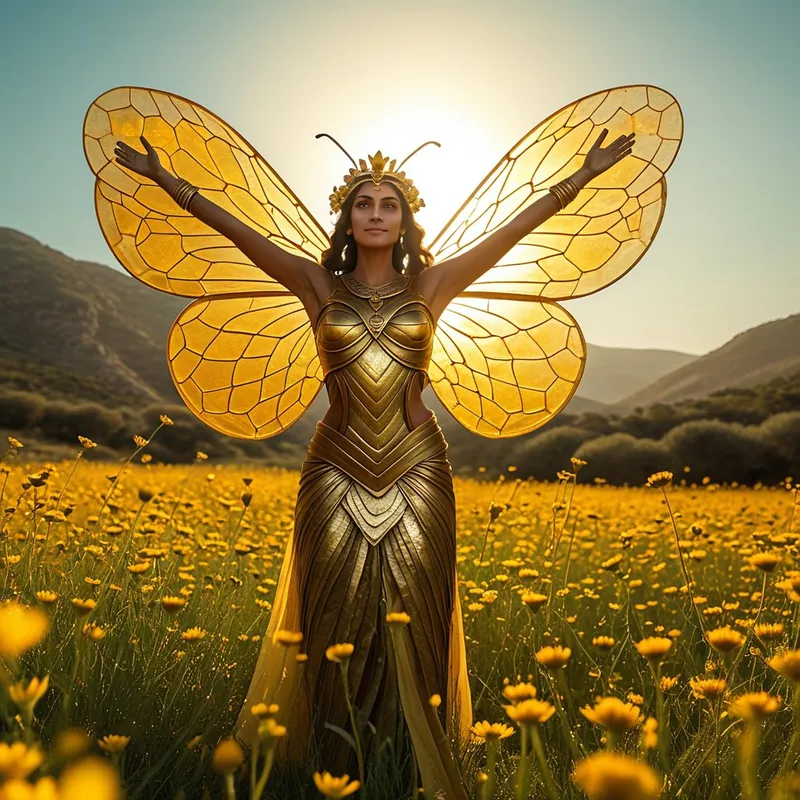
Bee Goddesses Myth Meaning & Symbolism
Ancient goddesses of the hive embody sacred order, divine sweetness, and the alchemy of transforming primal chaos into nourishing gold.
The Tale of Bee Goddesses
Listen. Before the clamor of empires, in the sun-baked hills of a land kissed by a wine-dark sea, the world hummed with a different music. It was the song of the golden ones, the messengers between the world of flowers and the world of gods. And she who heard their song, who understood the secret geometry of their dance, was the Lady of the Hive.
In the palace of Minos, where the labyrinth coiled in the earth’s belly, there was another, older sanctuary. Not of stone, but of woven straw and sacred intention. Here, the air was thick with the scent of thyme and orange blossom, carried on the wings of countless bees. The priestesses moved in silence, their bare feet on cool clay, their linen robes the color of cream. They were the keepers of the mystery, the attendants of the Potnia Theron, the Mistress of Animals, who in this place wore the form of the Bee.
Her image was small, cast in gold that caught the flicker of oil lamps: a woman’s body, slender and strong, her arms raised to the sky or crossed over her chest. From her head rose a delicate crown, not of jewels, but of the perfect, hexagonal cells of the honeycomb. Sometimes, she held in her hands the very symbols of her power: a golden honeycomb in one, a small, sacred bee in the other.
The myth was not told in a single epic, but lived in the ritual. It was the story of the Melissae, the bee-nymphs. They were the first to learn the secret. They followed the wild swarm into the cleft of a sacred mountain, a place where the earth breathed. There, in the darkness, the chaos of the swarm began to build. From a buzzing, formless cloud emerged a perfect, growing city of wax. Each cell a chamber of potential, each wall a marvel of natural engineering. This was the first act of creation: the imposition of divine, geometric order onto the fertile chaos of life.
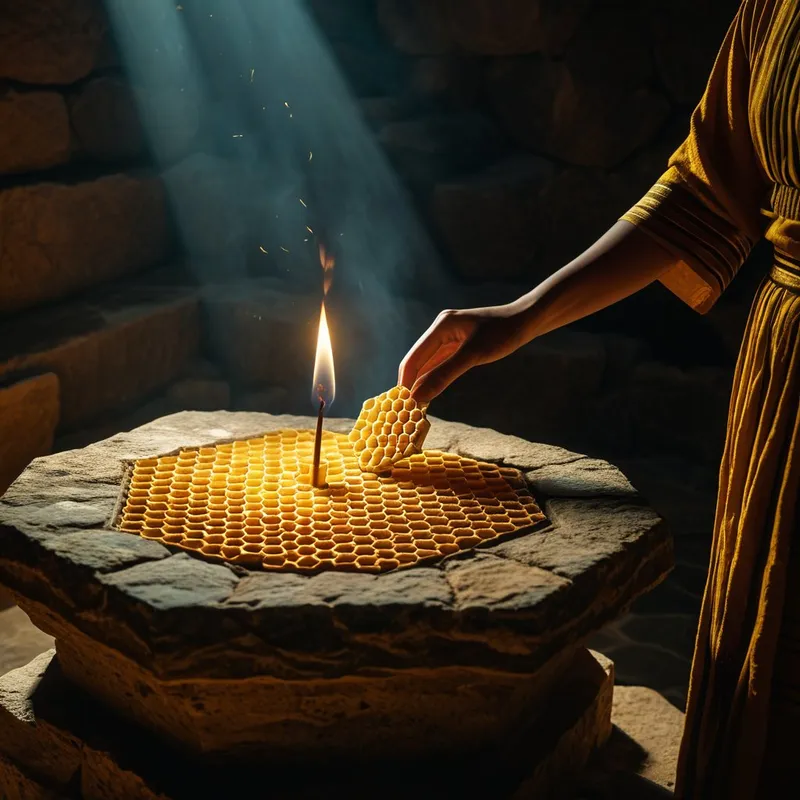
The priestesses, the human melissae, re-enacted this divine ordering. They would dance, their movements mimicking the waggle dance of the scouts, tracing paths to unseen meadows of plenty. They would chant, their voices a low hum that vibrated in the chest, calling the swarm. And they would receive the gift: the amber gold, the thickened sunlight, the nectar of the gods. This honey was not mere food. It was the distilled essence of a thousand flowers, transformed by the alchemy of the hive. It was offered to the gods, used to sweeten the lips of oracles, and given to the dead as sustenance for their journey into the dark.
The tale reaches its crescendo not in battle, but in a silent, collective act of making. The goddess, through her winged servants, teaches the people the covenant: tend the chaos with reverence, guide the wild swarm, and you shall partake in the sweetness of a world made sacred by order. The resolution is the full hive, humming with purpose, and the dripping honeycomb held aloft in the temple—a testament that the divine is not only in the thunderbolt, but in the patient, industrious conversion of the raw, blooming world into nourishing gold.
Cultural Origins & Context
The veneration of bee goddesses is a thread woven through the tapestry of several ancient Mediterranean and Near Eastern cultures, most prominently the Minoan civilization of Bronze Age Crete (circa 2700–1100 BCE). The archaeological record provides our primary testimony: exquisite gold pendants from the Chrysolakkos necropolis at Malia depicting a bee or a stylized figure with a bee-like body, and seal stones showing human figures in close communion with bees.
This was not a myth confined to a single sacred text, but a living folk tradition and cult practice deeply integrated into the agricultural and spiritual cycles. The goddess—whether called The Great Mother, Potnia, or later associated with Artemis of Ephesus (whose priests were called "Essenes," or drones)—presided over the natural world’s fertility. The hive was a microcosm of the ideal society: industrious, hierarchical, matrifocal, and perfectly organized for the survival and prosperity of the whole.
The myth was passed down through the women who served as priestesses, the melissae. Their knowledge was practical and sacred—the art of beekeeping (apiculture) was a mystery religion in itself, requiring careful observation, ritual cleanliness, and a respectful relationship with the often-dangerous swarm. The myth functioned as a societal blueprint, reinforcing values of communal labor, female authority in domains of nature and sustenance, and the sacred duty to transform the wild into the cultivated without destroying its vital essence.
Symbolic Architecture
The bee goddess myth is a profound symbolic system built on the architecture of the hive.
The Hive represents the psyche itself—a dark, protected interior where the raw materials of experience (pollen/nectar) are gathered, stored, and transmuted. Its hexagonal cells are symbols of natural efficiency, communal interdependence, and the hidden, crystalline order underlying apparent chaos.
The Honey is the ultimate symbol of alchemical success. It is sunlight made liquid, experience distilled into wisdom, suffering transformed into sweetness. It represents the treasure hard to attain, the nourishing product of sustained, collective inner work.
The Swarm embodies the primal, undifferentiated energy of life—potentially destructive in its chaotic frenzy, yet containing the seed of a new order. It is the unformed potential of the unconscious before it is engaged by the organizing principle of consciousness (the queen/priestess/goddess).
The journey from swarm to hive to honey is the soul’s journey from chaos to structure to enlightenment. The sting is the necessary price of guarding this sacred process.
The Bee Goddess herself is the archetype of the anima as ordering principle. She is not a warrior but an architect and a chemist. She presides over the mysterious process of conversion, teaching that true power lies not in domination, but in the patient, intelligent guidance of nature’s own laws towards a state of fertile, golden abundance.
The Dreamer's Resonance
When the motif of the bee goddess or the hive emerges in modern dreams, it signals a profound somatic and psychological process underway. It is rarely a gentle symbol.
Dreaming of a swarm may indicate a feeling of being overwhelmed by buzzing thoughts, chaotic emotions, or unintegrated aspects of the self. The psyche is in a state of fertile but frightening agitation, seeking a new center, a new "queen" to organize it.
Dreaming of entering a hive suggests a deep dive into the structured depths of one’s own psyche. The dreamer is ready to confront the intricate, sometimes claustrophobic, architecture of their habits, memories, and inherited patterns (the honeycomb). There may be a fear of being "stung" by painful truths.
Dreaming of tasting or gathering honey is a profoundly positive sign. It indicates that a period of difficult inner work is yielding its nourishing results—a new insight, a sense of psychic integration, or the sweet taste of hard-won emotional or creative fulfillment. The body itself may feel a resonant hum of vitality, a somatic echo of the hive’s productive harmony.

Alchemical Translation
For the modern individual navigating the chaos of life, the bee goddess myth provides a potent model for psychic transmutation, or individuation.
The First Stage (Nigredo) is the swarm: the raw, undifferentiated mass of our impulses, traumas, potentials, and distractions. It is the buzzing anxiety, the creative block, the midlife crisis—the feeling of being a chaotic cloud with no center. The alchemical work begins not by fighting the swarm, but by calling it. One must acknowledge the chaos within.
The Second Stage (Albedo) is the construction of the hive: the establishment of a conscious container. This is the practice of ritual, routine, therapy, meditation, or creative discipline—the hexagonal cells of daily order that give structure to the buzzing energy. The "queen" in this stage is the emerging, centered Self, the organizing principle that decides where the energy will be directed. It is the commitment to the patient, often repetitive work of building a coherent inner life.
The alchemy occurs in the darkness of the hive, where the raw nectar of experience is broken down and reconstituted by enzymes of reflection and time.
The Final Stage (Rubedo/Citrinitas) is the production of honey: the golden result. The chaotic emotional pain (nectar) is digested by the psyche and transformed into compassionate wisdom (honey). The frantic energy of ambition is distilled into the sustained sweetness of purpose. The individual no longer is the swarm; they have become the steward of the hive, capable of producing a nourishing golden substance that sustains not only themselves but can be offered to their community. The sting—the pain, the sacrifice, the disciplined guard—is understood not as a flaw, but as an essential, sacred defense of this hard-won inner sanctum and its precious yield. One becomes, in essence, a human hive: a complex, humming, productive organism that has mastered the sacred industry of turning the blooming, fleeting world into enduring, nourishing gold.
Associated Symbols
Explore related symbols from the CaleaDream lexicon: