
Bear Medicine Myth Meaning & Symbolism
A myth of a hunter who enters the bear's den, learns its sacred healing ways, and emerges forever changed by the power of introspection.
The Tale of Bear Medicine
Listen. In the time before memory, when the world was a cloak of whispering pines and the rivers sang their ancient songs, there lived a hunter. He was a good man, strong and swift, but his heart carried a hollow ache. His people were sick, a wasting shadow clinging to their bones, and no herb, no prayer he knew could lift it. Despair was a cold stone in his belly.
One bitter winter, driven by a grief sharper than the wind, he tracked a great Bear—not for meat or glory, but for a sign. The trail led deep into the mountains, to a place where the cliffs frowned and the shadows grew long. There, beneath the gnarled roots of a lightning-struck pine, was the dark mouth of the bear's den. The scent of earth, sleep, and wild power flowed from it like a breath.
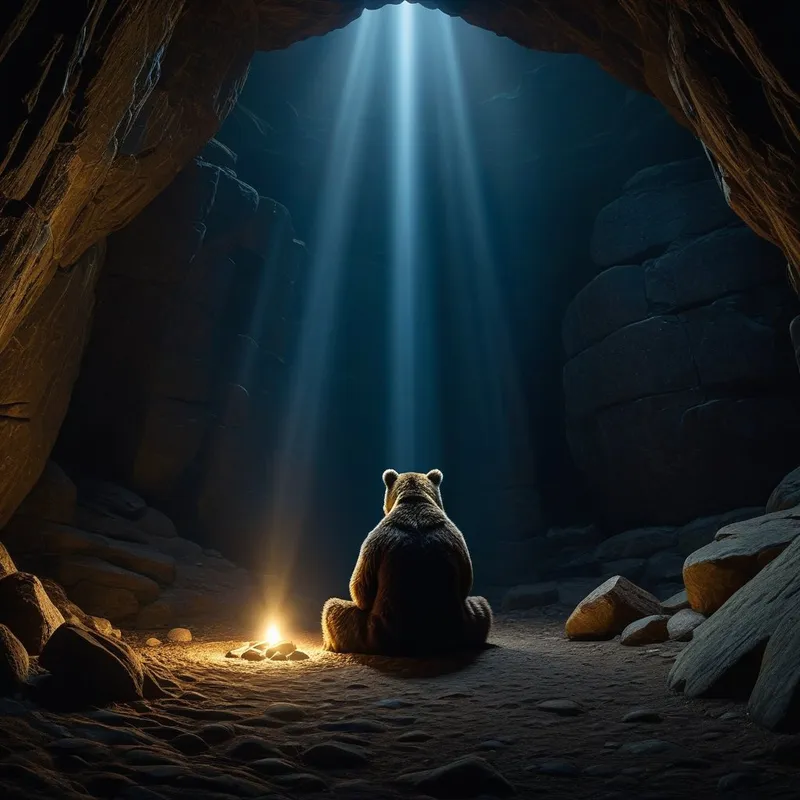
The hunter knew the law: to enter a bear's den was to invite death. But the stone of despair weighed heavier than fear. He left his bow, his knife, all his weapons at the threshold—a surrender. On hands and knees, he crawled into the profound darkness. The air was thick and warm, smelling of damp fur and deep sleep. In the black heart of the earth, he found her: the great She-Bear, a mountain of living shadow, her eyes two pools of ancient, patient knowledge.
He expected fury, the final blow. Instead, a low rumble filled the space, not a growl, but a language older than words. It vibrated in his bones. "You have come unarmed," the rumble seemed to say. "You have come seeking. Now you must learn to be still." And so began his long vigil in the womb of the earth. Time lost its meaning. The world outside—the wind, the sun, the cries of his people—faded to a distant murmur.
In that sacred darkness, the She-Bear taught him. She showed him, in dreams that were not dreams, the secret places where healing roots slept. She breathed the knowledge of which bark could break a fever, which leaf could mend a wound, which berry could strengthen a fading spirit. She taught him the medicine of sleep, of hibernation—the alchemy of turning inwards to gather strength. She showed him that true power was not in the chase, but in the profound, regenerative silence of the den.
When the first scent of thawing earth finally seeped into the den, the hunter knew it was time. He emerged, blinking, into the light. He was a man transformed, not just in knowledge, but in essence. He carried the bear's quiet strength in his posture, her grounded wisdom in his eyes. He returned to his people with the Bear Medicine, and with it, he healed them. But he was forever different. Each winter, they would say, a part of him would return to the stillness, to the deep introspection of the den, to remember.
Cultural Origins & Context
The story of Bear Medicine is not a single, fixed tale but a powerful, recurring pattern found across many Native American nations, from the Iroquois and Lakota to the peoples of the Pacific Northwest. It belongs to the rich corpus of origin myths and land-based teachings.
Traditionally, these stories were not mere entertainment; they were functional, pedagogical, and sacred. Elders and medicine people would recount them to transmit essential survival knowledge—the identification and use of medicinal plants—within a spiritual and ethical framework. The myth encoded the proper, respectful relationship between humans and the powerful bear, an animal revered for its strength, solitude, and cyclical disappearance and return. It served as a societal reminder that profound knowledge often requires a high cost (surrender, solitude) and must be approached with humility and reverence, never dominion.
Symbolic Architecture
At its core, the myth maps a profound psychological and spiritual initiation. The hunter represents the conscious ego, skilled in the outer world but helpless before an inner or collective sickness—a crisis of meaning, a spiritual malaise.
The den is the vas hermeticum of the soul, the sacred space of the unconscious where all transformation must occur.
The act of leaving his weapons is the critical first step in any deep work: the surrender of the ego's defenses, its need for control and aggression. The She-Bear is the embodiment of the instinctual Anima or the Magna Mater, but in a specifically grounded, non-human form. She is the wisdom of the body, the deep, cyclical intelligence of nature itself, which can only be accessed in a state of receptive stillness. Her medicine is not just herbal lore; it is the knowledge of rhythms—when to act and, more importantly, when to retreat, digest, and heal.

The Dreamer's Resonance
When this myth stirs in the modern psyche, it often manifests in dreams of entering caves, basements, or other subterranean spaces. One might dream of encountering a bear that is not threatening but profoundly calm and present, or of finding oneself in a forced, peaceful hibernation.
Somatically, this points to a psyche that is overwhelmed by external demands—the constant "chase" of modern life. The body-mind is signaling a critical need for withdrawal. This is not depression in the pathological sense, but what analyst Carl Jung might call a necessary enantiodromia—a swing toward the opposite pole. The dreamer is undergoing a process of psychic consolidation. The "illness" to be healed is often a fragmentation of the self, a burnout, or a loss of instinctual connection. The bear in the dream is the Self, the total, integrated psyche, calling the ego into the den of introspection to be re-made.
Alchemical Translation
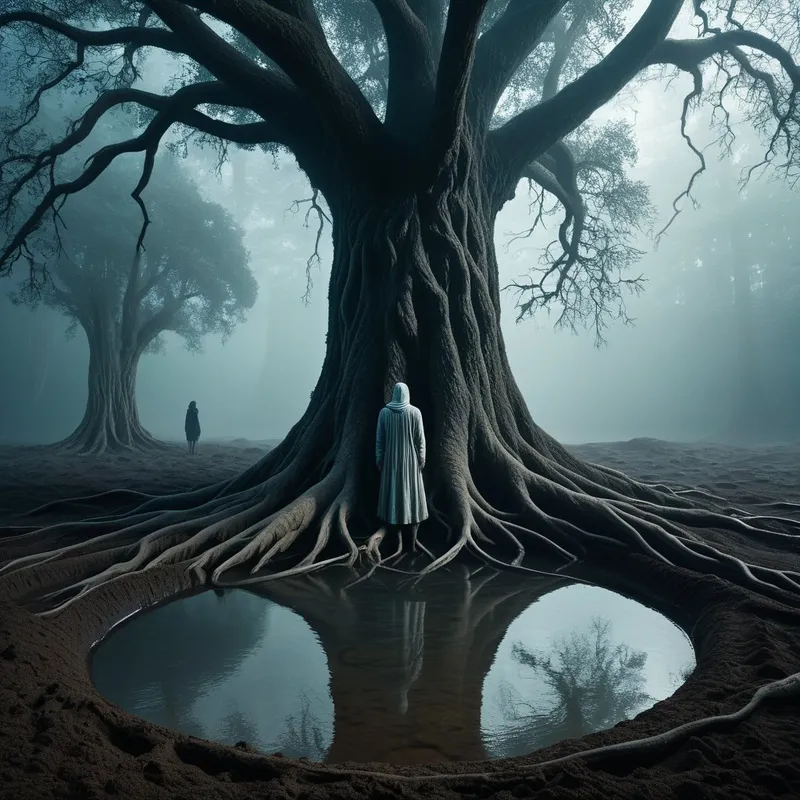
The myth of Bear Medicine is a perfect allegory for the individuation process. The hunter's journey is the ego's reluctant descent into the unconscious (nigredo—the blackening, the descent into the dark den).
The long vigil in the stillness is the ablutio and albedo, where old identities are dissolved in the dark and new understanding slowly dawns.
The medicine learned is not an intellectual prize, but a symbolic citrinitas, the integration of soulful wisdom into the personality. Finally, the return to the village with healing power represents the rubedo—the reddening, the conscious embodiment of the transformed Self in the world.
For the modern individual, this translates directly. Our "weapons" are our relentless productivity, our curated personas, our avoidance of silence. The myth instructs us that to heal our modern sicknesses of disconnection and anxiety, we must consciously, willingly, enter our own "den." This is a disciplined retreat: turning off the noise, engaging in deep reflection, journaling, or somatic practices that listen to the body's wisdom. It is in that fertile darkness that we receive our own unique "Bear Medicine"—the innate, instinctual knowledge of how to heal ourselves and, in turn, offer grounded wisdom to our communities. We learn that power is cyclical, that true strength requires periods of regenerative solitude, and that the deepest healing always begins with a courageous surrender.
Associated Symbols
Explore related symbols from the CaleaDream lexicon: