
Bawang Merah Bawang Putih Myth Meaning & Symbolism
A tale of a gentle stepdaughter, a magical fish, and a cruel stepsister, revealing the soul's journey through injustice to grace and profound transformation.
The Tale of Bawang Merah Bawang Putih
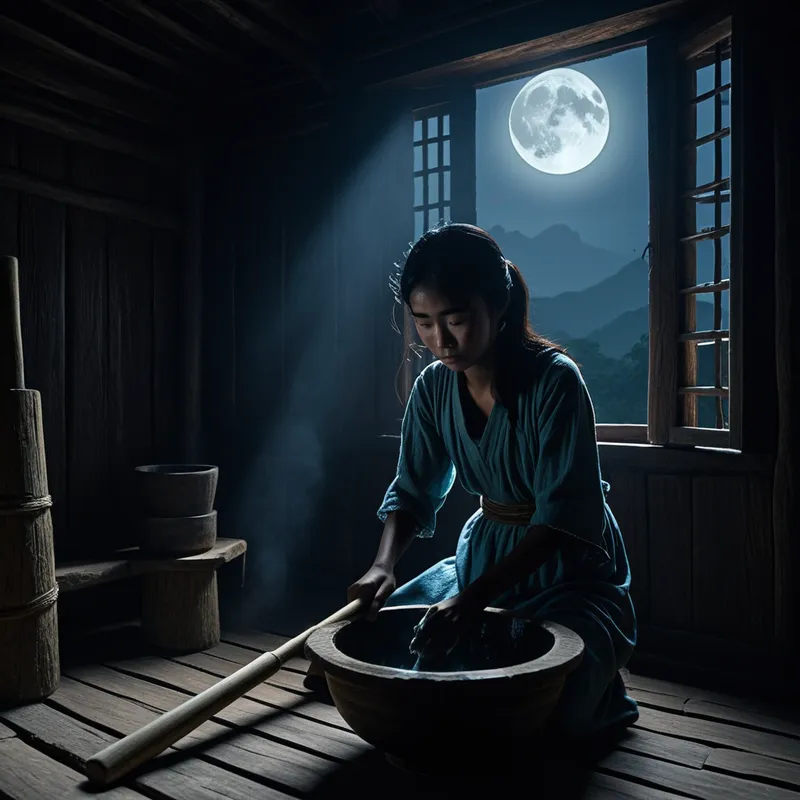
Listen, and let the tale settle in the heart’s quiet place. There was once a widower, his heart a hollow gourd, who took a new wife. This woman brought with her a daughter, Bawang Merah. The man’s own daughter, a girl of a spirit as clear and gentle as morning dew, was named Bawang Putih. But with the new wife came a cold wind. The stepmother’s love flowed only to her own blood, and Bawang Putih became a shadow in her own home, a servant to her stepsister’s whims.
Her days were a tapestry of endless labor, her hands raw from scrubbing, her back bent under burdens. Yet, in her heart, no bitterness took root. One day, while washing clothes in the river’s embrace, the current stole her stepmother’s precious sarong. Desperate, Bawang Putih plunged into the water, chasing the silken ghost downstream until she came upon a sight that stilled her breath: an old woman, wise and weathered as ancient stone, holding the lost garment.
“I have your sarong, child,” the crone said, her voice like rustling leaves. “But you must serve me for three days. Clean my house, cook my meals, and do not look into the back room.” Bawang Putih agreed. For three days she worked with diligent grace, resisting the gnawing curiosity about the forbidden door. Pleased with her virtue, the old woman offered her a reward: two pumpkins, one large and one small. “Choose,” she said. The humble girl took the small one.
Returning home, the small pumpkin was met with scorn. But when Bawang Putih opened it, a miracle spilled forth: jewels and gold coins, a river of light upon the dirt floor. Seeing this, the covetous stepmother commanded her own daughter, Bawang Merah, to seek the same fortune. Bawang Merah went to the river, threw in a sarong deliberately, and found the old woman. But her service was grudging, her mind consumed by greed. She could not resist; she peeked into the forbidden room. On the third day, the disappointed old woman still offered the choice. Bawang Merah, of course, seized the largest pumpkin.
Triumphant, she returned home. But when the great pumpkin was split open, no treasure emerged. Instead, a seething swarm of stinging insects and snakes poured out, a manifestation of the venom within her own heart, bringing chaos and ruin upon the household. And from that day, Bawang Putih, her spirit tempered by suffering and her heart proven pure, lived in peace and abundance, her innocence not lost, but crowned.
Cultural Origins & Context
This story is one of the most cherished and widespread folktales in the Indonesian archipelago, with variations found from Sumatra to Java and beyond. It belongs not to the realm of written epics or court literature, but to the vibrant oral tradition of the dongeng (folktale), told by grandmothers at dusk, by village storytellers under banyan trees, and passed between generations as a shared moral inheritance. Its function was deeply pedagogical, woven into the fabric of community life to teach children about filial piety, humility, the dangers of envy (iri hati), and the ultimate, almost karmic, justice that rewards good character. The tale is a classic "Cinderella" variant, but its soul is distinctly Nusantaran, rooted in an animist-hued worldview where rivers have spirits, old women in the forest are keepers of magic, and the natural world actively participates in moral reckoning. It reinforces a core societal belief: that integrity, even in the face of profound injustice, is a spiritual currency that the universe itself recognizes and rewards.
Symbolic Architecture
At its core, the myth is a stark map of the psyche’s inner family. Bawang Putih and Bawang Merah are not just stepsisters; they are two potential orientations of the same soul. Bawang Putih embodies the Divine Child and the Innocent, operating from a place of intrinsic worth and connection to a deeper, natural order. Her labor is not merely servitude; it is an ascesis, a purification through action.
The true treasure is not found in the pumpkin, but forged in the river of tears and the steadfast refusal to let the heart become a stone.
The stepmother and Bawang Merah together constitute the Shadow—the complex of envy, greed, and familial betrayal that must be encountered and endured. The old woman by the river is the Crone or the Great Mother in her testing aspect. She is the threshold guardian of the unconscious. The river itself is the flow of life and fate, while the forbidden room represents the temptation of premature knowledge—the desire to shortcut the process of maturation and seize power (the treasure) without the necessary inner development.
The Dreamer's Resonance
When this myth stirs in modern dreams, it often signals a profound somatic and psychological process of navigating unjust dynamics and reclaiming one's intrinsic value. Dreaming of endless, futile chores may point to a life situation—a job, a relationship, a family role—where one feels exploited and unseen, their labor and spirit taken for granted. The figure of the cruel stepmother may manifest as a boss, a partner, or even an internalized critical voice that withholds love and approval.
To dream of the river and the old woman is a potent sign of the psyche initiating its own healing. It suggests the dreamer is being called to a deeper engagement with their own process, to perform the "three days of service"—a period of intentional, perhaps difficult, inner work (therapy, reflection, creative practice) with patience and faith, without demanding to see the immediate results (the "back room"). The appearance of the pumpkins in a dream asks the crucial question: which aspect of the self is choosing? The small, humble pumpkin of authentic, hard-won growth, or the large, tempting one of quick fixes and egoic gratification that promises treasure but delivers only psychic "snakes"?

Alchemical Translation
The journey of Bawang Putih is a perfect model of psychic alchemy, the individuation process where the base metal of suffering is transmuted into the gold of a cohesive Self. It begins with the nigredo, the blackening: the death of her old life, the immersion in the shadowy dynamics of the step-family. This is a necessary dissolution of naive innocence.
Her service to the old woman is the albedo, the whitening: a purification. By submitting to the task with integrity and respecting the boundaries set (the forbidden room), she demonstrates ego obedience to the deeper Self’s guidance. This is the stage of Bawang Putih becoming truly herself—not through rebellion, but through steadfast, ethical action in alignment with a transpersonal law.
The soul's gold is mined in the dark, quiet chambers of endurance, not in the loud, greedy grasp for glitter.
The final reward is the rubedo, the reddening: the culmination. The small pumpkin bursting with jewels is not a material windfall, but a symbol of the Self’s latent wholeness and richness becoming conscious and available. The treasure was always within; the trials were the pressure needed to crack the shell. Conversely, Bawang Merah’s fate illustrates the catastrophic result of the ego attempting to steal the treasure of the Self without undergoing the transformation. Her pumpkin releases the unintegrated shadow in its raw, chaotic, and destructive form. For the modern individual, the myth instructs: the path to your true inheritance is through humble, patient, and ethical engagement with life’s trials, trusting that the process itself is the goal, and the reward is the emergence of an unshakeable, authentic being.
Associated Symbols
Explore related symbols from the CaleaDream lexicon:
- River — The flowing current of fate, emotion, and the unconscious mind, which carries away the old (the sarong) and leads to the transformative encounter with the deep Self (the old woman).
- Mother — Represented by the cruel stepmother, this symbol signifies the negative mother complex, the archetype of nourishment turned to poison, betrayal, and conditional love within the family sphere.
- Child — Embodied by Bawang Putih, this is the archetype of innate purity, resilience, and potential that must be protected and nurtured through life's harsh trials to reach fulfillment.
- Shadow — The combined force of the stepmother and Bawang Merah, representing the repressed envy, greed, and cruelty that the conscious self must endure and ultimately integrate or overcome.
- Fish — The golden-scaled magic fish often featured in variants of the tale, a numinous creature representing soul guidance, unexpected blessings, and the wisdom that arises from the depths of the unconscious.
- Door — The forbidden door in the old woman's house, symbolizing the boundary between conscious and unconscious knowledge, the temptation of shortcuts, and the importance of disciplined timing in psychic growth.
- Gold — The treasure inside the pumpkin, symbolizing the achieved Self, psychological wholeness, spiritual wealth, and the intrinsic value revealed through the alchemy of suffering and integrity.
- Snake — The venomous creatures released from Bawang Merah's pumpkin, representing the chaotic, destructive, and untransformed aspects of the shadow when they erupt violently into conscious life.
- Servant — The role forced upon Bawang Putih, symbolizing the necessary stage of humility, ego-submission, and dedicated work (ascesis) required for any genuine spiritual or psychological transformation.
- Rebirth — The core arc of the myth, depicting Bawang Putih's journey from a state of oppressed innocence through a symbolic death and purification to a new life of peace and authentic abundance.