Basilisk of Siena Myth Meaning & Symbolism
A medieval Italian city is paralyzed by a mythical serpent's gaze until a lone hero, armed with mirrors, faces the collective terror to restore life.
The Tale of Basilisk of Siena
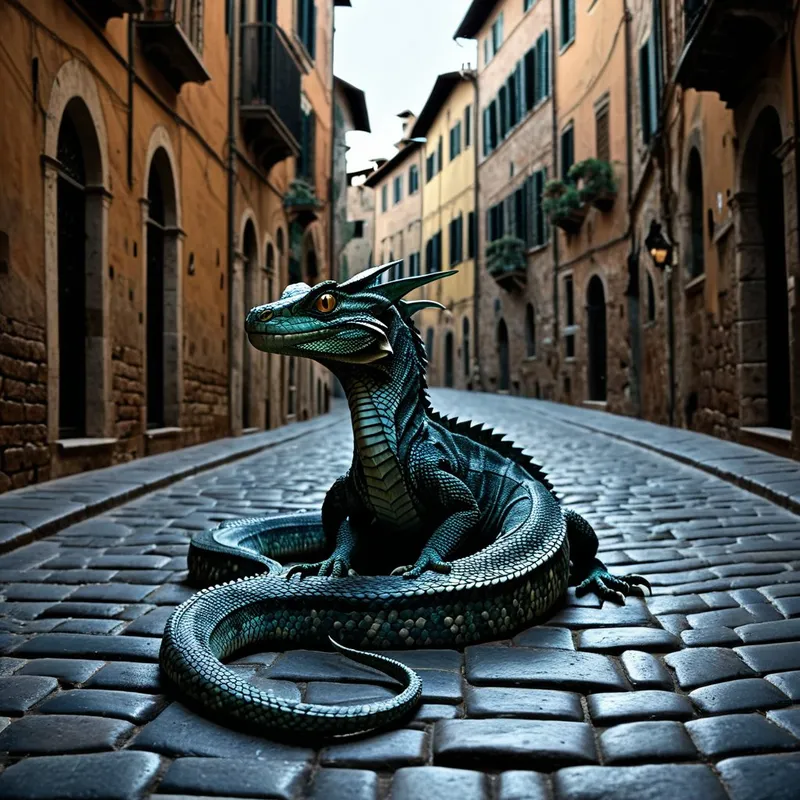
Listen, and hear the tale that crept through the crooked streets of Siena, a whisper carried on the dust of a dying well. In the year when the sun grew weary, a blight fell upon the city. It began in the deep, dark belly of the world, in a cellar beneath the house of a man named Dominico. From a forgotten corner, where damp stone met older earth, a horror was born. Not from an egg laid by a rooster, as some mumbled, but from the very miasma of the place—the condensed foulness of neglect and fear.
It was the Basilisk, the Serpent King. Its body was scaled in the colors of tarnished copper and dried blood. Upon its head sat not a crown of gold, but a crest of bony, pale spikes, a diadem of death. But its true terror was its eyes. To meet that gaze was to be frozen in a final, silent scream; flesh and bone turned to a statue of ash, breath stolen forever.
The plague of petrification spread from that cellar like a silent tide. First, the cats that hunted rats in the alley vanished, found as brittle figurines. Then a curious child, peering into the gloom. Then a guard sent to investigate. The street itself grew still, a corridor of tombs. The city’s heart, the great Piazza del Campo, which once roared with life, fell into a terrified hush. The very air grew thick and stale, tasting of stone dust and despair. The Basilisk did not roam; it festered, its malignant presence poisoning the wellspring of communal life, turning the vibrant city into a necropolis of the living.
The council of wise men wrung their hands. Knights in shining armor deemed the foe unworthy of a noble death—it was a vermin, a devil, not a warrior. The terror was a passive one, a gaze that killed ambition and courage alike. Who could fight a look?
The answer came not from the halls of power, but from the ovens of necessity. A humble baker, a man whose name is lost to all but the myth, stepped forward. He had watched his city starve not for bread, but for courage. He proposed a weapon not of steel, but of sight. He would descend, armed with mirrors polished to a watery brilliance. His plan was not to look upon the beast, but to let the beast look upon itself.
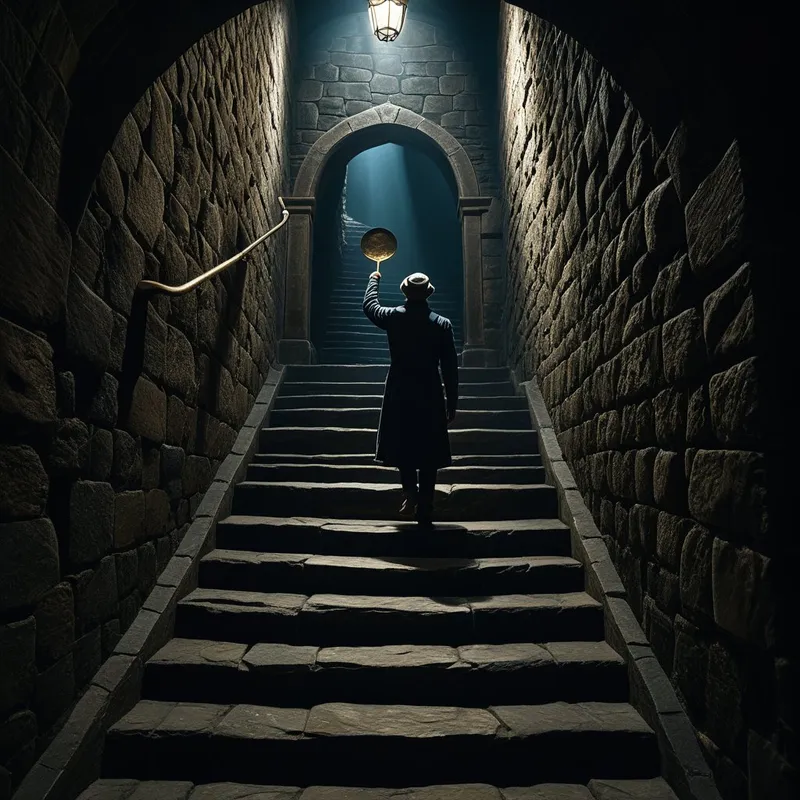
With the prayers of the desperate at his back, he descended the worn stone steps into the cellar’s throat. The darkness was absolute, a physical weight. The only sound was the scuttle of his own fear and a dry, rasping hiss that seemed to come from the walls themselves. He did not search with his eyes. He moved by memory and touch, holding the mirrors before him like a shield, angling them into the blackness.
And then, he saw it—not directly, but in the cold, clear surface of the bronze. Coiled upon a mound of its own desiccated victims, the Basilisk waited. Its head lifted. In the mirror’s depth, their eyes met—the monster’s and its own reflected image. The effect was instantaneous and catastrophic. A sizzling crack, a flash of terrible light reflected back and forth between beast and mirror, between reality and image. The Basilisk, king of serpents, was slain by the one thing it could not withstand: the truth of its own lethal nature. The baker, unharmed but forever changed, emerged into the light. The silent street breathed again. The well, though forever tainted in memory, began to flow.
Cultural Origins & Context
The myth of the Basilisk of Siena is a fascinating artifact of late medieval urban consciousness. Unlike older, rural myths of dragons, this tale is distinctly civic and claustrophobic. It emerges from the walled city-state, a place where public health, social order, and collective survival were paramount. The story was not penned by a single poet but was woven into the city’s chronicles and novelle (short stories), passed down as a cautionary legend and a testament to civic resilience.
Its tellers were likely the citizens themselves—merchants, friars, and guildsmen—using it to explain inexplicable tragedies: a sudden plague, the collapse of a well, a neighborhood struck by mysterious death. The Basilisk became the embodied form of miasma, the unseen pestilence that haunted the medieval mind. Societally, the myth functioned as a narrative container for communal anxiety. It externalized the terror of internal decay, of a corruption born from within the city’s own foundations (literally, a cellar). The hero’s victory was not just over a monster, but over the paralysis of fear that threatened the social body.
Symbolic Architecture
Psychologically, the Basilisk is the perfect emblem of the Shadow made manifest—specifically, the collective shadow. It is not a personal demon, but a shared one, born from the neglected, damp cellar of the group psyche. It represents the toxic, petrifying force of unacknowledged guilt, shame, or secret horror that can freeze an entire community or an individual’s inner life.
The gaze that turns life to stone is the unexamined truth we refuse to see.
The creature’s lair, a cellar, symbolizes the subconscious foundation of the self or society. The hero, the baker, is not a classic warrior but an archetype of the practical, embodied self—the part of us that must nourish and sustain daily life. His tools are profound: mirrors, the ancient symbols of self-reflection, truth, and the reversal of projections. His victory demonstrates a fundamental psychological law: we cannot fight the shadow with direct confrontation (looking it in the eye), for that is to be identified with it and destroyed. We must use the reflective capacity of consciousness to turn the shadow’s own power against itself.
The Dreamer's Resonance
When this myth pattern stirs in modern dreams, it often signals a confrontation with a paralyzing, collective, or inherited fear. The dreamer may find themselves in a familiar place (a childhood home, an office) that has become eerily still, its inhabitants frozen or absent. There is a sense of a pervasive, invisible poison—anxiety about societal collapse, a family curse, or a deep-seated belief that “looking” at a core wound will destroy them.
Somatically, this can feel like a tightening in the chest, a literal stiffness in the body, or a nightmare of being unable to move or scream. Psychologically, the dreamer is at the threshold of the cellar. The process underway is the gathering of the “mirrors”—the tools of self-awareness, therapy, honest conversation, or artistic expression—that will allow them to face the petrifying truth indirectly, by reflecting it, understanding its origin, and thus robbing it of its lethal power.
Alchemical Translation
The alchemical process modeled here is the solve et coagula—dissolve and coagulate—applied to the psyche. The city’s vibrant life (the initial massa confusa) is dissolved into paralysis and stone (the nigredo, the blackening, the descent). The Basilisk is the embodied prima materia of this blackness, the foul but potent substance of collective fear.
The transmutation begins not with attack, but with reflection. The mirror is the vas philosophorum, the vessel where the deadly thing is turned back upon itself.
The baker’s descent is the courageous journey into the putrefactio, the rotting stage necessary for renewal. By introducing the mirror (the principle of consciousness, Mercurius), he creates a feedback loop. The Basilisk’s destructive gaze (unconscious, projected evil) is reflected, recognized as part of the whole, and in that recognition, it is sublimated. The deadly fixedness (the lead) is shattered. The outcome is not a golden treasure, but something more vital: the return of breath, movement, and communal flow—the aqua vitae, the water of life, restored to the well. For the modern individual, this myth maps the path of individuation through confronting the collective shadow. We do not slay it with force, but by mustering the humble, reflective courage to see it for what it is, thereby transforming its petrifying energy back into the fluid stuff of life.
Associated Symbols
Explore related symbols from the CaleaDream lexicon: