Baridegi the Spirit Princess Myth Meaning & Symbolism
A princess descends to the underworld to heal her father, becoming a divine shaman who guides souls, embodying the ultimate journey of filial love and spiritual rebirth.
The Tale of Baridegi the Spirit Princess
Listen, and hear the tale that echoes from the mist-shrouded mountains of the ancient kingdoms. In a time when the world was woven tight with magic, there lived a king, a ruler blessed with power but cursed with a wasting sickness. No physician’s herb, no court ritual could stir him from his bed of agony. His body was a kingdom under siege, his spirit fading like dusk.
He had seven sons, but it was his youngest child, his daughter Baridegi, whose heart was a well of fierce love. Seeing her father’s torment, she went to the sacred altar and prayed until the skies darkened. A voice, thin as wind through reeds, spoke from the void: “Only the water from the Underworld can cleanse this sickness. But the path is for the dead, not the living.”
Without a moment’s hesitation, Baridegi turned her back on the sunlit world. She walked until the colors bled from the land, until the air grew cold and carried the scent of damp stone and forgotten things. She crossed a Bridge that groaned under her living weight, spanning a black River where silent shapes drifted beneath the surface.
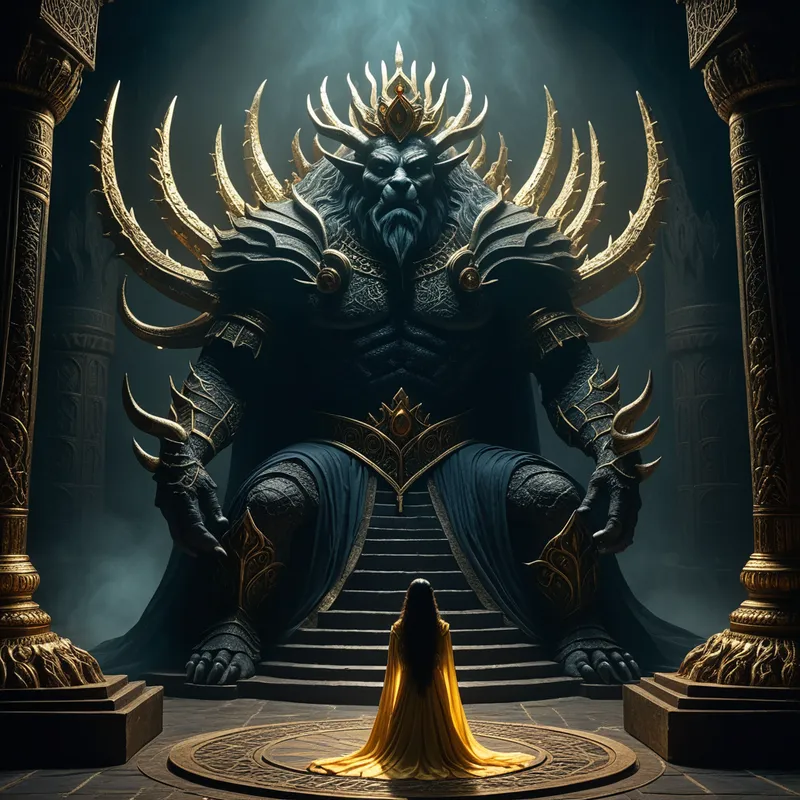
At the gates of the dark realm, she was met by the fearsome King of the Underworld, a being of shadow and immense power. “Why does a child of light trouble my domain?” his voices boomed. Baridegi did not cower. “I come for the Water of Life to heal my father.” The king laughed, a sound like grinding stone. “The price is your life. Stay here, and become one of the dead.”
But Baridegi was clever, her love a sharp Key. “Great King,” she said, “grant me a return to the world above. I will bring you treasures it lacks: the brilliance of gold, the grace of woven silk, and a vessel to sail your dark waters.” Intrigued, the king agreed.
She returned to the living world, gathered the promised gifts, and descended once more into the gloom. Presenting the gold, the silk, and the wooden boat, she satisfied the king. He gave her the sacred water in a humble gourd. “You have paid a price no other dared,” he said, and a strange respect colored his tone. “But your feet have walked the path of ghosts. You can never fully return to the life you knew.”
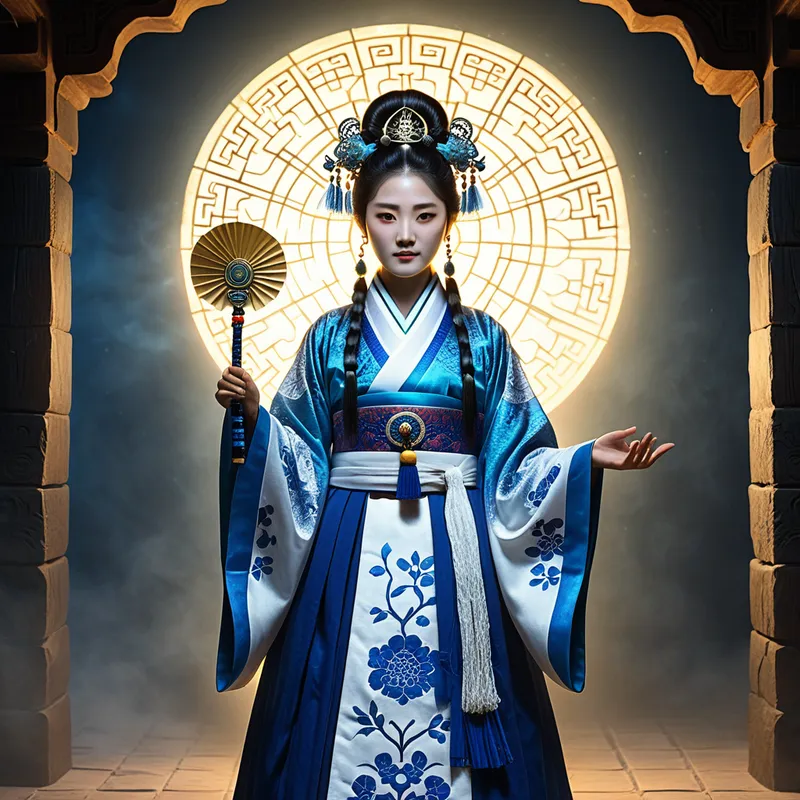
With the water, she healed her father, who rose from his bed whole and weeping with gratitude. But the king’s words were true. Baridegi was changed, touched by the otherworld. She left the palace and ascended into the mountains. There, she became the first Mudang, a divine spirit-princess who could travel between all worlds. She became a guide not for kings, but for every lost soul, using the bell and fan she earned in the underworld to heal, to protect, and to shepherd spirits on their final Journey. She who went down to save one, arose to save all.
Cultural Origins & Context
The myth of Baridegi is a foundational narrative in Korean Mugyo (Shamanism). It is not merely a folktale but a myth of origin, a sacred story recited and performed within Gut rituals to invoke the very deity it describes. Baridegi, also known as Bari Gongju, is one of the most revered Sin in the shamanic pantheon, specifically the patron of shamans and the guide of the dead.
The myth was traditionally transmitted orally by Mudang themselves, who are considered her descendants and earthly embodiments. In a society where Confucian patriarchy often rigidly defined roles, the shamanic tradition—and this myth—preserved a powerful space for feminine spiritual authority. The story functioned as a sacred justification for the shaman’s difficult vocation, explaining its origins in profound Sacrifice and marginalization. It also served a profound societal function: modeling filial piety of an ultimate degree while simultaneously providing a cosmological map of the afterlife and a figure of compassion to navigate its terrors.
Symbolic Architecture
At its core, the myth of Baridegi is a profound map of descent and return, not for treasure, but for Healing. It details the ultimate inversion: the child becomes the parent to the parent, the princess becomes the servant of all souls.
The deepest healing often requires a journey into the very heart of what we fear—the neglected, the diseased, the seemingly dead parts of our personal and ancestral history.
The Father’s illness symbolizes a broken lineage, a stagnant or poisoned source of authority and life. Baridegi’s quest is not one of conquest but of negotiation with the Underworld. The three gifts—Gold, Silk, and the Boat—signify that one must offer the treasures of the upper world (consciousness, culture, means of passage) to gain the treasure of the lower world (the transformative Waters of the unconscious). Her inability to fully “return” marks her transformation; she becomes a permanent inhabitant of the threshold, the Bridge itself.

The Dreamer's Resonance
When this myth stirs in the modern Dream, it often manifests as dreams of descending into basements, caves, or submerged landscapes to retrieve something vital for a sick or aging parent figure. The dreamer may feel a solemn duty, a mix of fear and determination. Somatically, this can correlate with a feeling of weight in the chest or a sense of navigating dense, dark energy.
Psychologically, this signals a crucial process of ancestral or familial Healing. The “father’s illness” represents a psychic or emotional inheritance—a pattern of depression, rage, or emotional absence—that is now critical and demands attention. The dream-ego, like Baridegi, is being called to undertake a Journey into personal history and shadow material to find the “water” that can cleanse this inherited wound. The process is often isolating, feeling like one is leaving the “sunlit world” of normal life to engage with something dark and foundational.

Alchemical Translation
The alchemy of Baridegi’s myth is the transmutation of personal Grief and obligation into transpersonal vocation. It is a blueprint for Individuation, where the central task is not to reject one’s origins but to heal them at their root, even if it means journeying into the soul’s underworld.
The spirit does not ascend by fleeing the dark, but by learning its pathways so thoroughly it can guide others through them.
The initial Sacrifice (leaving home) leads to the confrontation with the King of the Underworld—the dominant, often terrifying complex that guards our deepest wounds. Successful negotiation requires offering one’s developed gifts (skills, insights, compassion). The healing “water” retrieved is the transformative insight or emotional release that mends an inner rupture. The final, crucial stage is the integration: one cannot simply “go back.” The psyche is permanently altered. The Baridegi process culminates in becoming a “spirit-princess” of one’s own psyche—developing a permanent inner function that can mediate between conscious and unconscious, heal inner splits, and guide lost parts of the self (the “dead” or neglected aspects) home. The personal cure becomes the universal capability for compassion.
Associated Symbols
Explore related symbols from the CaleaDream lexicon:
- Journey — The central structure of the myth, representing the perilous but necessary descent into the unconscious or the afterlife to retrieve something vital for healing.
- Sacrifice — Baridegi's ultimate offering of her ordinary life and royal future, first for her father and then for all souls, modeling the cost of profound transformation.
- Healing — The core purpose of the quest, symbolized by the Water of Life, which transforms sickness into wholeness and personal grief into a capacity to heal others.
- Underworld — The realm of shadow, the dead, and the repressed, which must be consciously entered and negotiated with to achieve psychological and spiritual completion.
- Bridge — Baridegi's own transformed state; she becomes the living connection between the world of the living and the dead, between consciousness and the unconscious.
- Father — Represents the ancestral lineage, authority, and the source of life that has become ill, requiring the next generation to intervene for its salvation.
- Water — The transformative, cleansing substance of life itself, held in the underworld, symbolizing the healing emotions or insights found in the depths of the psyche.
- Spirit Guide — Baridegi's ultimate archetypal identity after her transformation, the one who has mastered the journey and now shepherds others through their own transitions.
- Grief — The powerful emotional fuel that initiates the journey, the love for a dying parent that compels one to face the unimaginable.
- Door — The threshold to the underworld, representing the point of no return in any profound psychological process, where one chooses to face the unknown within.
- River — The boundary and flowing pathway of the afterlife, symbolizing the fluid, often unconscious currents of fate, memory, and soul that must be crossed.
- Princess — The initial identity of the heroine, representing a cherished but confined role that must be surrendered to achieve a greater, more sovereign spiritual destiny.