
Bardo Myth Meaning & Symbolism
The mythic journey through the luminous, terrifying, and transformative liminal state between death and rebirth, a map of consciousness for navigating profound change.
The Tale of Bardo
Listen. The great breath has ceased. The anchor of the body is cut loose, and the mind, that flickering lamp, is cast adrift into a vast and shoreless ocean of potential. This is the Bardo. Not an ending, but a profound and terrifying between.
For forty-nine days and nights, the voyager journeys. At first, there is only a profound peace, a luminous emptiness that is the mind’s own true nature—the Clear Light. It dawns like a sun without heat, a soundless thunder. Most, bewildered by its sheer immensity, turn away in fear, seeking the comfort of form.
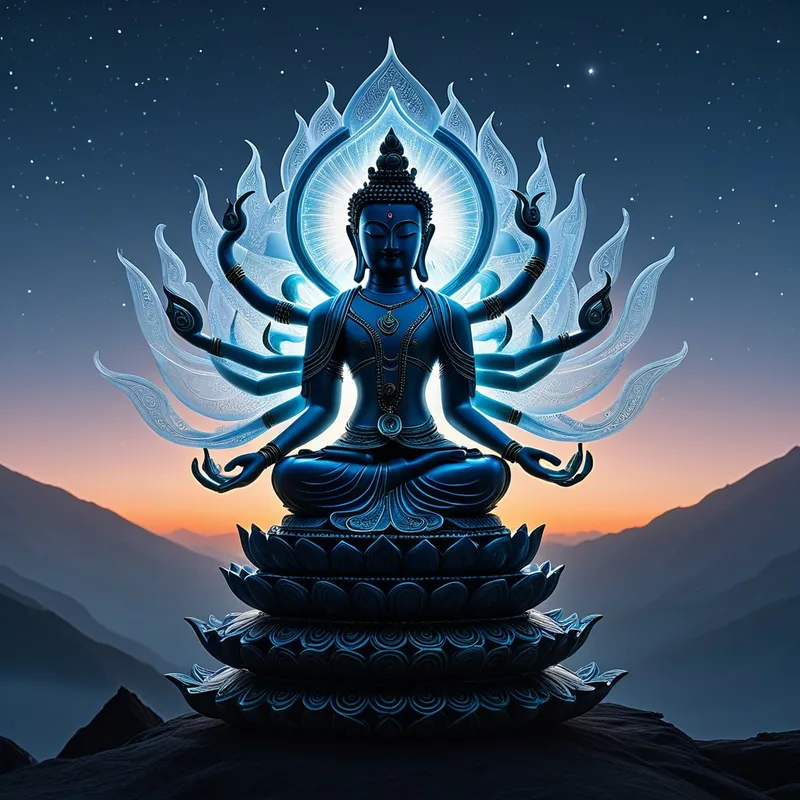
And so the journey deepens. From that luminous emptiness, sounds and lights erupt—a symphony of pure being. Then, visions. For seven days, the peaceful deities manifest. They are not outsiders, but emanations of the mind’s own deepest qualities. Amitabha, red and radiant, holding a lotus. Avalokiteshvara, white and all-seeing. They appear in majestic splendor, emanating not threat, but a profound invitation to recognize one’s own enlightened nature. Their light is blindingly gentle, yet the voyager, clinging to the ghost of a self, often flees from this brilliance, mistaking liberation for annihilation.
Then the atmosphere shifts. The peaceful lights recede, and from the mind’s own turbulence arise the wrathful deities. This is the Bardo of Becoming. They are not monsters of punishment, but fierce compassion made manifest. Yamantaka, conqueror of death, stomps upon ignorance. Vajra Heruka dances in a blaze of wisdom-fire. Their forms are terrifying: bulging eyes, fangs, garlands of skulls. Their roars shake the fabric of reality. Yet, in their hearts, they hold the same invitation: “Recognize me as the mirror of your own mind. Do not fear your own power.” To mistake them for external demons is to be thrown into the whirlpool of samsaric existence.
Driven by habit, by longing and aversion, the voyager now seeks refuge. They perceive the lights of possible rebirths—the dull glow of the god realms, the murky light of the hells. They are pulled by karmic winds toward a vision that feels like home, often a glimpse of future parents in union. In a moment of profound attachment or aversion, the consciousness is drawn into the new womb, and the great wheel turns once more. The tale of the Bardo ends not with a conclusion, but with a transition—a poignant reminder that every ending is a haunted, luminous beginning.
Cultural Origins & Context
The mythic narrative of the Bardo finds its most elaborate expression in the Tibetan Buddhist tradition, particularly within the Bardo Thödol. This text, whose name translates to “Liberation Through Hearing in the Intermediate State,” is not a single-authored scripture but a terma—a “hidden treasure” text, said to have been concealed in the 8th century by the great master Padmasambhava and later rediscovered by a tertön (treasure revealer). Its societal function was deeply pragmatic and profoundly compassionate. It was (and is) read aloud to the dying and the recently deceased, serving as a guidebook for navigating the uncharted territory of death. It functioned as a map for the ultimate journey, a ritual technology to prepare the consciousness for liberation and, failing that, to secure a favorable rebirth. Passed down through lineages of lamas and practiced in intimate, solemn settings, it represents a core cultural technology for confronting humanity’s most universal mystery.
Symbolic Architecture
The Bardo is the ultimate symbol of liminality—the “betwixt and between.” It is not merely a post-mortem state, but a metaphysical blueprint for every significant transition in life: the end of a relationship, the loss of a career, a psychological crisis, the space between sleep and waking.
The Bardo is the psyche’s own theater, where the contents of a lifetime are projected onto the screen of primordial awareness.
The deities are not external saviors or judges, but archetypal personifications of the mind’s own latent potentials. The peaceful deities represent the pure, refined qualities of wisdom and compassion. The wrathful deities symbolize the raw, untamed psychic energies—our repressed anger, passion, and fear—which, when unrecognized, terrorize us, but when faced and integrated, become the fierce energy of transformation. The entire journey is a profound allegory for perception: we do not see what is; we see what we are. The light of reality is constant, but our karmic habits—our clinging to a solid “I”—cause us to perceive it as either a threat (the wrathful deities) or an irrelevant abstraction (the peaceful deities), thereby propelling us back into the dream of separate existence.
The Dreamer's Resonance
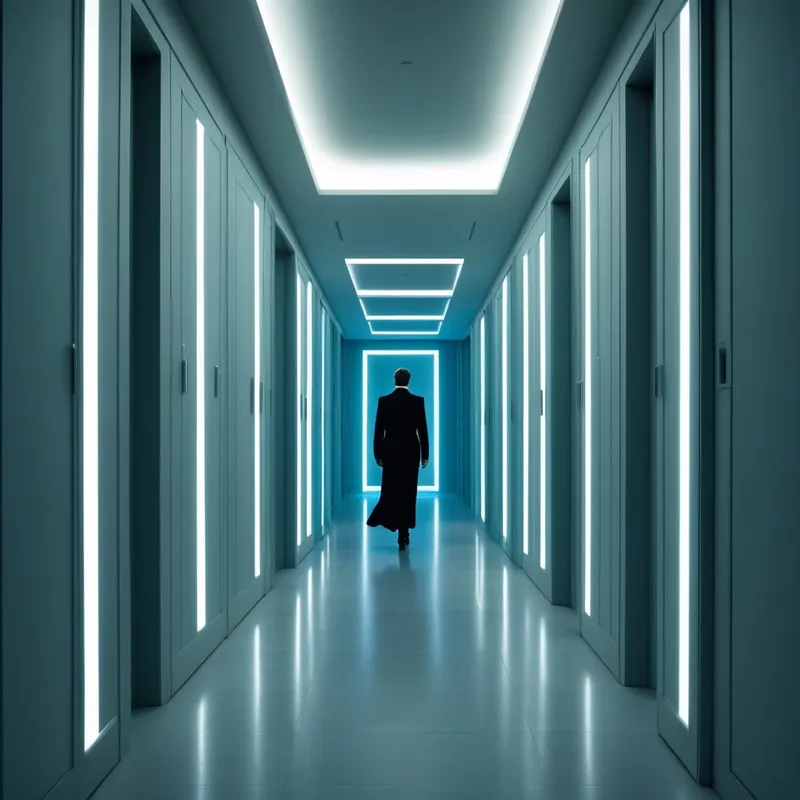
When the pattern of the Bardo manifests in modern dreams, it rarely appears with literal Buddhist iconography. Instead, we dream of being lost in endless, shifting airports or train stations where all signs are in an unknown language. We dream of wandering hallways in our own home that suddenly lead to unfamiliar, vast landscapes. We encounter figures who are simultaneously a loved one and a terrifying stranger. These are Bardo dreams.
Psychologically, they signal that the dreamer is in a profound state of transition. The old identity or life structure has “died,” but the new one has not yet coalesced. The somatic experience is often one of free-floating anxiety, disorientation, and a deep sense of unreality. The dream is the psyche’s way of rehearsing this liminal state, of presenting the dreamer with the core Bardo choice: to panic and cling to the familiar (leading to a repetitive, “karmic” rebirth of the same old patterns) or to find a point of stillness and observation within the chaos. The terrifying figures in such dreams are our own wrathful deities—unintegrated shadow aspects demanding recognition.
Alchemical Translation
For the modern individual engaged in the process of individuation—the alchemical work of becoming whole—the Bardo myth provides a master template for psychic transmutation. It models the entire journey of facing the unconscious.
The initial “Clear Light” moment is akin to a profound insight or a sudden, grace-filled experience of self-transcendence—the glimpse of the Self beyond the ego. Most of us, unprepared, shy away from this radical freedom. Then comes the confrontation with the contents of the personal and collective unconscious: the “peaceful” talents and potentials we’ve neglected, followed by the “wrathful” shadow—the rage, shame, and primal fears we have buried.
The alchemical fire is not meant to destroy the contents of the psyche, but to reveal their essential, empty nature, freeing their energy for conscious life.
The work is to “recognize” these figures as parts of oneself, not to fight or flee them. To integrate the wrathful deity is to reclaim one’s own fierce vitality and will. To merge with the peaceful deity is to embody compassion and clarity. Each integration is a “liberation” within a Bardo, preventing a “karmic rebirth” into an old, constricted ego-state. The ultimate goal, mirrored in the Bardo’s ideal, is to “dwell in the Clear Light”—to rest in the non-dual awareness of the true Self, thereby ending the compulsive cycle of psychological death and rebirth. In this light, every life crisis becomes a potential Bardo, a sacred interval where one can choose between repeating an old pattern or stepping into a more authentic, liberated form of being.
Associated Symbols
Explore related symbols from the CaleaDream lexicon: