Barbat Myth Meaning & Symbolism
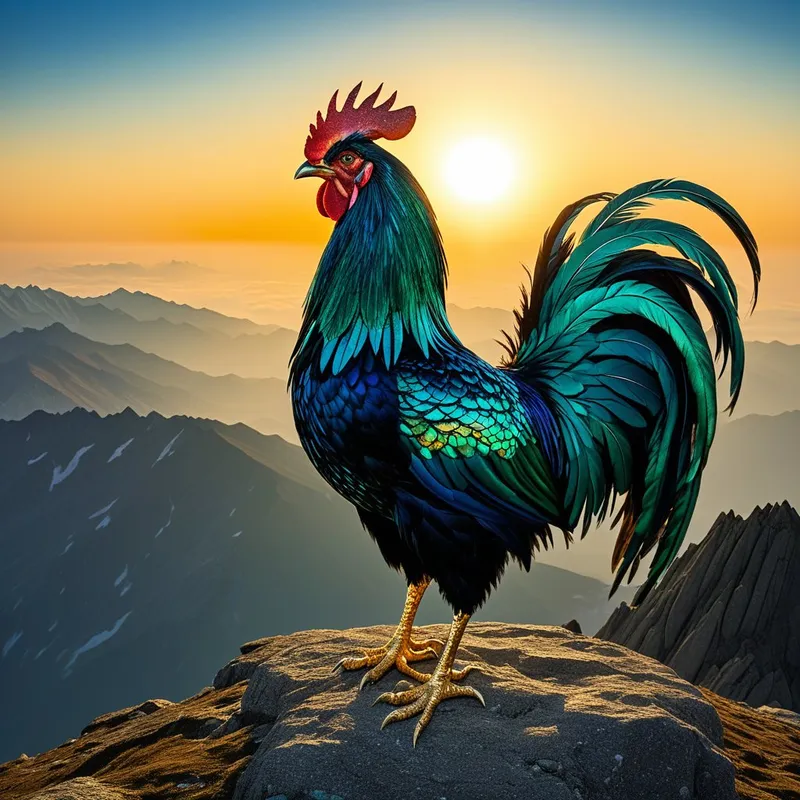
The myth of Barbat, the celestial rooster whose crow at the world's dawn banishes demons and announces the triumph of light over primordial chaos.
The Tale of Barbat
Listen, and hear the tale of the First Sound, the Cry that carved the world from the womb of silence.
Before the sun knew its path, before the stars had names, the universe was a deep and formless ocean of shadow. In that endless night, the div and daevas held sway. They were not creatures of flesh, but of whispering doubt, of clinging cold, of the terror that lives in the space between breaths. They coiled through the unmade realms, savoring the perfect, undisturbed darkness. The great mountain, Hara Berezaiti, was but a sleeping giant, its peak lost in black clouds.
Upon this mountain, in a nest woven from the last threads of a forgotten light, an egg of burnished copper and lapis lazuli rested. It did not tremble. It did not shake. It simply was, a secret held against the dark. For three thousand years, the demons circled it, hissing spells of eternal sleep, pouring the venom of despair upon its shell. But the secret within was older than their malice.
Then came the turning. From the far eastern vault, a breath—not yet light, but the promise of light—stirred the stagnant air. It was the breath of Ahura Mazda, though his name was not yet spoken. That breath touched the egg.
A crack, finer than a spider’s thread, appeared. Not a sound, but the possibility of sound. The div shrieked in sudden, formless fear. The crack widened. And from within, not a chick, but a being full-formed and radiant, unfolded itself. It was Barbat, the Rooster of Dawn. His feathers were the hues of a sky yet to be: throat of molten gold, wings of twilight purple, tail feathers like trailing comets. His eyes held the piercing clarity of a truth that admits no lie.
He stretched his neck toward the unseen east. He drew in the breath of creation. And he crowed.
That crow was no mere animal cry. It was a sonic spear, a wave of pure, ordering vibration. It shattered the silence into a million harmonic fragments. Where the sound traveled, the whispering demons dissolved like mist in a sudden wind, their forms unable to bear the announcement of reality. The crow rolled across the slopes of Hara Berezaiti, down into the shadowed valleys, declaring a single, undeniable fact: Night is done.
In its wake, the first ray of sunlight, khvarenah, crested the mountain. Light followed sound, order followed announcement. The world, now defined by the contrast between the retreating dark and the advancing dawn, had begun. And Barbat, having issued the first command, took his eternal post upon the highest peak, his cry now the daily ritual that keeps the chaos at bay, a vigilant heartbeat for the world.
Cultural Origins & Context
The myth of Barbat finds its roots in the ancient Zoroastrian cosmology of pre-Islamic Persia, later preserved and embellished within the Shahnameh and other poetic and mystical texts. This was not a bedtime story for children, but a cosmological anchor. In a worldview defined by the cosmic struggle between the forces of light, order, and truth (asha) and those of darkness, chaos, and falsehood (druj), Barbat served a critical function.
He was the muezzin of the natural world, a divine timekeeper whose call was a religious duty performed for all creation. His crow was believed to be a prayer, a potent formula that actively repelled the demonic forces (daevas) who thrive in silence and stillness. In practical life, his myth justified and sanctified the rooster’s role in agrarian societies—its crow marked the time for prayer, for rising to work, for the community to begin its ordered day. The myth was told to explain why darkness feels oppressive and why the dawn brings relief; it was because a heroic, vigilant consciousness was forever on guard, sounding the alarm against the entropy of the soul and the world.
Symbolic Architecture
Psychologically, Barbat is the archetypal Awakener. He represents the first moment of conscious awareness that disrupts the comfortable, undifferentiated darkness of the unconscious. The primordial night is not evil in itself; it is the state of potential, of everything and nothing. But it is also where our personal div reside—our latent fears, unresolved complexes, and psychic inertia.
The first act of consciousness is not to see, but to declare. It must make a sound in the void, asserting "I am here," before it can perceive what else is.
Barbat’s crow is that declaration. It is the ego’s initial, courageous differentiation from the unconscious mass. The demons that flee are not defeated in battle; they are dispelled by the quality of attention. Chaos cannot coexist with a focused, present awareness. The copper-and-lapis egg symbolizes the latent Self, the total personality, incubating in the darkness of potential for what feels like an aeon ("three thousand years"). The breath of Ahura Mazda is the call from a deeper layer of the psyche, the Self itself, prompting the awakening. Barbat, then, is the agent of the Self, born fully formed to perform a specific, world-creating function: to announce the separation of light from dark, known from unknown, self from not-self.
The Dreamer's Resonance
When this mythic pattern stirs in the modern dreamer, it often manifests not as a literal rooster, but as a sudden, shocking sound in a dream of profound silence or stagnation. It might be the ring of a crystal glass, a single clear bell, a shout, or a sharp intake of breath. The dream setting is typically a liminal space: a darkened house, a foggy landscape, a paused moment of dread or deep sleep within the dream itself.
Somatically, the dreamer may report waking with a start, a gasp, or a feeling of their heart "jumping." This is the psychic equivalent of Barbat’s crow. The psychological process is one of imminent breakthrough. The dream ego has been submerged in a complex—a depression (the clinging dark), a period of confusion (the formless demons), or a state of moral or creative paralysis. The sound is the first signal from the Self that the incubation period is over. The tension has reached its peak, and a new, ordering principle is ready to emerge. The dream is modeling the initial, often jarring, moment of awakening from a psychic slumber. The demons fleeing are the old, habituated thought-forms and emotional patterns that can only exist in the absence of clear, conscious attention.
Alchemical Translation
The alchemical journey mirrored in Barbat’s myth is the transition from the nigredo—the blackening, the state of putrefaction and uniform darkness—to the albedo, the whitening or dawning. This is the most critical and perilous phase of transmutation. The massa confusa of the soul must be subjected to a separating principle.
Individuation does not begin with a plan, but with a cry. It is the innate, organic protest of the spirit against its own dissolution in the unconscious.
For the modern individual, the "crow" is that first, often awkward or frightening, act of self-assertion that initiates healing. It is speaking a painful truth after years of silence. It is setting a boundary where none existed. It is writing the first sentence of a creative project after a long drought. It is the moment of saying "no" to a toxic pattern or "yes" to a buried longing. This act feels heroic because it is. It creates a psychic "dawn." It establishes an inner order (asha) where chaos (druj) reigned. The key is that the power for this does not come from the struggling ego alone; it is breathed into us (the breath of Ahura Mazda) from the deeper Self, the total psyche waiting to be born. We are both the copper egg and the rooster that breaks from it. Our daily practice then becomes one of vigilance—of continuing to "crow," to reaffirm that conscious, truthful stance, lest the demons of forgetfulness and doubt creep back in with the falling of our inner night.
Associated Symbols
Explore related symbols from the CaleaDream lexicon: