Barad-dûr / Isengard Myth Meaning & Symbolism
The myth of two dark towers, born from betrayal and forged in shadow, representing the perilous architecture of a will turned against life itself.
The Tale of Barad-dûr / Isengard
Listen, and hear the tale of the Towers of Shadow. Not one, but two, born of the same black seed in different ages of the world.
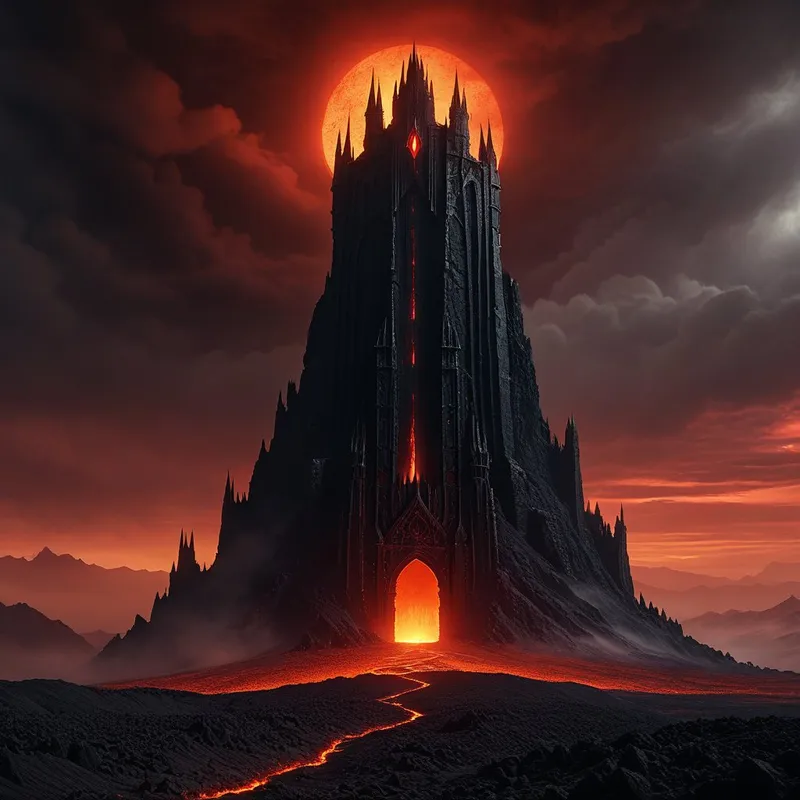
In the Second Age, in a land of ash and fire, a shadow took form. It was not a man, nor a beast, but a will—a will to dominate all things. This was Sauron, the Deceiver. He looked upon the fair lands of Middle-earth and saw not beauty to cherish, but order to impose. He went to a place of ancient dread, the plateau of Gorgoroth, and there began his great work. For centuries, with the labor of countless slaves and the sorcery of his own terrible mind, he raised a tower. It was not built; it was grown, like some monstrous iron tree whose roots clawed deep into the bones of the earth. They called it Barad-dûr, the Dark Tower. Its foundations were woven with spells of binding, so that while the One Ring endured, the tower could not fall. From its highest window, a single, lidless Eye of flame surveyed the world, a beacon of sleepless malice that cast no light, only a searching, oppressive gaze that choked hope from the air.
An age passed. The tower fell, but the shadow slept, waiting.
In the Third Age, in a green valley encircled by mighty mountains, stood another tower. Orthanc was its name, built by men of old not for war, but for wisdom. It was a pillar of sleek, unyielding stone, a place of starlight and learning. Into its keeping came Saruman the White, wisest of the Istari. For long years, he studied there, and his voice was fair, and his counsel sought by kings. But he, too, began to listen to a whisper on the wind, a voice from the East that spoke of order, efficiency, and strength. He looked upon the tangled, "wasteful" beauty of the forest and saw only fuel. He gazed upon the simple lives of hobbits and men and saw only disorder to be corrected.
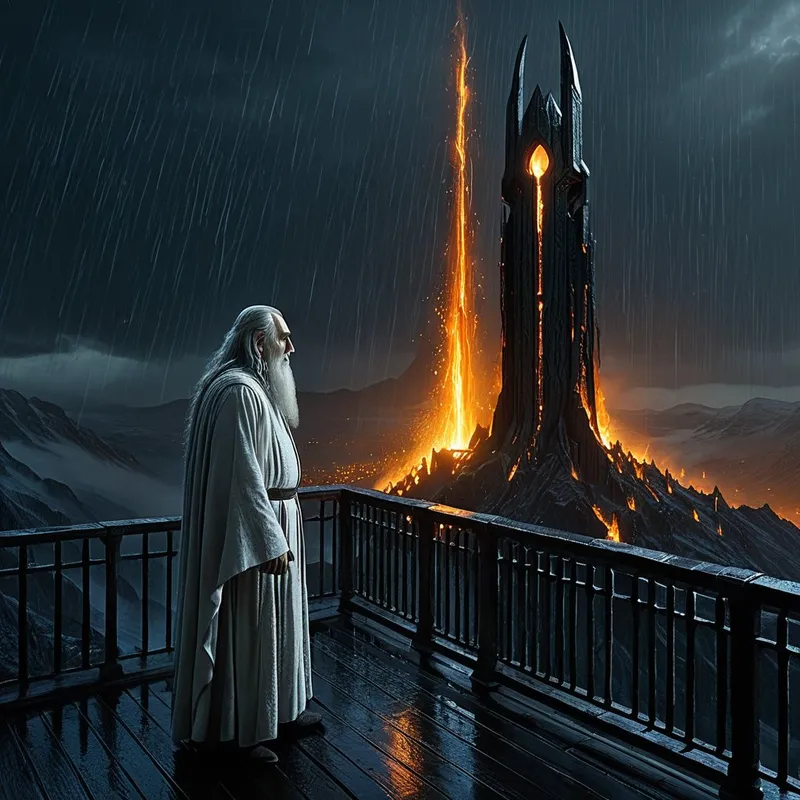
So, the betrayal began. The green circle of Isengard, the Ring of Isengard, was torn asunder. Ancient trees were felled, the earth was gouged, and in their place rose pits of fire, wheels of iron, and tunnels of reeking industry. The tower of stone did not change, but its purpose was inverted. From a sanctuary of thought, it became a command spire for a new army, forged in vats from pain and corruption—the Uruk-hai. The air, once sweet with meadow flowers, grew thick with smoke and the clang of hammers. Isengard became a lesser shadow, a mimic of Barad-dûr, its master not a dark god but a proud sage who believed he could wield the tools of the shadow to shape a "better" world. Two towers, one ancient and born of pure malice, the other modern and born of corrupted reason, now cast their long shadows across the land, singing the same song of dominion.
Cultural Origins & Context
This myth originates from the comprehensive legendarium of J.R.R. Tolkien, a 20th-century scholar of ancient languages and myths. While presented as a novel, The Lord of the Rings functions as a transmitted mythology for a modern age, drawing deeply from Tolkien's expertise in Beowulf, Norse sagas, and Finnish folklore. The tales of Barad-dûr and Isengard are not standalone fables but integral chapters in a vast, interwoven history of Middle-earth.
The story is passed down through the "Red Book of Westmarch," an in-universe manuscript compiled by the hobbits Bilbo and Frodo Baggins. This framing device gives the myth the weight of historical record, filtered through the perspectives of the small and humble who stood against the vast and terrible. Societally, the myth functions as a profound warning against two faces of tyranny: the external, supernatural evil of Sauron's nihilistic domination, and the internal, seductive evil of Saruman's utilitarian corruption. It reflects a deep cultural anxiety about industrialization, the will to power, and the betrayal of intellectual and custodial authority for the sake of control.
Symbolic Architecture
At its core, the myth of the two towers is an exploration of the architecture of the corrupted will. They are not merely fortresses; they are psychic structures.
Barad-dûr represents the archetypal Shadow in its most absolute form—a consciousness that seeks to absorb all other consciousness into itself. It is the psyche turned entirely inward upon its own hunger, externalized as a fortress that blights the landscape. Its unblinking Eye is the symbol of a paranoid, controlling awareness that cannot tolerate any existence outside its gaze. It does not create; it only commands, consumes, and imposes a dead, static order.
The ultimate tyranny is not the destruction of the body, but the colonization of the will. The Dark Tower is the monument to a mind that wishes to be the only mind that is.
Isengard represents a more insidious, and thus more dangerously relatable, shadow: the corruption of light by its own pride. Orthanc, the unbreakable tower, symbolizes an intellect that believes itself above the organic, messy processes of life. Saruman does not start with a desire for pure evil; he starts with a desire for efficiency, order, and "the greater good." His sin is hubris—the belief that he can manage the tools of domination without being dominated by them. The felling of the Huorns to feed his forges is the perfect symbol of this: sacrificing living wisdom (the ancient trees) for dead, instrumental power (the engines of war).
Together, they model the two paths to psychic tyranny: from the outside in (possession by an external shadow, Sauron) and from the inside out (the rational ego's seduction by power, Saruman).
The Dreamer's Resonance
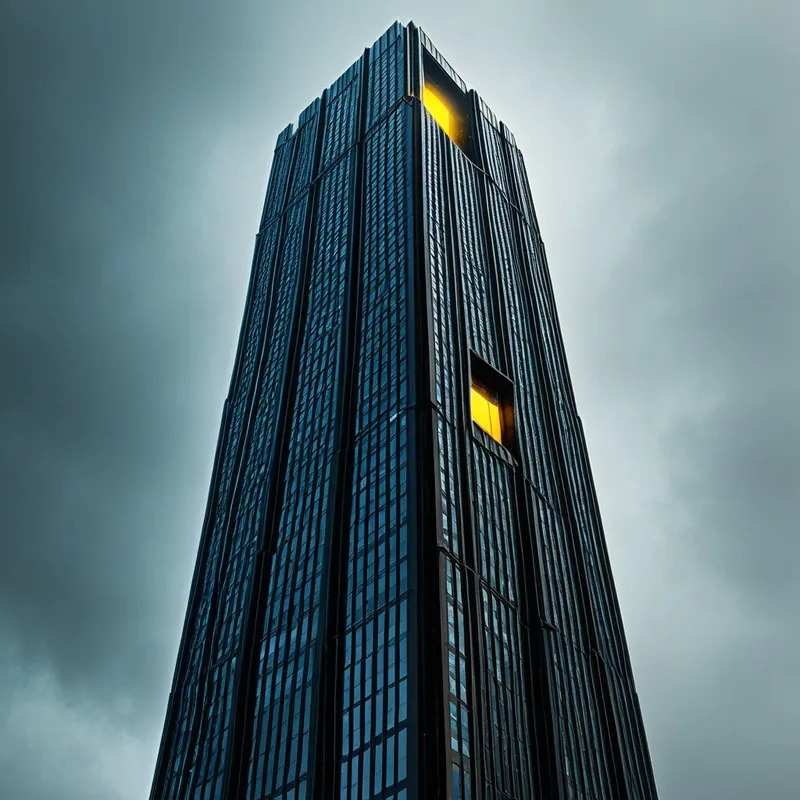
When this mythic pattern stirs in the modern dreamscape, it often manifests as dreams of oppressive, impersonal architecture. The dreamer may find themselves trapped in a labyrinthine corporate headquarters that feels alive with surveillance, or living in a skyscraper that is slowly, mechanically, consuming the park below it. The key somatic feeling is one of constructive suffocation—a sense that one's environment is not just hostile, but actively engineered to diminish and control.
Psychologically, this dream signals a confrontation with what we might call the "Inner Architect"—that part of the psyche that builds structures of control. This could be the overbearing inner critic (the Lidless Eye), a rigid life schedule that has killed spontaneity (the paved-over gardens of Isengard), or a intellectual complex that dismisses emotion and intuition as "illogical" (Saruman's scorn for the Ents). The dream is a signal from the deeper self that a tower is being built within, one that is walling off parts of the soul's territory in the name of a brittle, fearful order. The process underway is the soul's rebellion against its own self-imposed tyranny.
Alchemical Translation
The alchemical journey modeled here is the dissolution of the false citadel. Individuation requires not just building the true self, but diligently dismantling the fortress of the false self—the complex of defenses, personas, and power strategies we mistake for strength.
Barad-dûr represents the nigredo of the soul—the black, leaden state of total identification with a monolithic, power-driven complex. Its fall, only possible when the Ring (the symbol of its binding power and our attachment to it) is unmade, is the ultimate solutio: a dissolution so complete it requires a journey into the heart of the volcanic shadow (Mount Doom) to achieve.
Isengard's transformation offers a more nuanced recipe. Its healing comes not from cataclysm, but from reclamation. The Ents, the ignored and despised forces of deep, slow, organic life, rise up to break the dams and flood the pits. This is the alchemical stage of coagulatio—the return to the watery, feminine, chaotic principle that the rigid, masculine, industrial complex had tried to suppress.
The path to the Self is not paved with the stones of willpower, but cleared by the floodwaters of what the will has long denied.
For the modern individual, the myth instructs us to identify our own "Isengards." Where have we, in the name of productivity, security, or reason, paved over our inner gardens? What ancient, tree-like wisdom (intuition, feeling, creativity) have we relegated to the "childish" realm of Fangorn Forest, only to find our psyche becoming a barren, noisy, productive wasteland? The triumph is not in destroying the tower of the intellect (Orthanc remains), but in cleansing its grounds, silencing its forges, and allowing the green, living world to reclaim its rightful place at the tower's foot. The true citadel of the Self is not a fortress against the world, but a tower integrated within a thriving, diverse, and uncontrollable ecosystem of the soul.
Associated Symbols
Explore related symbols from the CaleaDream lexicon: