Banksy Myth Meaning & Symbolism
The myth of an anonymous trickster whose art appears overnight, challenging authority and revealing hidden truths, embodying the modern archetype of the faceless rebel.
The Tale of Banksy
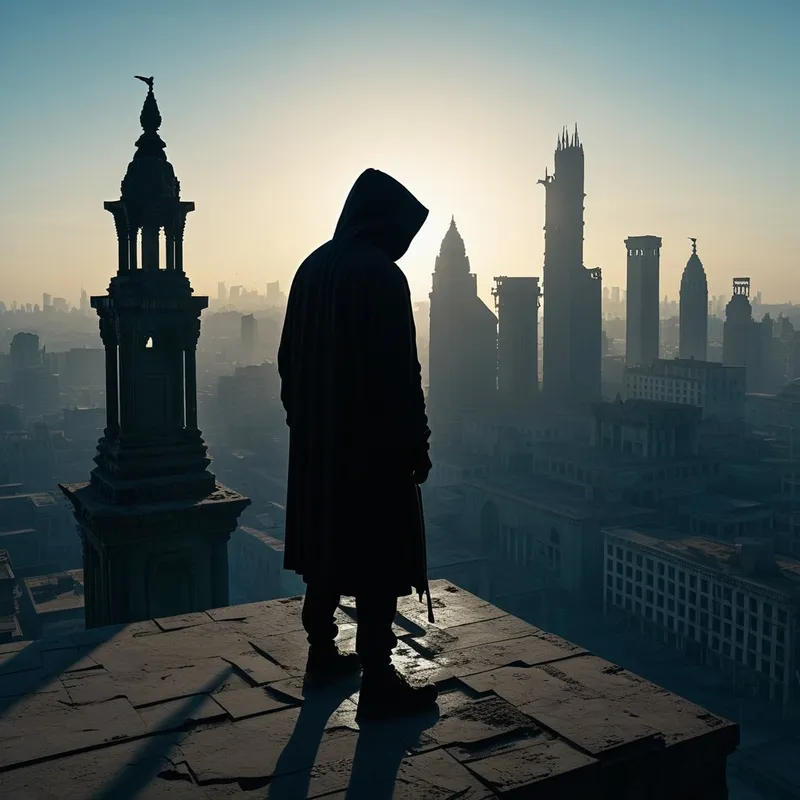
Listen, and hear the tale whispered on the wind that carries the scent of rain on concrete and distant sirens. In the great, sleeping beast of the city, where stone and glass canyons trap the light, a legend walks unseen. He is the Faceless One, the Genius Loci of the alleyway.
He moves not by day, when the world is watched and measured, but in the sacred hours between midnight and dawn—the Witching Hour of the urban sprawl. His tools are simple: a blade to cut the stencil, a can to hold the pigment. His canvas is the skin of the city itself—the blank, scarred walls, the rusting shutters, the forgotten bridges. These are his temples.
The conflict is eternal and silent. It is the conflict between the seen and the unseen, the sanctioned and the illicit, the loud voice of authority and the quiet truth waiting to be revealed. The guardians of the ordered world—the Eyes of the Tower—patrol with lights and laws, seeking to keep the surfaces clean, the narratives controlled. But the Faceless One is a ghost in their machine.
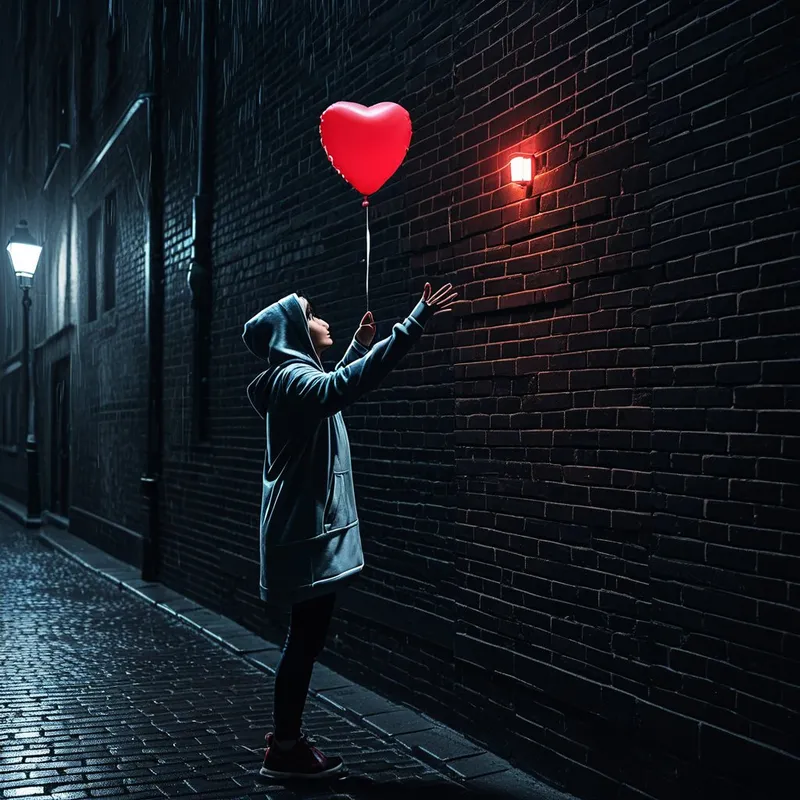
The rising action is never a battle of strength, but of sudden, brilliant apparition. The people of the city would wake to find a miracle had bloomed in the night. A young girl, her hand outstretched, letting go of a balloon shaped like a heart, forever poised between hope and loss. A rioter, frozen in the act of throwing not a Molotov, but a bouquet of flowers. A chimpanzee holding a sign that read, “Laugh now, but one day we’ll be in charge.” Each image was a perfect, poignant question etched into the everyday.
The resolution is never capture, never a final reveal. It is the act of becoming a rumor given form, a truth that cannot be un-seen. The authorities would rush to cover the sacred graffiti with gray paint, a futile attempt to bury the oracle’s pronouncement. But this only deepened the myth. The act of erasure became part of the ritual, proving the power of the transient message. The Faceless One’s greatest triumph was his continued absence, his enduring anonymity. He became every person who ever felt unseen, every silent thought that screamed for a voice. He won by remaining a shadow, proving that the idea, once released into the wild, belongs to no one and everyone.
Cultural Origins & Context
This myth was born not in ancient temples but in the subcultural crucible of the late 20th and early 21st centuries. It emerged from the Graffiti movement, which itself was a primal scream of identity from marginalized urban youth—“I am here.” Street Art culture evolved this into a more complex language of iconography and social commentary. The myth of Banksy is this culture’s most potent folk tale, passed down not through scrolls but through digital whispers, gallery scandals, and the shared experience of discovering a piece on a morning commute.
The myth-tellers are the global community itself: bloggers, documentary filmmakers, art critics, and everyday citizens who become accidental pilgrims when they photograph a stencil. Its societal function is multifaceted. For the culture, it serves as a foundational hero story, validating the entire practice by producing a figure of undeniable cultural weight. For the wider society, it acts as a psychic corrective—a persistent, playful challenge to corporate aesthetics, political hypocrisy, and the commodification of public space. It democratizes the role of the prophet, suggesting that profound truth can come from the alley, not the academy.
Symbolic Architecture
At its core, the myth symbolizes the power of the Shadow made visible. The anonymous artist is the personified collective shadow of a hyper-surveilled, brand-saturated society. He represents the part of us that wishes to speak truth without consequence, to critique without identity, to create without seeking the ego’s reward.
The true rebellion is not in the destruction of the wall, but in the sacred re-consecration of its surface.
The Self in this myth is not the individual artist, but the artwork-in-context—the mysterious image in dialogue with its environment and its audience. The stencil is a perfect symbol of this: a cut-out template that allows for infinite reproduction yet is forever tied to the unique texture of the wall it lands upon. It represents the archetypal pattern finding unique expression in the individual soul.
The act of nocturnal creation symbolizes the necessary work of the unconscious. Insights, critiques, and transformative images often come to us not in the glaring light of conscious effort, but in the quiet, unobserved moments. The city’s frantic daytime identity is challenged by its own nighttime dreams, made manifest on its skin.
The Dreamer's Resonance
To dream of this mythic pattern is to be in a state of profound confrontation with one’s own facelessness and one’s desire for authentic expression. The dreamer may find themselves in a labyrinthine city, holding a tool (a spray can, a brush, a piece of chalk) with a urgent message they cannot quite articulate. The somatic feeling is often one of exhilarating risk mixed with deep anxiety—the thrill of the clandestine act under the threat of discovery by vague authorities (police, parents, bosses).
This dream signals a psychological process where the dreamer’s Persona is feeling restrictive. The unconscious is pressuring for an expression that bypasses the ego’s need for credit, approval, or a polished identity. It is the psyche’s way of staging a guerrilla operation against its own internalized “authorities”—the inner critic, the need to please, the fear of exposure. The dream asks: What truth are you carrying that needs to be released anonymously, for its own sake, without attachment to your name?
Alchemical Translation
The alchemical journey modeled by this myth is the transmutation of silent, shadowy critique into a creative, revelatory force—the Nigredo of societal disillusionment into the Albedo of clarified image.
The first stage is Dissolution: the ego-identity (the artist’s name, face, biography) is dissolved into the anonymous collective. This is a voluntary descent into the shadow, a sacrifice of personal fame for the potency of the message. The second stage is Purification: the act of creation itself, under the cover of night (the unconscious). Here, raw observation and emotion are distilled through the stencil (the archetypal pattern) into a precise, potent symbol.
The gold is not in the sale of the canvas, but in the moment of shared recognition between the unseen artist and the seeing stranger.
The final stage is Coagulation: the new substance forms. This is not a physical object, but a psychological event—the moment the public encounters the work. The “lead” of the mundane wall is transmuted into the “gold” of a numinous, questioning space. The individuation process here is collective. It suggests that wholeness for the modern individual involves developing an inner Rebel who can creatively dissent from internal and external tyrannies, not necessarily to destroy, but to reveal a deeper, often neglected, layer of reality. The triumph is in the integrity of the act and the liberation of the symbol, achieving a form of immortality not through a named legacy, but through the enduring life of an idea set free.
Associated Symbols
Explore related symbols from the CaleaDream lexicon: