Bamboo Spirit Myth Meaning & Symbolism
A myth of a spirit born from bamboo, embodying resilience, integrity, and the profound wisdom found in yielding to life's storms.
The Tale of Bamboo Spirit
Listen, and let the wind through the grove carry you back. In a time when mountains were the spines of sleeping dragons and rivers were their silver dreams, there existed a bamboo forest of impossible stillness. This was no ordinary wood. Its canes were pillars of jade reaching for the heavens, their leaves whispering secrets older than the dynasties. The people of the nearby village knew to speak in hushed tones when passing its edge. They called it the Shen Lin, the Spirit Grove.
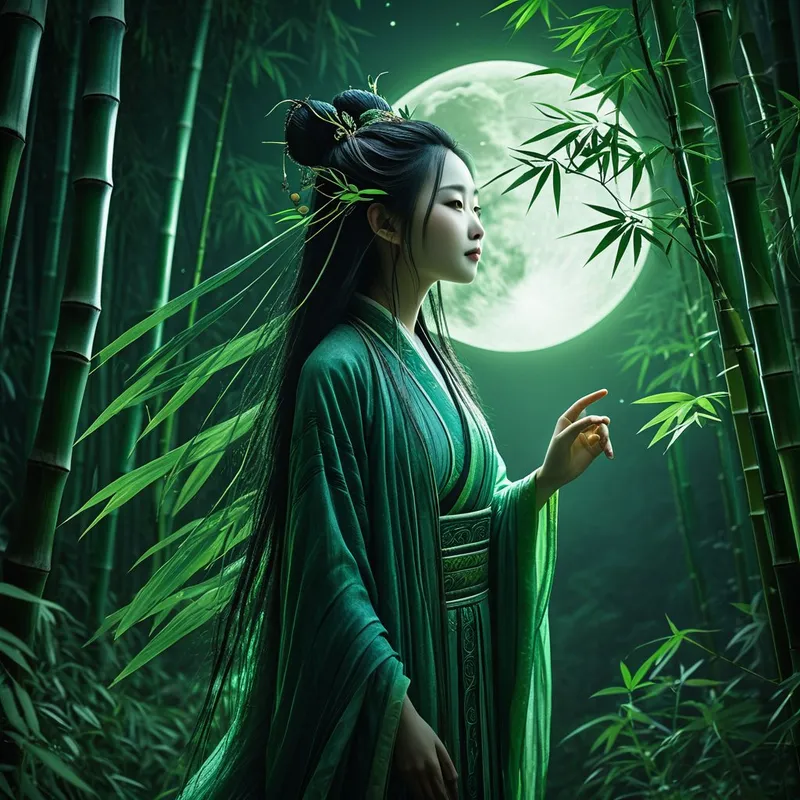
Within this green cathedral lived the Bamboo Spirit. She was not born, but manifested—a coalescence of the grove’s quiet endurance over ten thousand seasons. To the rare, pure-hearted observer, she might appear as a maiden whose skin held the cool, smooth texture of bamboo, her hair a cascade of dark leaves, and eyes the deep, knowing green of shaded pools. She was the guardian of resilience, the embodied principle of the grove itself: to bend so as not to break.
The conflict came not with a roar, but with a creeping silence. A bitter, unseasonal frost, born from a disharmony in the Yin and Yang, began to seep from the northern peaks. It was a cold that killed not with ice, but with stillness—a frost that sought to still the sap, silence the whisper of leaves, and turn vibrant green into brittle, lifeless grey. The villagers’ crops failed. The rivers grew timid. Fear, colder than the frost, took root in their hearts. Some elders muttered that the world itself was forgetting how to breathe.
The Bamboo Spirit felt this deathly stillness touch her grove. She watched as the fiercest pines, proud and unyielding, groaned and splintered under the weight of unnatural ice. Their rigidity was their doom. Then, the storm arrived in full fury—a gale that sought to flatten every living thing. The Spirit did not fight. She entered a state of profound surrender. She began to dance, a slow, graceful movement that mimicked her charges. The great bamboos, under her silent command, bowed low. They bent until their crowns brushed the frozen earth, yielding completely to the storm’s passage. The wind screamed over them, finding no purchase, no resistance to exploit. The frost settled on their backs, but could not reach the vital heart within the hollow stalk.
For three days and nights, the grove held this posture of profound humility. Inside that bowed space, a different kind of power gathered. It was the power of the hollow core—the Wu Wei. When the tempest spent its final breath, spent and confused, a silence returned. Then, with a sound like a thousand sighs, the bamboo straightened. They shook off the frost, which fell like diamond dust, and stood once more, taller for having bowed, stronger for having yielded. The Spirit, standing amidst them, breathed out, and a warm, green light pulsed from her into the roots, into the earth, chasing the residual chill from the land. The lesson was written not in words, but in the saved grove and the returning vitality to the valley. The bamboo, by being empty, had been made full; by bending, it had remained unbroken.

Cultural Origins & Context
The myth of the Bamboo Spirit is not the property of a single text or dynasty, but a folk archetype woven into the fabric of East Asian, particularly Chinese, natural philosophy. It finds its deepest roots in Daoist observation and Feng Shui principles. Bamboo was one of the "Four Gentlemen" in Chinese art (along with plum blossom, orchid, and chrysanthemum), a symbol of the scholarly ideal due to its resilience, flexibility, and hollow stem representing humility and an open mind.
This story was likely transmitted orally by farmers, monks, and traveling storytellers who observed the actual behavior of bamboo during typhoons and harsh winters. Its societal function was multifaceted: an allegory for survival in times of political turmoil (advising flexibility in service to ultimate integrity), a model for ethical conduct (strength through humility), and a natural metaphor for the power of the soft and yielding over the hard and brittle. It taught that true strength is not found in rigid resistance, but in intelligent adaptation, a core tenet for agrarian societies living at the mercy of nature’s cycles.
Symbolic Architecture
Psychologically, the myth constructs a complete model of resilient consciousness. The Bamboo Spirit herself represents the Self in harmony with nature’s laws—the guiding principle of integrity that knows when to stand firm and when to yield. The grove is the totality of the psyche, the inner world.
The hollow stalk is not a void, but a vessel. It is the essential space within the psyche where the winds of emotion and the frosts of circumstance can pass through without causing a catastrophic break.
The unseasonal frost and storm symbolize external adversity—trauma, loss, pressure, change—but also internal psychological states: frozen rigidity, depressive stillness, or the tempest of uncontrollable emotion. The proud pines that shatter represent the ego’s brittle defenses, the rigid identifications and old patterns that, under sufficient stress, lead to psychological fragmentation.
The act of bending is the critical symbolic action. It is not submission, but conscious, chosen adaptation. It is the ego surrendering its rigid stance to serve the greater integrity of the whole Self. The hollow core is the capacity for reflection, the space of mindful awareness that allows experience to be processed without being destroyed by it. The straightening after the storm is the emergence of the individuated personality—the same, yet fundamentally strengthened and more conscious for having integrated the experience.
The Dreamer's Resonance
When this mythic pattern stirs in the modern dreamscape, it often signals a psyche engaged in a profound process of adaptation to stress. To dream of being in a bamboo forest, especially one in a storm, may reflect the dreamer’s feeling of being amidst overwhelming pressures where familiar, rigid ways of coping are failing.
Dreaming of being bamboo—feeling segmented, hollow, or bending under a great weight—points directly to a somatic experience of the psyche’s resilience strategy being activated. The body-mind is practicing yielding. It can feel like vulnerability, even fear of breaking, but within the dream logic, it is a necessary movement. A dream of a spirit figure composed of plant life may herald the emergence of a guiding inner figure, an aspect of the Self that knows how to navigate this storm through flexibility and inner emptiness.
Conversely, dreaming of snapping, splintering wood (like the pines in the tale) can be a warning from the unconscious: the current path of rigid resistance is leading towards a psychological fracture. The dream is presenting the myth’s alternative path.
Alchemical Translation
The journey of the Bamboo Spirit is a perfect map for the alchemical process of individuation. The initial state is the integrated grove (the nascent Self). The frost represents the nigredo stage—the confrontation with difficulty, the "dark night" that forces a crisis.
The conscious decision to bend, to abandon the ego’s rigid posture, is the beginning of the albedo. It is the dissolution of old forms to save the essential core. The hollow stalk during the storm is the vas bene clausum (the well-sealed vessel), the protected inner space where the transformation occurs unseen. Here, in that mindful emptiness, the chaotic elements (wind, frost) are rendered powerless because they are allowed passage; they are witnessed but not identified with.
The transmutation occurs not in defiance of the pressure, but within the very act of yielding to it. The ego’s leaden rigidity is transmuted into the bamboo’s golden resilience.
The straightening after the storm is the citrinitas and rubedo—the emergence of the newly conscious individual. The psyche is not returned to its old state; it is more itself. It has integrated the reality of storms into its very structure. For the modern individual, this translates to the practice of resilient humility: the strength to not be right, to bend to a truth larger than one’s current opinion, to find the fertile emptiness at the center of a busy life, and to understand that sometimes, the only way to remain unbroken is to have the courage to bow.
Associated Symbols
Explore related symbols from the CaleaDream lexicon: