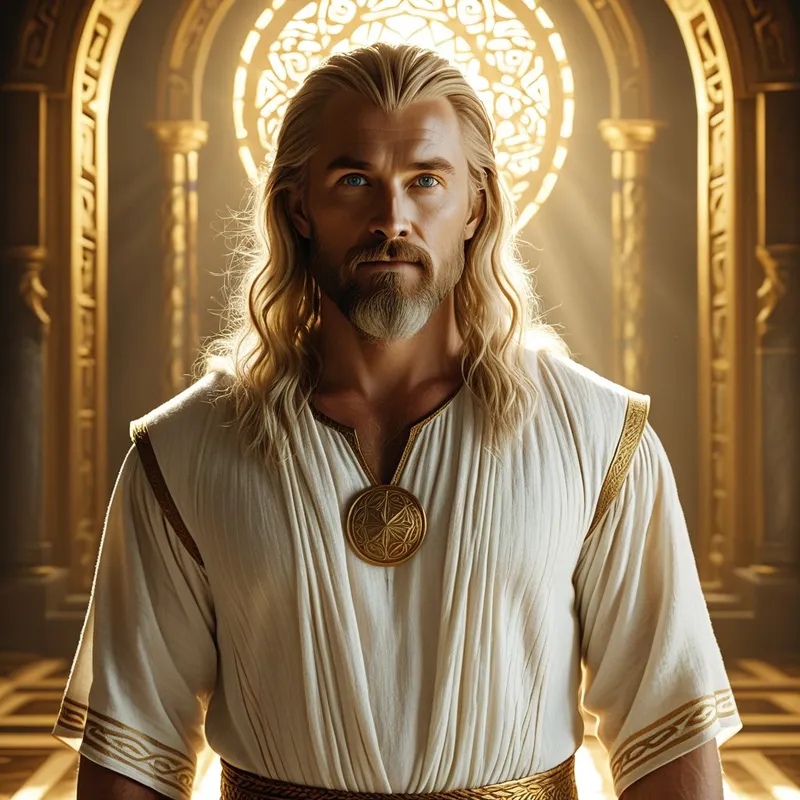
Baldur Myth Meaning & Symbolism
The beloved god Baldur is slain by a mistletoe dart, a tragedy born of prophecy and Loki's malice, plunging the world into grief and foreshadowing Ragnarok.
The Tale of Baldur
Hear now of the brightest of days, and the darkest of nights. In the high halls of Asgard, where the mead flows golden and the hearth-fires never die, there lived a god who was beloved by all things. His name was Baldur, son of Odin and Frigg. His presence was like the dawn after a long winter; his hair was sunlight on new snow, his voice the promise of spring. Where Baldur walked, laughter followed, and strife fell silent. He was the innocence of the world made flesh, a shield against the creeping dread of the coming twilight.
But Baldur began to dream. Not dreams of glory or revelry, but dark, cold dreams of falling, of a silence that swallowed all light. A shadow had touched his shining soul. His mother, Frigg, who could see the threads of fate, felt a terror colder than the rivers of Hel. She journeyed to every corner of the nine worlds. She went to fire and stone, to iron and bronze, to the beasts of the earth and the birds of the air, to every poison and every disease. From each, she extracted a solemn oath: you shall not harm Baldur. The world, loving him, swore it gladly. Soon, it became a game for the gods. In the courtyards of Asgard, they would hurl spears and stones at Baldur, watch axes shatter on his breast, and laugh as he stood unharmed, a testament to his mother’s love and his own purity.
All laughed but one. Loki, whose heart was a nest of serpents, watched this spectacle with a smile that did not reach his eyes. In the joy of the gods, he saw only a lie. Disguised as an old woman, he went to Frigg and spoke with honeyed tongue. “Is it true,” he asked, “that all things have sworn this oath?” The weary goddess, proud of her work, confided, “All but the young mistletoe that grows west of Yggdrasil. It seemed too young, too soft to swear an oath.”
That was all Loki needed. He went and plucked the mistletoe, its stem pale and pliant. He carved it into a dart, sharp as a needle. Returning to the gods’ sport, he found Hodr, Baldur’s blind brother, standing apart, unable to join the game. “Here,” Loki whispered, placing the dart in Hodr’s hand and guiding his aim. “I will direct your throw. Honor your brother.”
Hodr, trusting, drew back his arm and let fly.
The sound was not of shattering stone, but of a sigh. The slender dart pierced Baldur’s heart. The brightest of the Aesir fell, a star extinguished. Laughter died in a thousand throats. The sun itself seemed to dim. A silence fell upon the world, a silence so complete it was a new kind of sound. Then came the weeping—a grief so vast it shook the roots of Yggdrasil. The gods’ tears were the first winter rain.
They carried Baldur’s body to the sea, built a great ship of dreams, Hringhorni, and set it aflame. As the pyre burned against the twilight, a promise was made. A hero, Hermod, rode Odin’s eight-legged steed Sleipnir down the long, dark road to Hel. He begged the goddess Hel for Baldur’s release. She was unmoved, but gave one condition: “If all things in the nine worlds, living and dead, weep for Baldur, he shall return.”
And so all things wept. The gods wept, the giants wept, the stones and the metals wept. But in a dark cave, a giantess named Thokk sat dry-eyed. “Let Hel keep what she holds,” she croaked. And so Baldur remained in the underworld, and the world was forever wounded, waiting for the final battle where shadows would finally consume the light.

Cultural Origins & Context
This central myth comes to us primarily from the Prose Edda of Snorri Sturluson, written in the 13th century, and echoes in earlier poetic fragments. It is crucial to remember that Snorri was a Christian scholar recording a fading pagan tradition. His account, while our most complete, is filtered through a post-conversion lens, potentially shaping the narrative’s emphasis on inevitable loss and a Christ-like innocent.
In pre-Christian Norse society, these stories were not mere entertainment; they were the sacred texts of a worldview. Skalds (poets) would recite them in halls, weaving together cosmology, ethics, and fatalism. The myth of Baldur served a profound societal function: it articulated the painful understanding that no goodness, no matter how pure, is immune to the capriciousness of fate (wyrd) and the presence of malice. It prepared the psyche for a universe without guarantees, where even the gods are subject to prophecy and loss. The failure to retrieve Baldur from Hel is not a failure of effort, but a confirmation of the inescapable logic of their cosmos—the shadow cannot be fully banished, and Ragnarok must come to pass.
Symbolic Architecture
Baldur is the archetype of the unblemished Self, the psychic core of purity, joy, and integrity before it encounters the world’s harshness. He represents consciousness in its ideal state: harmonious, beloved, and seemingly invulnerable.
The most potent vulnerability is not in strength, but in the one thing deemed too insignificant to require protection.
His dreams are the first intrusion of the unconscious, the shadow-knowledge of his own fate. Frigg’s oath-taking is the ego’s desperate attempt to create a perfect defense system, a wall of conscious intention against the chaotic, unpredictable unconscious (represented by all the sworn elements). The mistletoe is the fatal flaw, the repressed content, the “soft” and “young” complex deemed harmless. It is the blind spot in our psychological armor, the unintegrated aspect of ourselves we ignore because it seems inconsequential.
Loki is not merely an external villain, but the personification of the trickster archetype within the psyche itself—the deconstructive principle that must expose hypocrisy, shatter illusion, and force confrontation with reality, no matter how painful. He ensures that no state of perfection, however blissful, becomes stagnant. Hodr, the blind brother, is the instrument of fate, the unconscious actor carrying out a destiny he cannot see.
The refusal of Thokk (Loki in disguise) to weep is the final, cruel truth: some parts of the psyche are so hardened, so identified with cynicism or trauma, that they will actively block redemption and cling to the state of brokenness.

The Dreamer's Resonance
When this myth patterns a modern dream, it often signals a profound process of disillusionment or the shattering of a cherished self-image. To dream of a radiant, beloved figure who is wounded or killed by a small, overlooked object speaks to a somatic experience of shocking vulnerability.
The dreamer may be undergoing what James Hillman called the “soul’s code” meeting its flaw. Psychologically, it is the moment when a lifelong identity—the “good child,” the perpetual optimist, the invulnerable caregiver—is pierced by a reality it could not ward off: a betrayal from a trusted source, the emergence of a hidden illness, a failure that stems from a neglected personal weakness. The grief felt in the dream is not just for the lost figure, but for a lost version of the self. The dream is the psyche’s ritual funeral for its own innocence, a necessary death that makes space for a more complex, embodied consciousness. The lingering feeling is often one of irreversible change and a cold, clear clarity that follows the tempest of emotion.
Alchemical Translation
The alchemical process mirrored here is the nigredo, the blackening, the essential first stage of dissolution. Baldur’s death is the mortificatio—the killing of the naive, solar consciousness. For individuation, this is a non-negotiable crisis. We all harbor an inner Baldur—a belief in our own essential goodness that should protect us from life’s cruelties. The work is not to resurrect that specific, brittle innocence.
The goal is not to return to the garden, but to bear the knowledge of the serpent while remembering the taste of the fruit.
The alchemical translation is in the journey to Hel and the failed retrieval. Hermod’s ride is the courageous descent into the underworld of the psyche—into depression, grief, and shadow-work—to confront what has been lost. The condition set by Hel is the key: all things must weep. This is the demand for total acknowledgment. Every aspect of the self, even the bitter, wounded, cynical parts (the Thokk within), must be recognized and included in the grief. The failure is, paradoxically, the success. It forces the acceptance that the old, pure state is gone forever. The “Baldur principle” of light and joy is not annihilated, but is transmuted. It descends into the underworld, becoming a latent potential, a memory of light held within the darkness, waiting to be reborn in a new, more resilient form after the Ragnarok of the personal psyche. We integrate the knowledge of the mistletoe. We learn to see in the dark like Hodr, and we carry the trickster’s insight without being destroyed by his malice. The process transforms solar innocence into lunar wisdom—a light that knows and contains the night.
Associated Symbols
Explore related symbols from the CaleaDream lexicon: