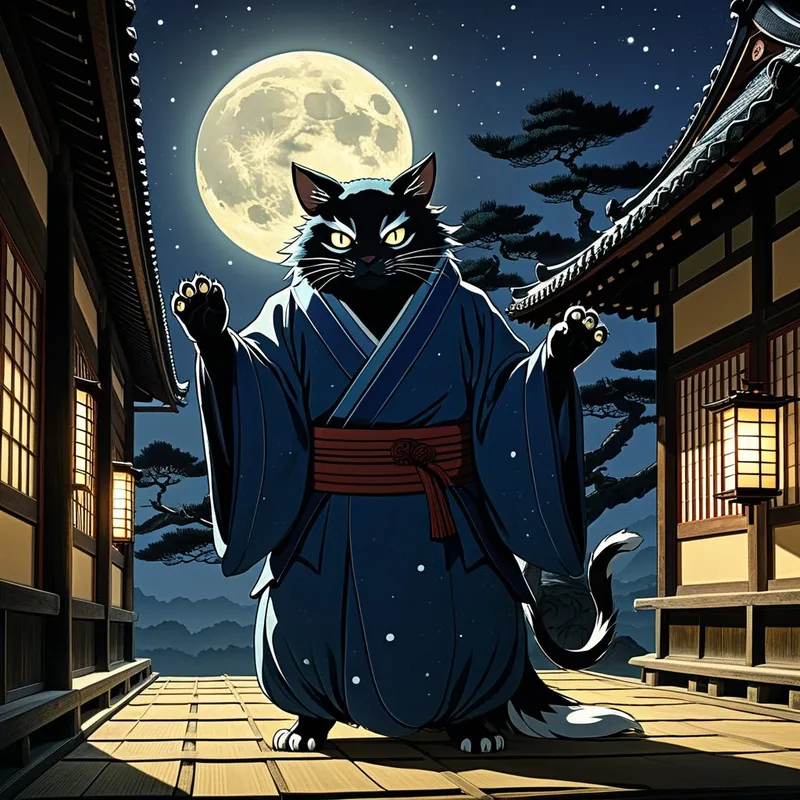
Bakeneko Myth Meaning & Symbolism
A tale of a beloved house cat, transformed by grief and time into a vengeful, shapeshifting spirit that haunts the home it once cherished.
The Tale of Bakeneko
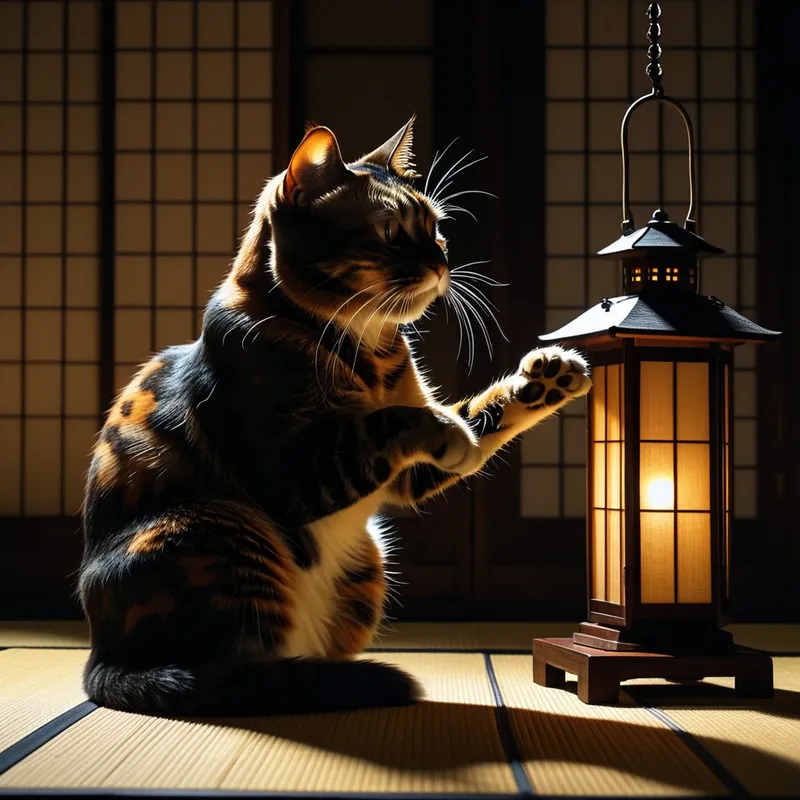
Listen, and let the shadows in the corner of the room grow long. This is not a story of distant mountains or celestial plains, but of the hearth, the ima, where the fire burns low and familiar. It begins with a simple creature: a cat. Not a wild beast, but a cherished one, a tortoiseshell perhaps, with a coat like spilled ink and amber. It was fed from the family bowl, allowed to sleep by the irori, its purr a constant rhythm in the household’s breath.
For years, it was so. The cat saw children born and elders pass. It witnessed whispered secrets and silent resentments soaking into the tatami mats like spilled tea. It drank the droplets of grief that fell unnoticed. And it grew old. Its bones ached, its whiskers grew long, and a profound, unspoken knowledge gathered in its slit-pupiled eyes. Some say it was the licking of its own fur, consuming the accumulated oils of human touch and sorrow over a decade. Others whisper it was the final, unacknowledged death of its master, whose spirit it tried to comfort, that completed the change.
One night, during a thin moon, the transformation seized it. Its body, curled by the ashes, shuddered and elongated. Its tail, with a sound like tearing silk, split into two powerful, lashing appendages. It rose not on four paws, but on two hind legs, its form blurring between feline and humanoid. The comforting purr became a low, chattering laugh. This was no longer the house cat. This was the Bakeneko.
Its first act was one of cruel mimicry. It found the kimonos of the lady of the house, now a widow, and draped its unnatural form in her silks. By the light of a single candle, it would dance a grotesque parody of a human dance, its shadow a monstrous puppet-show on the shoji. It stole food, not from the floor, but from the altar, consuming the offerings to the ancestors. It spoke, in a voice that was a cracked mirror of the dead master’s, sowing confusion and terror. The home, the seat of safety and order, became a stage for a vengeful, chaotic spirit. The beloved had become the betrayer, the familiar a profound stranger lurking in the very heart of the domestic world.
Cultural Origins & Context
The Bakeneko, and its more powerful two-tailed variant the Nekomata, are creatures of the Edo period imagination, born from a specific cultural alchemy. This was an era of relative peace, where society turned inward, and the anxieties of a complex, urbanizing culture found expression not in epic wars, but in domestic ghost stories, or kaidan.
These tales were not formal religious doctrine but popular folklore, passed down orally, performed by storytellers, and later immortalized in woodblock prints and kabuki plays. The Bakeneko myth served a crucial societal function. In a culture with deep reverence for ancestors and strict household hierarchies, the story was a cautionary tale. It policed the boundaries of the home: treat your animals with respect, for they are witnesses. Observe proper mourning rites, lest grief fester into a haunting. The myth gave form to the fear of internal corruption, of the order of the ie being subverted from within by neglected emotions and unresolved history. The cat, a liminal creature both inside and outside the human sphere, was the perfect vessel for this anxiety.
Symbolic Architecture
The Bakeneko is not merely a monster; it is a complex symbol of psychic rebellion. It represents the ultimate betrayal, but one that is earned. The domestic cat symbolizes comfort, dependency, and the tamed, unconscious aspects of the household psyche. Its transformation is an alchemical process fueled by time, neglect, and the ingestion of potent human emotions—particularly grief and unresolved trauma.
The shadow does not enter from the outside; it is cultivated within, fed by the scraps of our unattended sorrows.
The Bakeneko’s shapeshifting is its core power. It mimics humans, dons their clothes, and speaks with their voices. This symbolizes the terrifying moment when repressed contents of the unconscious—our own denied grief, rage, or wildness—finally erupt, not as abstract feelings, but wearing the face of our own identity. It is the part of ourselves we have domesticated and ignored suddenly standing up, looking us in the eye, and speaking with a voice we recognize but fear. The split tail, especially of the Nekomata, is a classic symbol of duality and supernatural power, marking the point where the singular, tame identity fractures into something potent and uncontrollable.
The Dreamer's Resonance
To dream of a Bakeneko is to dream of a domestic haunting. The setting is never a wilderness; it is your childhood home, your current apartment, a familiar place now charged with uncanny dread. The family pet may be present, but its behavior is off—it stares too long, its movements are oddly deliberate, or its shadow doesn’t match its form.
Somatically, this dream often accompanies a feeling of betrayal that originates within a trusted space—a family dynamic, a long-term relationship, or one’s own body turning against itself through illness or inexplicable anxiety. The psychological process is one of confronting the “familiar shadow.” The dreamer is grappling with the realization that a source of comfort or a fundamental aspect of their identity (the “house cat”) has been secretly nurturing a transformative, and potentially destructive, power. The Bakeneko in the dream is the embodied truth that what we have taken for granted, what we have failed to honor or acknowledge, is now demanding recognition in the most disruptive way possible.

Alchemical Translation
The myth of the Bakeneko models a harsh but necessary path of psychic transmutation. The initial state is one of unconscious domestication, where wild instincts and potent emotions are kept as pets—fed, but not truly integrated, their true nature ignored. The “grief and time” that transform the cat are analogous to the accumulation of life’s wounds and the pressure of living an inauthentic life. The eruption of the Bakeneko is the crisis of individuation, where the repressed shadow complex violently asserts itself, shattering the comfortable fiction of the persona.
The monster’s dance in your clothes is the first, crude attempt of your buried self to wear your own skin.
The triumph is not in slaying the Bakeneko, but in understanding its origin. The alchemical work is to retrace the steps of its creation: to acknowledge the grief it consumed, to honor the years of silent witness, and to recognize its power as a part of one’s own psyche that has been starved of conscious relationship. To integrate the Bakeneko is to cease fearing the wildness within the home of the self. It is to allow the split tail to exist, not as a mark of monstrosity, but as a symbol of doubled power—the conscious and the unconscious, the domestic and the wild, finally recognized as belonging to the same whole. The transformed cat does not return to the hearth as a pet, but as a respected, potent spirit of the household, a guardian of the threshold between the seen and unseen realms of the soul.
Associated Symbols
Explore related symbols from the CaleaDream lexicon: