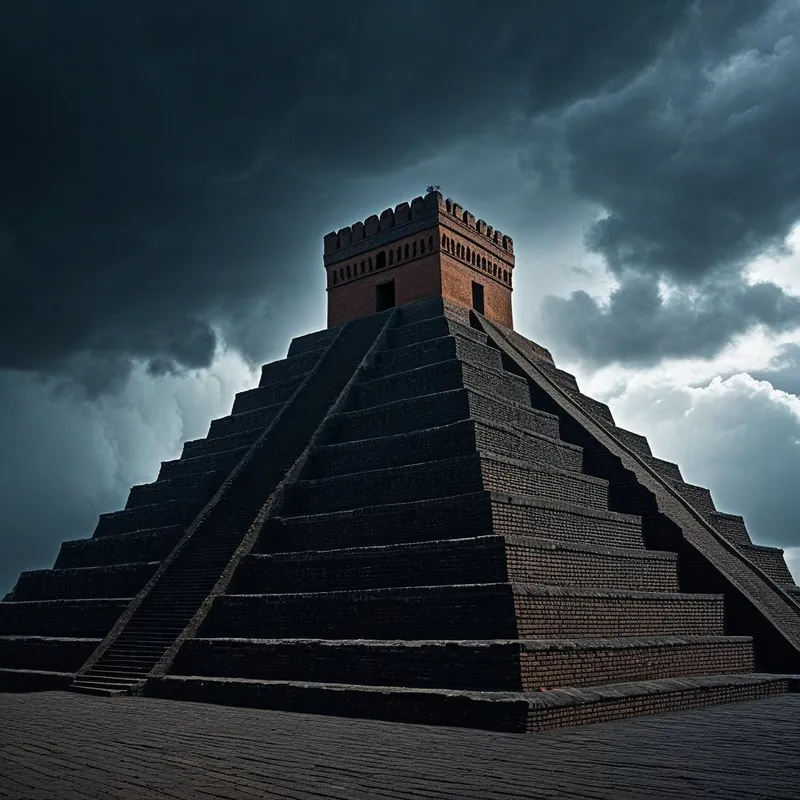
Babel Myth Meaning & Symbolism
A story of humanity's united ambition to build a tower to heaven, halted by a divine scattering of language, seeding the world's diversity and discord.
The Tale of Babel
In the beginning, after the great waters had receded, the whole earth was of one language and one speech. And the children of men, multiplying in the land of Shinar, said to one another, “Come, let us make bricks, and burn them thoroughly.” And they had brick for stone, and bitumen for mortar. A fire of purpose burned in their collective breast, a singular will.
They looked upon the empty plain and the vast sky and declared, “Come, let us build ourselves a city, and a tower whose top is in the heavens. Let us make a name for ourselves, lest we be scattered abroad upon the face of the whole earth.” It was not a prayer, but a proclamation. The ambition was a physical thing, a heat rising from the kilns that baked their bricks. The sound was a symphony of unified labor: the slap of wet clay, the rhythmic chant of haulers, the precise calls of masons. The tower began to rise, a monstrous ziggurat of human making, tier upon tier, a stairway not for gods to descend, but for humanity to ascend.
It climbed, blocking out the sun for those at its base, its shadow a creeping claim upon the earth. The air grew thin at its heights, but the builders climbed higher, their eyes fixed on the heavens they sought to conquer. The scent of bitumen and sweat filled the air, and the glow of their kilns at night rivaled the stars they sought to reach.
Then, Yahweh came down to see the city and the tower which the children of men had built. And Yahweh said, “Behold, they are one people, and they have all one language; and this is only the beginning of what they will do. Now nothing that they propose to do will be impossible for them.” There was, in the divine voice, a note not of anger, but of profound and terrible recognition. The unity itself was the threat, a power unchecked.
“Come,” said Yahweh, a word echoing their own, but with cosmic finality. “Let us go down, and there confuse their language, that they may not understand one another’s speech.” The descent was not of form, but of consequence. It began as a subtle wrongness—a foreman’s command heard as gibberish, a request for water met with a look of blank terror. The unified symphony shattered into a cacophony of frantic, isolated noises. The chant became a babble. A man pointed to a brick and uttered a sound; his companion heard only an insult or a plea for something unknown. Frustration curdled into panic, then fear, then rage. The cooperative organism of humanity fractured into a thousand confused and hostile cells.
They left off building the city. Their great work, the symbol of their name and their unity, stood abandoned, a monument to a shattered dream. Yahweh scattered them abroad from there over the face of all the earth. The tower was named Babel, for there Yahweh confused the language of all the earth. And from there, Yahweh scattered them abroad over the face of all the earth. The plain of Shinar was left with a silent, unfinished finger pointing at a heaven that had become infinitely distant.
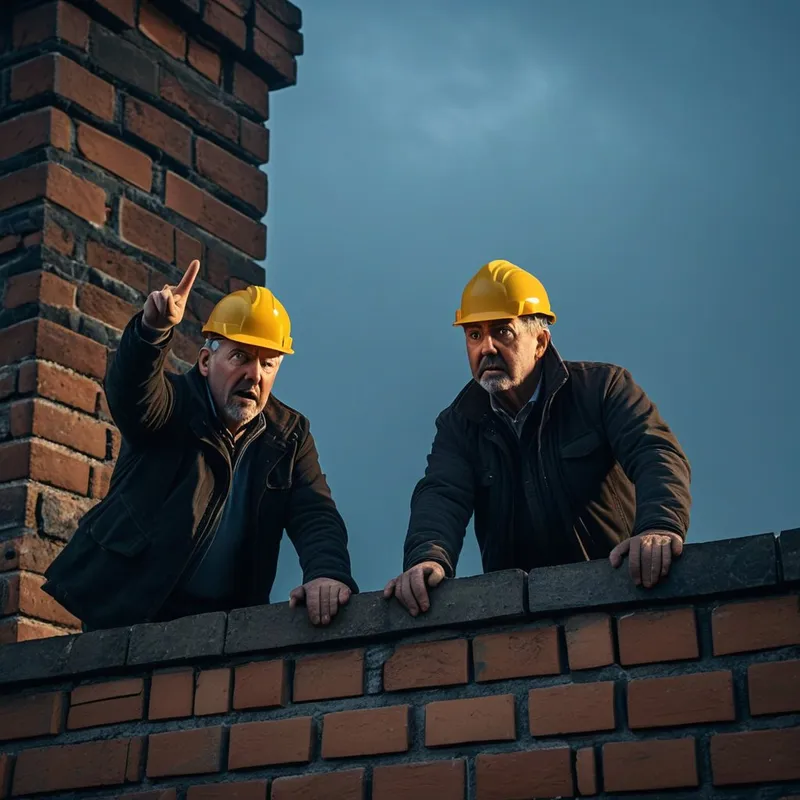
Cultural Origins & Context
This compact, potent narrative is found in the Book of Genesis (11:1-9), a foundational text of the Hebrew Bible. It functions as an etiological myth—a story explaining the origin of a phenomenon, in this case, the vast diversity of human languages and the dispersed, often conflicted state of global nations. Scholars situate it within the Pentateuch's "primeval history" (Genesis 1-11), a series of stories that move from cosmic creation to the particular calling of Abraham. Babel is the climax of this pre-Abrahamic cycle, following the Garden, Cain and Abel, and the Flood. It provides the "why" for the world Abraham is born into: a world of separation.
The tale likely draws upon and polemicizes against Mesopotamian culture, where massive temple-towers called ziggurats (like the famous Etemenanki of Babylon) were seen as bridges between heaven and earth, the domains of gods and kings. The Biblical authors transform this symbol of imperial and cultic power into a symbol of human hubris. Told and preserved by priestly and wisdom traditions, the myth served to explain Israel's place among the nations: scattered not by chance, but by a divine act that set a boundary between the human and the divine, making Israel's later covenant with Yahweh a unique healing of that rupture.
Symbolic Architecture
The Tower of Babel is not merely a story about language. It is a master symbol of the psyche's encounter with its own limits and the divine Self.
The tower is the monument of the unified ego, a psychic structure built from the bricks of will and the mortar of consensus, seeking to displace the transcendent.
The "one language" represents a state of unconscious identification—a collective psyche with no internal differentiation, where the individual is subsumed by the group's will. This is not true unity, but uniformity, a powerful but primitive force. The drive to "make a name for ourselves" is the ego's desire for self-deification, to achieve immortality and centrality through its own works, refusing the condition of being a created, dependent thing.
The divine descent and confusion of tongues is often read as a punishment, but from a depth perspective, it is a necessary, if traumatic, act of differentiation. It is the intervention of the Self that shatters the monolithic ego-complex to prevent a total identification with consciousness, which would be psychic death. The resulting "confusion" is the birth of subjectivity, of inner space. The other's speech becomes opaque, forcing introspection, the development of inner dialogue, and the painful, creative work of seeking understanding across a gap.
Scattering is the prerequisite for individuation. One must be exiled from the collective certainty of the tribe to begin the journey toward the authentic self.

The Dreamer's Resonance
When the Babel pattern arises in modern dreams, it signals a critical juncture in the dreamer's relationship with their own ambitions and their community. To dream of a vast, impossible construction project—especially one that feels hubristic, chaotic, or doomed—points to an ego-inflation. The psyche is warning that one's conscious plans are overreaching, built on a foundation of "burned brick" (rigid, burnt-out ideas) and "bitumen" (sticky, unconscious attachments), rather than living stone.
Dreams of being in a crowd where suddenly no one understands you, or where language dissolves into nonsense, reflect a somatic experience of profound alienation. This is not merely social anxiety. It is the feeling of the conscious mind losing its connection to the guiding languages of the unconscious—the symbolic language of dreams, the somatic language of the body, the intuitive language of the soul. The dreamer may be undergoing a process where old ways of communicating with themselves and the world are breaking down. The frustration and rage felt in the dream are the birth pangs of a new, more complex psychic structure struggling to emerge from the collapse of a simpler, more unified, but ultimately limiting, state.

Alchemical Translation
The alchemical process mirrored in Babel is the Nigredo—the blackening, the necessary dissolution of a prima materia that is too solidified. The conscious personality, identified with its grand project and its collective agreement, must be broken apart for transformation to occur.
The alchemical work begins with the opus of building the tower: the conscious effort, the focused will, the gathering of resources. This is necessary. One must have an ego, a structure, to be dissolved. The divine wind that "confounds the language" is the influx of the unconscious—the Massa Confusa—that disrupts the tidy order of the conscious mind. The old, unified meaning falls apart.
The psychic transmutation occurs not in the building, but in the scattering. The individuation journey begins at the base of the abandoned tower, in the bewildered silence after the crowd has left.
The modern individual's "Babel moment" is the crisis where life plans shatter, relationships based on false understanding end, or a career built on borrowed identity collapses. It feels like a curse, a fragmentation. Yet, this is the alchemical separatio. The scattered pieces—the different "languages" of one's talents, conflicts, and roles—must now be acknowledged as distinct. The work is no longer to build a single tower to heaven (a perfect, idealized self), but to learn to translate between these inner nations, to find the hidden unity that underlies the diversity of the psyche. This is the slow, lifelong work of the Magnum Opus, which leads not to a tower visible to all, but to an inner, living city where difference is held in a state of sacred communication.
Associated Symbols
Explore related symbols from the CaleaDream lexicon: