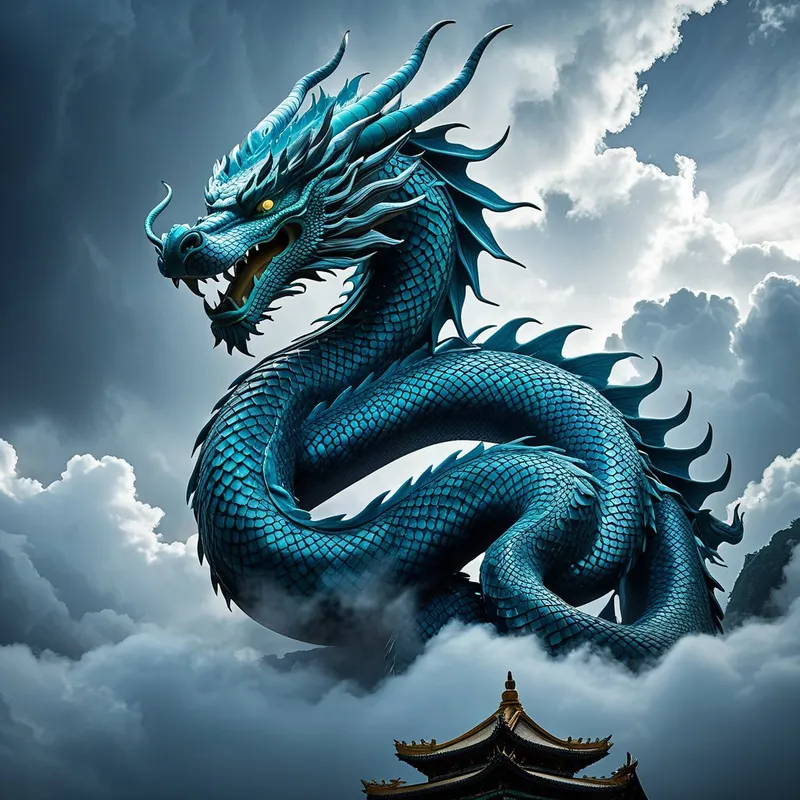
Azure Dragon Myth Meaning & Symbolism
The celestial Azure Dragon, sovereign of the East and spring, embodies cosmic order, benevolent authority, and the potent yang energy of renewal and ascension.
The Tale of Azure Dragon
Before the world knew its name, there was a stirring in the Void of the East. From the churning mists of pre-dawn, before the sun had ever carved its path, a presence gathered. It was not born, but manifested—a coalescence of the first breath of spring, the gathering force of a thunderhead, and the unyielding promise of the rising sun.
The people below, in their river-valley kingdoms, knew only the chaos of untamed seasons and the terror of celestial disharmony. The winds howled without reason; rains drowned or withheld their bounty. The world was a body without a spirit, a kingdom without a king.
Then, a sound—not a roar, but a deep, resonant hum that vibrated in the marrow of the mountains and the roots of the bamboo forests. The eastern horizon, which had been a flat line of grey, began to swell. Clouds spiraled into being, not as harbingers of destruction, but as a royal procession. And within them, He revealed Himself.
The Qing Long was a vision of terrifying benevolence. His body, longer than the greatest river, was sheathed in scales of living jade and deepest lapis, each one holding a captured star-gleam. His antlered crown spoke of ancient, vegetative wisdom, while his whiskers flowed with the currents of the high winds. His eyes were not pits of fire, but pools of calm, luminous authority, seeing the pattern of all things.
He did not descend to the earth. He arranged it. With a sinuous movement of his celestial form, he drew the wild winds into orderly currents—the gentle zephyrs of spring. His breath, cool and moist, summoned the life-giving rains to fall in their proper time and measure. Where his shadow passed, the hard frost of winter retreated, and the seeds in the black soil dared to stir. He appointed the Blue Dragon's Mansions in the sky as his unchanging court, a clockwork of stars by which the seasons could now be faithfully told.
His conflict was not with a monster, but with Chaos itself. His rising action was the very turning of the world from formlessness to form. The resolution was not a battle's end, but the establishment of a perpetual, graceful rule. The people looked east and felt not fear, but a profound relief—the relief of cosmic order. They saw the spring come reliably, they felt the predictable shift of the winds, and they knew, in their bones, that a sovereign of immense power and profound benevolence held the eastern quadrant of the world in his unwavering grasp. The myth was not an event, but the revelation of an eternal, structuring principle.
Cultural Origins & Context
The Azure Dragon is no mere folktale, but a cornerstone of the Chinese cosmological worldview. Its origins are inextricably linked to the system of the Si Xiang or Four Symbols. This schema emerged from ancient Chinese astronomy, where the night sky was divided into four celestial palaces, each corresponding to a season and a direction. The cluster of stars we know as the constellation Draco was seen by early Chinese astrologers as the form of the Azure Dragon, ruling the eastern palace and the season of spring.
This myth was propagated and formalized by court astronomers, philosophers of the Yin-Yang and Wu Xing schools, and later, Daoist mystics. It was a myth told not around a hearth, but in observatories and imperial courts. Its societal function was profound: it provided a sacred map of the cosmos, legitimizing the emperor's role as the "Son of Heaven" who maintained earthly order in alignment with these celestial powers. The dragon adorned military banners (as the guardian of the east), informed architectural principles (like palace layout and city planning according to Feng Shui), and dictated the ritual calendar. It was a myth that governed reality.
Symbolic Architecture
Psychologically, the Azure Dragon is the archetype of benevolent, structuring consciousness. It represents the principle of Yang in its most refined and potent form—not brute force, but the active, ordering, and life-giving force of the universe.
The Dragon does not conquer the land; it reveals the land's true, harmonious form by subduing the chaos within itself.
It symbolizes Sovereign Order. Unlike the Western dragon often hoarding gold, the Azure Dragon is the treasure—its very presence bestows fertility, seasonal regularity, and cosmic law. It is the internal "ruler" faculty that organizes our inner chaos into a functional psyche, establishing boundaries, rhythms, and purpose.
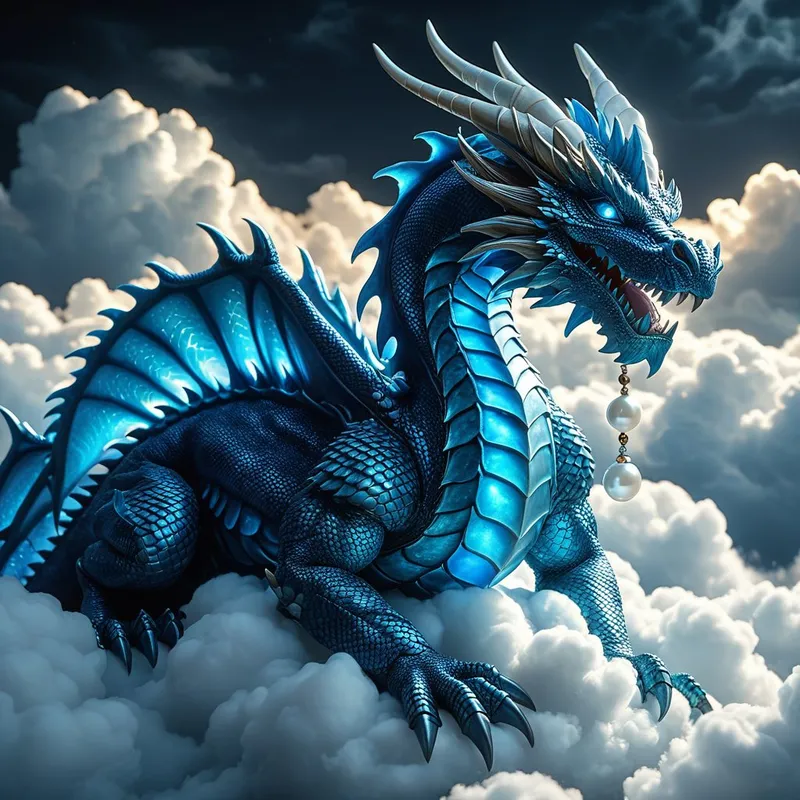
It is also the emblem of Ascension and Potential. Associated with the Wood element and spring, it embodies upward growth, expansion, and the awakening of latent potential. The dragon's ascent into the heavens mirrors the soul's journey towards enlightenment, wisdom, and the integration of higher consciousness. Its pearl, often depicted clutched in its claw or beneath its chin, symbolizes wisdom, spiritual essence, or the elusive goal of perfection—the treasure of the integrated Self.
The Dreamer's Resonance
When the Azure Dragon glides into the modern dreamscape, it signals a profound psychological process underway. It is not the dream of the chaotic, fiery Shadow, but of the organizing, authoritative Self.
To dream of the Azure Dragon watching from the east may coincide with a life phase where one is establishing new order—starting a family, founding a business, or committing to a disciplined spiritual path. The somatic sensation is often one of deep, calm power in the chest and spine, a feeling of being "upright" and supported by a larger, cosmic framework. If the dragon is obscured or struggling, it may reflect the dreamer's conflict with imposing necessary structure, a fear of their own authority, or a feeling of being out of sync with life's natural cycles (a perpetual "winter" in the soul). The dream calls for the conscious assumption of responsibility for one's own inner kingdom.
Alchemical Translation
The myth of the Azure Dragon models the alchemical stage of Coagulatio—the process where the volatile insights and chaotic emotions of the unconscious are given stable, enduring form. The individuation journey is not only about diving into the depths (the Zhu Que's fire) but about structuring what is discovered there into a livable, functional life.
The psychic transmutation is from the lead of chaotic potential into the gold of realized, benevolent power.
First, one must recognize the "eastern quadrant" of one's own psyche—the domain of new beginnings, growth, and conscious action. The "chaos" it subdues is our own internal disorder: procrastination, ambivalence, and the tyranny of unregulated impulses. The dragon's "ascension" is the disciplined, daily effort to elevate one's perspective from petty concerns to a sovereign view, aligning personal will with a deeper, transpersonal pattern (one's destiny or Dao).
The ultimate alchemical translation is becoming the ruler of one's own inner seasons. To integrate the Azure Dragon is to no longer be victim to emotional winters or manic summers, but to understand their place in a larger cycle you oversee. You hold the pearl of your own hard-won wisdom. You breathe the winds of change with intention, not fear. You become the calm, potent center around which your world—once chaotic—now gracefully, and reliably, turns.
Associated Symbols
Explore related symbols from the CaleaDream lexicon: