Aziza Forest Spirits Myth Meaning & Symbolism
A myth of benevolent, dwarf-like forest spirits who gifted humanity with fire, hunting, and craft, teaching a sacred covenant with the wild.
The Tale of Aziza Forest Spirits
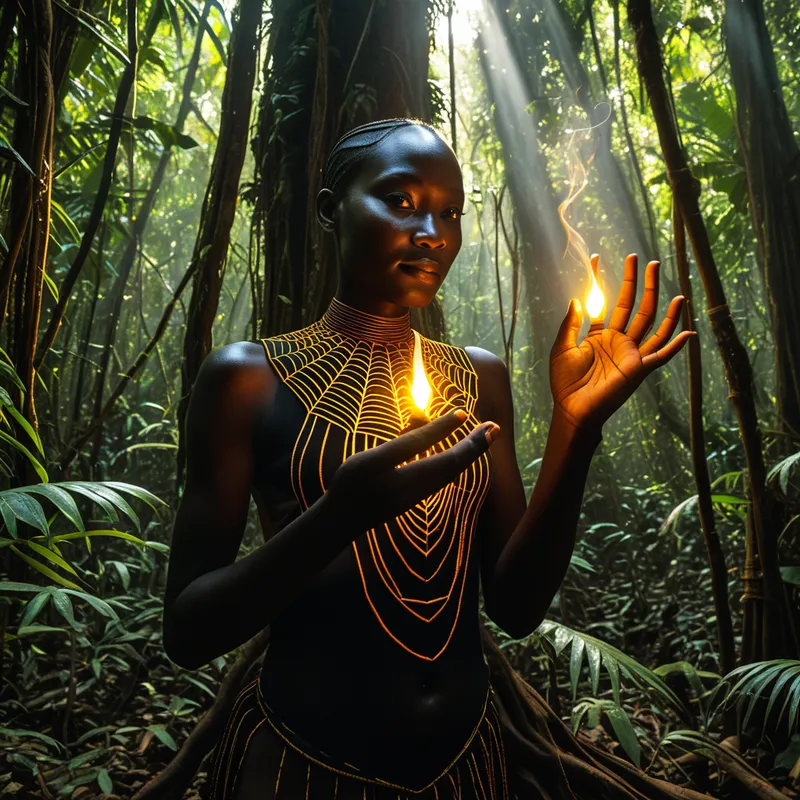
Listen. Before the world was mapped and named, when the air was thick with the scent of damp earth and blooming strangler figs, the deep forests of the world were not empty. They were home. Not just to the leopard and the hornbill, but to the First People of the Wood—the Aziza.
They were small, these ancient ones, no taller than a man’s knee, with skin the color of rich soil and eyes that held the quiet gleam of foxfire. They did not walk so much as shimmer between the buttress roots of the iroko trees, their laughter the soft rustle of dry leaves, their language the hum of cicadas. They were the keepers of the forest’s secret heart, the weavers of the unseen web that connected root to branch, predator to prey.
In those early days, humanity lived in fear at the forest’s edge. The night was a cold, toothy maw. Food was scavenged, not hunted. Tools were crude stones. The people shivered in the dark, ignorant of the spark that could push back the shadows.
One evening, a hunter, driven by desperation deeper than fear, strayed far into the Aziza’s domain. He was lost, his spirit frayed like a torn vine. As the indigo twilight descended, he sank to his knees at the base of a great tree, his breath a ragged prayer. It was then he saw them—a gathering of tiny figures in a clearing lit by no moon. They moved with a purpose he could not comprehend, their small hands working with impossible skill.
One, older than the rest, with moss for hair and eyes like still pools, approached. It did not speak with a tongue, but placed an image directly into the hunter’s mind: the friction of dry wood, the careful nurturing of a tiny glow, the blossoming of a warm, dancing light—Fire. Then came other visions: the crafting of a bow from resilient wood, the knapping of a sharp stone point, the silent tracking of game.
The hunter awoke at dawn, alone. But in his hands was a neatly tied bundle of specific dry grasses and a piece of ironwood. And in his mind, a perfect, burning knowledge. He returned to his people not just with a story, but with a revolution. He showed them the gift. He taught them the craft. For the first time, night was not an end, but a time of community around a protective flame. For the first time, the hunt was a dialogue, not a desperate gamble.
But the Aziza had given a second, silent lesson with their gift. The hunter remembered the feeling in that clearing—a profound respect, a sense of being a guest in a living, conscious sanctuary. The gift was not free. It was an exchange. It demanded gratitude, restraint, and the understanding that to take from the forest, one must also give back, must honor the spirit within the tree and the creature. This was the unspoken covenant.
Cultural Origins & Context
The myth of the Aziza originates primarily among the Fon and Yoruba peoples of West Africa, in the region that encompasses present-day Benin, Togo, and southwestern Nigeria. They are classified among the myriad of Orisha and lesser spirits that populate a cosmos seen as deeply animate and interconnected.
This was not a myth confined to formal priesthoods, but a living story told by elders and hunters—those who interacted most intimately with the boundary between the village and the wild. It functioned as a foundational ethical and pedagogical narrative. It explained the origins of crucial technologies (fire, tool-making, hunting) not as human inventions, but as sacred gifts, thereby embedding an immediate moral framework around their use. The story taught that advanced knowledge comes from outside the human ego, from respectful engagement with the more-than-human world. It served as a core component of environmental ethics, instilling in each generation the principles of sustainable hunting, mindful foraging, and ritual propitiation for resources taken.
Symbolic Architecture
The Aziza represent the archetypal spirit of the wilderness itself—not as a threatening chaos, but as a benevolent, ancient repository of wisdom. They are the personification of nature’s inherent intelligence, the hidden logic of ecosystems, the symbiotic relationships unseen by the cursory glance.
The first true teacher is not a human, but the spirit of the place that reveals itself only to the humble and the receptive.
Psychologically, they symbolize the transcendent function, the aspect of the psyche that holds the reconciling knowledge which can resolve the tension between our primal, instinctual state (the cold, fearful night) and our civilized, technological potential (the warm, communal fire). The hunter’s journey into the forest is a descent into the unconscious. His moment of despair and surrender is the necessary precondition for the reception of this transformative wisdom. The Aziza do not seek him out in his village; he must venture to the threshold of their world, demonstrating a need born of authentic struggle.
The gifts themselves are deeply symbolic: Fire is illumination, culture, transformation, and psychic energy. The hunting tools represent focused skill, the ability to direct intention and sustain life. Together, they mark the leap from mere survival to conscious, empowered existence.

The Dreamer's Resonance
When this myth pattern stirs in the modern dreamscape, it often manifests as dreams of being lost in a vast, beautiful, but unfamiliar forest. One may encounter small, wise, or helpful non-human figures—animals with knowing eyes, glowing insects that form patterns, or indeed, elf-like beings. The dreamer is typically in a state of confusion or seeking, and the encounter brings a sudden, clear download of understanding, a “knowing” about how to solve a persistent life problem or craft something new.
Somatically, this can correlate with a release of tension in the chest and solar plexus—the place of anxiety and “not knowing.” The psychological process is one of reconnecting with innate, instinctual wisdom that feels alien to the conscious, over-civilized mind. It is the psyche’s way of initiating a retrieval. The dream is saying: the knowledge you seek for this creative endeavor, this life transition, or this healing is not “out there” in more data, but “in here,” in the deep, animate intelligence of your own unconscious wilderness. You must become the lost hunter, acknowledge your need, and be ready to receive.

Alchemical Translation
The alchemical journey modeled by the Aziza myth is one of sacred exchange, the core of psychic transmutation. The prima materia is the raw, fearful, undeveloped human consciousness (the hunter in the dark). The nigredo, or blackening, is his despair and admission of ignorance at the base of the great tree—the dissolution of egoic certainty.
Individuation begins not with a conquest, but with a petition at the roots of the world.
The encounter with the Aziza is the albedo, the whitening—the illuminating insight that comes from the union of the conscious mind with the benevolent spirit of the deep Self. The gift of fire is the citrinitas, the yellowing—the awakening of creative energy and conscious skill. But the process is incomplete without the final stage: the rubedo, the reddening.
This is the return to the community and the integration of the gift with the covenant. For the modern individual, this is the critical step. We receive insights, talents, and energies from the unconscious. The alchemical error is to hoard this as personal power, to use it only for selfish gain (exploiting the forest without honor). The Aziza myth dictates that true individuation requires us to use our gifts responsibly, to give back, to honor the source. It transmutes personal insight into ethical wisdom, and psychic energy into cultural contribution. The completed “Philosopher’s Stone” is not a solitary enlightenment, but a conscious life lived in respectful, reciprocal relationship with the inner and outer wilderness from which all true power flows.
Associated Symbols
Explore related symbols from the CaleaDream lexicon:
- Forest — The primordial realm of the unconscious, a place of mystery, danger, and profound wisdom where the conscious ego ventures to meet the unknown.
- Spirit — The essential, non-material intelligence and animating force within all things, represented by the Aziza as benevolent guides from the unseen world.
- Fire — The transformative gift of illumination, culture, and psychic energy bestowed upon humanity, symbolizing the spark of consciousness and technological mastery.
- Journey — The necessary descent or quest into the unknown (the deep forest) which is the prerequisite for receiving transformative knowledge and growth.
- Gift — The sacred knowledge or power offered by the more-than-human world, which carries an implicit moral covenant of respect and reciprocity.
- Tree — The axis mundi or world pillar, often an iroko, representing stability, connection between worlds, and the site of revelation and surrender.
- Dream — The state of receptive consciousness, akin to the hunter's twilight experience, where direct communication from the deep psyche becomes possible.
- Mystical Forest — The enchanted, animate aspect of the wilderness where normal laws are suspended and communion with spiritual entities occurs.
- Root — The hidden, foundational source of wisdom and connection, from which all growth emerges and where one must go to receive nourishment.
- Ancestral Spirits — The Aziza as ancient, pre-human keepers of wisdom, representing the deep time and inherited intelligence of the land itself.
- Bridge — The moment of connection and exchange between the human world and the spirit world, facilitated by humility and need.
- Knowledge — The practical and spiritual wisdom transferred from spirit to human, which elevates existence from mere survival to conscious culture.