Ayodhya Myth Meaning & Symbolism
The story of the perfect city, its exiled divine king Rama, and the epic quest to restore cosmic order, dharma, and the kingdom within.
The Tale of Ayodhya
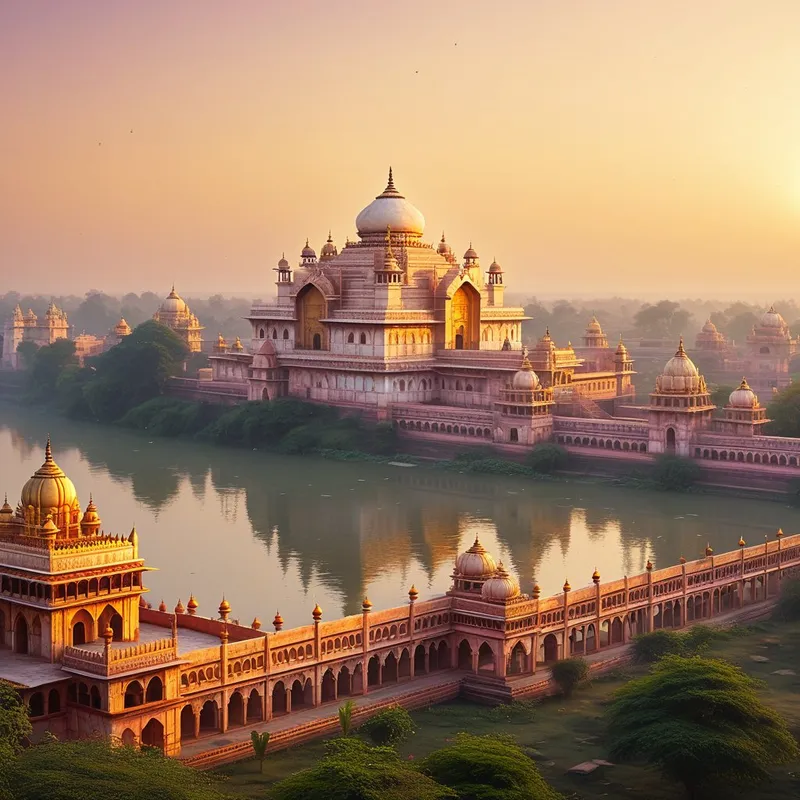
Listen. There was a city that was not merely built, but conceived. It was the first thought of perfect order made manifest in stone, water, and light. Its name was Ayodhya, “the Unassailable.” It rose on the banks of the gentle Sarayu, its towers like spears of dawn catching the first fire of the sun, its walls white as the moon’s own promise. Here, under the just and beloved rule of King Dasharatha, the wheels of dharma turned without a whisper of friction. Joy was not an event but the very air they breathed.
Into this perfection was born Rama, the prince whose smile held the warmth of a thousand suns and whose gaze held the depth of a still ocean. He was the heart of the city, its heir, its future king. His marriage to Sita, who emerged from the sacred earth itself, sealed the union of righteous kingship and fertile sovereignty. All was in alignment, a celestial harmony poised to endure for ages.
But harmony is the most fragile of states. In the shadowed corners of the palace, a promise once whispered in passion now coiled like a serpent. Kaikeyi, the king’s wife, possessed of a fierce love for her own son, Bharata, was poisoned by the whispers of her maid, Manthara. Memory became a weapon. She recalled two boons granted by Dasharatha in a moment of gratitude long past. Now, with cold resolve, she demanded them: first, that her son Bharata be crowned king. Second, and most cruel, that Rama be exiled to the wild forest for fourteen years.
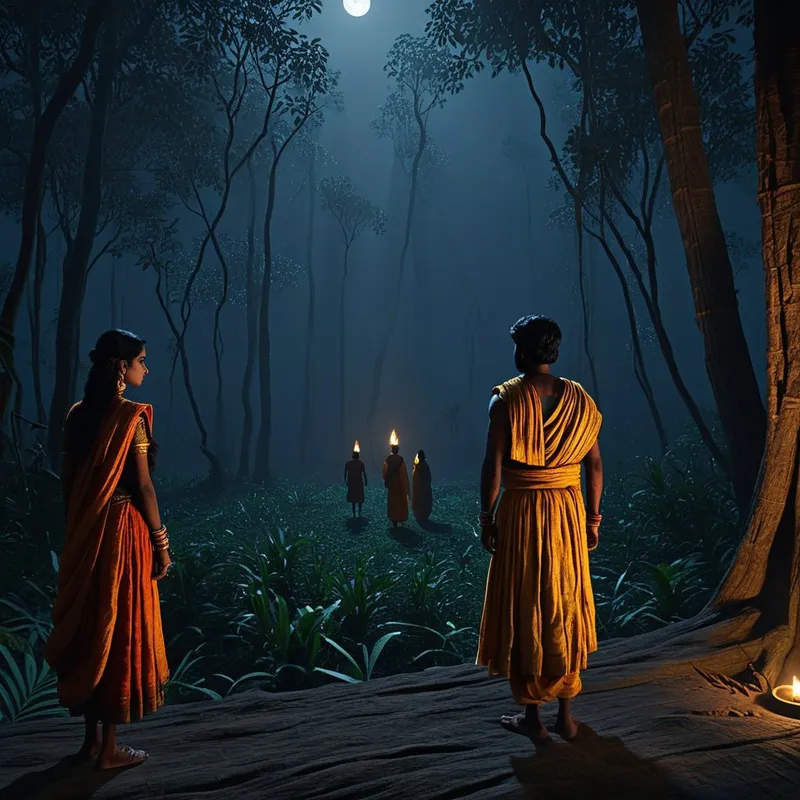
The city held its breath. The king, bound by the terrible law of his own word, shattered like a clay pot. The news fell upon Rama not as a blow of anger, but as a test of essence. Without a flicker of resentment, he accepted. “A father’s word is the foundation of the world,” he said. Sita, whose very nature was the cultivated earth, insisted on sharing the wilderness. His loyal brother Lakshmana, whose nature was protective fire, vowed to follow. As the citizens of Ayodhya wept, the three walked out of the gleaming gates, exchanging silks for bark, palaces for the unknown thickets of Dandaka. The perfect city was left hollow, its heart ripped out and walking into the dark.
The forest was not empty. It was the realm of Ravana, the ten-headed lord of Lanka, whose will knew no boundary. Through deceit, he kidnapped Sita, drawing Rama into a war not for a mere kingdom, but for the soul of creation itself. Alliances were forged with tribes of forest dwellers and monkey warriors, most profoundly with Hanuman, whose leap of faith across the ocean became legend. A bridge was built upon the sea. Lanka burned. Ravana fell.
And after the long, harrowing years, the exile ended. Rama, Sita, and Lakshmana returned. Bharata, who had refused the throne, ruling only as a caretaker with Rama’s sandals upon the seat, wept with relief. The Sarayu’s waters seemed to sing. Ayodhya, dark for fourteen years, was lit with a million lamps, a festival of light welcoming back its stolen dawn. Diwali was born in that moment. The king was home. The circle was closed. Order, tested in the crucible of chaos, was restored—not as it was, but forged into something more profound, more conscious, and eternally resilient.
Cultural Origins & Context
The story of Ayodhya is the spine of the Ramayana, an epic of staggering scale and antiquity, traditionally attributed to the sage Valmiki. Its origins are oral, sung and recited by bards and priests for centuries before being codified in Sanskrit. It functions as both sacred scripture and foundational national literature, defining ideals of kingship (Ramrajya), duty, familial loyalty, and the battle between dharma and adharma.
Unlike myths confined to ritual, the Ramayana is lived. It is performed in village plays (Ram Lila), recited in homes, and embedded in daily language and ethics. Ayodhya is not a lost, symbolic city; it is a living geographical and devotional reality, believed to be the very place where these events transpired. The myth served, and serves, as a societal blueprint, instructing individuals on their roles as rulers, brothers, wives, and subjects, while simultaneously presenting a theodicy—a explanation for why suffering and exile touch even the most perfect of beings.
Symbolic Architecture
At its core, the myth of Ayodhya is a map of the psyche’s journey from innate perfection, through necessary fragmentation, to earned wholeness.
Ayodhya represents the original, unconscious Self—a state of innate order and potential perfection, but one that is untested and therefore naive.
Rama is the conscious ego principle, the part of us that must willingly submit to a higher law (his father’s dharma) and leave the comfort of the known. His exile is the indispensable journey into the forest of the unconscious—the Dandaka where lurk our raw instincts, repressed desires, and shadow figures like the Surpanakha and the titanic Ravana.
Sita symbolizes the anima or the soul’s connection to life and fertility. Her abduction is the inevitable crisis where the conscious ego loses touch with its soul, its meaning, and must embark on a perilous quest to recover it. Hanuman is the embodiment of devoted service, the power of the instinctual nature (the monkey) harnessed and directed by love and discipline, enabling the impossible leap across the ocean of the unconscious.
The fourteen-year exile is the complete cycle of maturation. The return is not a regression to childhood, but the establishment of a conscious kingdom where the ego, having integrated the shadow and recovered the soul, now rules with wisdom.

The Dreamer's Resonance
When the pattern of Ayodhya stirs in the modern dreamer, it often signals a profound process of displacement and reorientation. One might dream of being exiled from a beautiful, familiar home into a bewildering landscape. Or of a cherished partner or inner value (Sita) being stolen by a powerful, shadowy force. The dream-forest is not peaceful; it is dense with unknown creatures and tasks, reflecting the somatic anxiety of life transitions—a career loss, a relational rupture, a spiritual crisis.
The psychological process is one of de-integration. The once-stable identity (the perfect city) is dismantled by an inner or outer demand (Kaikeyi’s boon) that feels unjust but is irrevocable. The dreamer is in the liminal space, the wilderness between who they were and who they must become. The somatic feeling is often of rootlessness, grief for a lost perfection, and a grinding, daily perseverance (the fourteen years). The dream prompts the question: What inner kingdom have I been complacently ruling, and what difficult dharma must I now accept to recover my soul?

Alchemical Translation
The alchemical journey mirrored in the Ramayana is the opus of turning leaden, unconscious existence into the gold of conscious Selfhood. Ayodhya is the prima materia, the original, divine but unawakened state.
The first, crucial stage is separatio, symbolized by the exile. The conscious ego (Rama) must separate from the protective, collective identity of the family and city. This is not a failure, but the beginning of the work. The forest represents the nigredo, the blackening, the descent into the chaotic, shadowy contents of the personal and collective unconscious, where one confronts the Ravana of the psyche—the grandiose, all-consuming ego-inflation that claims the soul for its own possession.
The building of the bridge to Lanka with the help of the Vanaras is the stage of coagulatio—forming new alliances with previously ignored or undervalued parts of the self (instinct, loyalty, playful strength) to concretely approach and engage the core complex.
The battle and victory are the albedo, the whitening, the purification. The fiery ordeal of Sita (her test by fire) is the rubedo, the reddening, the final, passionate integration that proves the soul’s integrity. The return to Ayodhya, now lit by the lamps of hard-won wisdom, is the citrinitas, the yellowing, and the achievement of the hieros gamos of conscious ruler and reclaimed kingdom.
For the modern individual, the myth does not promise a life without exile. It insists that exile is the path. Our personal Ayodhya—be it a relationship, a career, a belief system—will inevitably demand its due. The alchemical translation is the realization that we are not restoring a lost, static perfection. We are, through the willing acceptance of our own forest, building a new city within, whose walls are resilience, whose spires are insight, and whose foundation is a dharma tested in the fires of lived experience. The kingdom is not given; it is returned to us, earned, and shining with a light we had to first lose in order to truly see.
Associated Symbols
Explore related symbols from the CaleaDream lexicon: