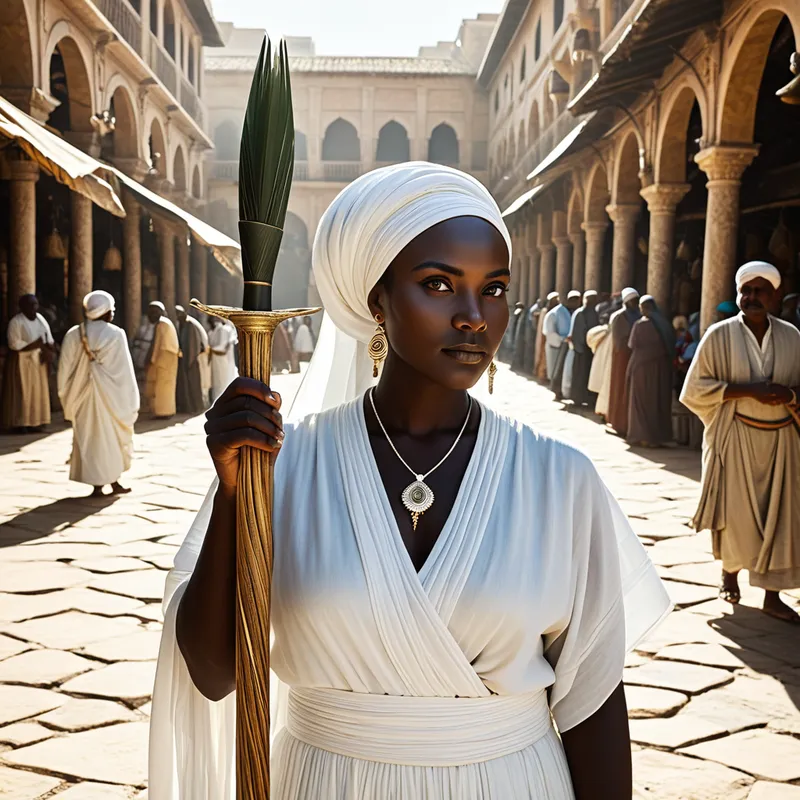
Ayizan the First Priestess Myth Meaning & Symbolism
The myth of the first priestess who descended from the sky to establish sacred order, ritual, and the connection between humanity and the divine.
The Tale of Ayizan the First Priestess
In the beginning, before the rhythms were set and the roads between worlds were clear, there was a great noise. It was the sound of life without pattern, of spirits wandering without home, of human hearts beating out of time with the cosmos. The world was fertile, yes, but it was wild—a marketplace of souls where anything could happen, and often did, with no one to tend the sacred fire at its center.
From the realm of the invisible, the Gran Met looked upon this teeming, beautiful chaos. Creation was complete, but connection was not. The divine laws, the Lwa, flowed like great rivers, but humanity had not yet learned to build the canals to receive them. There was worship, but it was fear-filled and scattered. There was need, but no clear way to call for aid. Something was missing: the first conduit, the primal point of contact, the one who would stand at the threshold and know the protocols of both sides.
And so, she was sent. Not born of the earth, but descending from the sky, from the very court of the creator. Her name was Ayizan. She arrived not with thunder, but with a profound, silencing calm. Her skin held the warmth of the sun, her eyes the depth of a still forest pool. She was clad in immaculate white, the color of purity and the spirit world, and in her hand, she carried not a weapon, but a simple, green palm frond.
She walked directly into the heart of the chaos—the marketplace. Here, goods were traded, news was spread, and life pulsed most fiercely. Here, too, disorder reigned: disputes flared, energies clashed, and the unseen world brushed too roughly against the visible, causing sickness and confusion. Ayizan did not speak. She planted her feet firmly on the dusty ground and raised her palm frond.
A vibration began, not a sound heard by ears, but a frequency felt in the bone. The frond in her hand shimmered. The frantic chatter of the market stilled. The tangled paths of desire and conflict began, slowly, to unravel and re-weave themselves into a discernible pattern. With her presence and her sacred tool, she established the first peristyle. She drew a boundary between the profane and the sacred right there in the midst of everyday life. She showed how to prepare the space, how to call the Lwa with respect, how to make an offering that would be received.
She became the first Mambo, the first master of the rites. She taught the people the songs, the dances, the rhythms of the drums that were the horses for the spirits. She taught them the language of ceremony, the grammar of the invisible. She established order—not the stifling order of a tyrant, but the vivifying order of a master musician who teaches the band to play in harmony. The marketplace became not just a place of trade, but the first temple, proving that the divine could be accessed in the very center of human activity. Having planted the seed of sacred structure, Ayizan did not depart. She became one with the principle she embodied, the eternal priestess, the guardian of the gate, the one who presides over every true beginning.

Cultural Origins & Context
The myth of Ayizan is a cornerstone of the Vodou tradition, a spiritual system forged in the crucible of the African Diaspora, primarily in Haiti. Her story is not found in a single, canonical text but is woven into the oral liturgy, the songs (chante), the ritual narratives, and the teachings passed from priest to priestess, from elder to initiate across generations.
Her origins are deeply rooted in the Fon and Yoruba traditions of West Africa, where she is associated with the earth, the marketplace, and female authority. Transformed in the New World, her narrative took on a foundational, cosmogonic role. In a context of brutal displacement and enslavement, where all traditional social and spiritual structures were violently dismantled, the myth of Ayizan served a crucial sociological function. It provided a divine charter for the re-creation of spiritual order from chaos. It authorized the establishment of new priestly lineages and communities (sosyete) in exile. She became the archetypal model for the Houngan and Mambo, legitimizing their authority not through European colonial structures, but through a direct, primordial link to the source of creation itself. Her story is a myth of cultural survival, asserting that sacred order is not given by the powerful of this world, but is established from the spirit world into the heart of communal life.
Symbolic Architecture
Ayizan is the archetype of the established, consecrated channel. She is not the wild, untamed spirit of inspiration, nor the fierce warrior of justice. She is the calm, authoritative presence that makes sustained relationship with the numinous possible. Her white garments symbolize purity, spirit, and the blank slate of a properly prepared ritual space. Her association with the marketplace is profoundly symbolic: she locates the sacred not in remote isolation, but in the crossroads of human interaction, commerce, and gossip—the messy, vital center of community.
The palm frond is her primary symbol, a tool of immense power. It is not a sword to cut, but a broom to sweep clean, a fan to cool and clarify, a marker that delineates sacred from profane. It represents the establishment of psychic and spiritual structure.
Her myth addresses the human confrontation with primal, undifferentiated spiritual force—an experience that can be overwhelming, chaotic, and even destructive without a container. Ayizan provides that container. Psychologically, she represents the ego's necessary function in service to the Self: it must learn the rituals, the disciplines, the forms that can safely mediate the overwhelming power of the unconscious. She is the principle that transforms raw, archetypal energy into a sustainable, life-giving relationship.

The Dreamer's Resonance
To dream in the pattern of Ayizan is to experience a profound somatic and psychological call to establish inner order. The dreamer may find themselves in a chaotic, crowded, or noisy place—a dream version of the primordial marketplace. This could be a frantic office, a confusing party, or a labyrinthine city. The emotional tone is one of overwhelm, diffusion, and a lack of center.
The emergence of the Ayizan energy in the dream is marked by a sudden, calming presence. The dreamer might see a figure in white, encounter a perfectly arranged geometric pattern, or find themselves holding a simple, natural object like a leaf or branch that inexplicably brings silence and focus. The body sensation upon waking is often one of deep, grounded calm after a storm of anxiety. This dream pattern signifies that the psyche is ready to move from a state of chaotic potential or spiritual crisis towards structured integration. It is the Self prompting the dreamer to become the priest or priestess of their own inner life—to learn the rituals (healthy habits, boundaries, meditative practices) that can "call down" and contain their own powerful energies and insights without being shattered by them.

Alchemical Translation
The alchemical journey modeled by Ayizan is that of coagulatio—the process of giving spirit a body, of bringing the divine down to earth in a stable, lasting form. For the modern individual, the "primordial chaos" is the unintegrated psyche: a swirl of impulses, complexes, spiritual yearnings, traumas, and talents with no governing center or operating protocol. Individuation is not just about experiencing the numinous; it is about building a durable vessel to hold that experience and translate it into a coherent life.
Ayizan’s myth teaches that this vessel is built through conscious ritual and disciplined structure. The "marketplace" is one's own daily life. The "palm frond" is the simple, consistent practice—the morning meditation, the journaling, the therapeutic dialogue, the artistic discipline—that repeatedly sweeps clean the inner space and re-establishes the boundary between the reactive ego and the observing Self.
The ultimate alchemical translation is becoming the priest/priestess of your own destiny. It is the move from being a passive, chaotic recipient of psychic and life events to an active, respectful mediator who knows how to prepare the altar of the heart, call upon the inner archetypes (the Lwa of one's own soul), and receive their gifts in a way that nourishes the whole community of the psyche.
This is not about rigid control, but about cultivated receptivity. It is the triumph of sacred order over chaos, where "order" is understood as the dynamic, living structure that makes deep relationship and sustainable transformation possible.
Associated Symbols
Explore related symbols from the CaleaDream lexicon:
- Marketplace — The chaotic, vital center of human life where Ayizan establishes the first temple, symbolizing that the sacred must be integrated into the mundane, not separated from it.
- Palm Frond — Ayizan's primary tool, representing the establishment of order, the sweeping away of profane chaos, and the creation of a consecrated, protected space for spirit to manifest.
- Priest — Ayizan is the archetypal embodiment of this role, representing the human capacity to mediate between the divine and the earthly, to hold ritual knowledge, and to maintain sacred structure.
- White — The color of her garments, symbolizing purity, the spirit world, readiness to serve as a clear vessel, and the blank slate of a properly prepared ritual space.
- Ritual — The sacred structure and protocol that Ayizan introduces to the world, providing the necessary container for safe and effective engagement with powerful spiritual forces.
- Order — The vivifying principle Ayizan brings, transforming undifferentiated chaos into a harmonious pattern where life and spirit can flow in relationship.
- Temple — The sacred space Ayizan creates in the marketplace, symbolizing the inner sanctuary that must be consciously built and maintained within the psyche.
- Root — Ayizan's connection to the earth and her role as the foundational, grounding source of priestly lineage and spiritual tradition in Diaspora culture.
- First Frost — A symbol of the first, pristine imposition of a new order or pattern upon a fertile but wild landscape, mirroring Ayizan's initial act of structuring chaos.
- Circle — The shape of the sacred space (peristyle) she establishes, representing wholeness, protection, and the cyclical nature of ritual and community.