
Aura Myth Meaning & Symbolism
Aura, the virgin Titaness of the breeze, is violated by Dionysus. Her ensuing madness and transformation into a spring symbolize the shattering of a pure, untamed spirit.
The Tale of Aura
Hear now of Aura, daughter of the ancient Lelantos, whose name means "the Unseen," and of Periboea. She was born of the air before the age of Zeus, a Titaness of the cool, morning breeze that sweeps down from the high mountain peaks. Her form was that of a fierce and splendid huntress, a companion to the great goddess Artemis. Where Artemis strode, Aura followed, a living zephyr at her side. Her pride was as vast as the sky, her purity as unassailable as the north wind. She mocked the softness of love, scorned the weakness of childbirth, and laughed at the goddess Aphrodite, declaring her own lean, athletic form superior to the curves of desire.
This mockery did not go unheard. Aphrodite, whose power none escape, planted a seed of vengeance in the heart of Dionysus. "See how she scorns the sacred rites of life?" the love goddess whispered. "See how she holds herself above the forces that move all things?" And Dionysus, the god who breaks all boundaries, looked upon the untouchable Aura and desired what was forbidden.
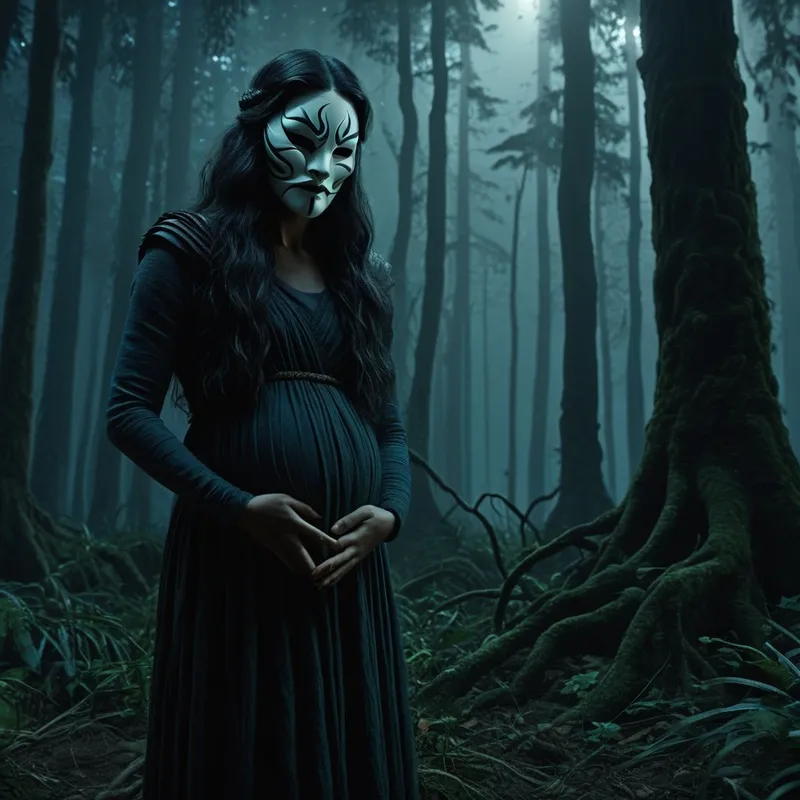
The scene was a resting place after the hunt. Aura, weary, drank deep from a spring—a spring where Dionysus had mingled his divine essence. The potion was not gentle. It was a torrent of forced ecstasy, a violation as sudden and brutal as a summer storm. The cool breeze was engulfed by the fever of the vine. When the madness passed, Aura awoke to a truth that shattered her world. She was with child.
The proud huntress was undone. She fled the company of Artemis, her sanity unraveling like a torn veil in a gale. She roamed the wilds, a figure of torment, until the pangs of birth took her in a lonely grove. Twin sons were born. In a frenzy of postpartum madness, a horror descended upon her. Consumed by a rage she could not name, a grief that had no outlet, she committed an unspeakable act against one of her newborns. The other, Iakhos, was saved by the intervening will of Dionysus.
But for Aura, there was no salvation, only transformation. Her madness complete, she threw herself into the river Sangarius. The gods, perhaps in pity, perhaps in finality, did not let her drown. Instead, they changed her. The Titaness of the breeze, the fierce virgin of the mountains, was dissolved and remade. From her essence, a new spring bubbled forth from the earth—a fountain of clear, cold water that bore her name forever after. The wind was made static; the untamable was made a fixed point on the land. Her story ends not with a death, but with a chilling, eternal sigh from the earth itself.
Cultural Origins & Context
The myth of Aura survives primarily through the late epic poet Nonnus, in his sprawling Dionysiaca. This places its most detailed telling in the Roman Imperial period, a time of syncretism and philosophical complexity. While the figure of Aura herself—a wind nymph or Titaness—is ancient, her tragic narrative arc is a later elaboration. It functions as an aition, a mythic explanation for the origin of a specific spring or locale in Phrygia.
Its transmission is literary and sophisticated, far from the campfire. In Nonnus's hands, the story becomes a dark counterpoint to the celebratory, liberating myths of Dionysus. It served as a grim reminder within the Dionysian cult itself: the god's power to liberate could also destroy; his ecstasy could be a weapon as much as a blessing. The myth explored the terrifying edges of divine interaction, where the clash of archetypes—the Untouched Virgin and the God of Dissolution—could only end in catastrophe. It spoke to a culture deeply aware of the fragile boundary between divine favor and divine wrath, between inspiration and insanity.
Symbolic Architecture
Aura represents the spirit in its most pristine, unintegrated state. She is not merely chaste; she is anti-eros, a personification of a consciousness that defines itself solely by negation and superiority. Her element, the breeze, is telling: it touches everything yet is touched by nothing, it is powerful yet intangible, present yet unseen.
The tragedy of Aura is the tragedy of a purity that has never known its own shadow. It is a fortress with no door, destined not to be entered, but to be besieged and shattered.
Dionysus, in this context, is not a villain but the inevitable psychological force of embodiment. He represents the totality of life—the chaotic, creative, destructive, and generative urges that Aura’s identity vehemently rejects. His violation is the brutal, involuntary irruption of the repressed. The forced pregnancy is the ultimate symbol of this: the sterile self is compelled to create life, to house the very "other" it despised. The ensuing madness is the inevitable collapse of a personality structure when its foundational negation is violently overturned. She is not integrated; she is broken open.
The transformation into a spring is the final, profound symbol. The free-moving wind (spirit, intellect, independence) is fixed into flowing water (emotion, the unconscious, nurture). It is a descent from the head to the heart, a painful grounding. The spring is both a tomb and a birth—the end of Aura as she was, and the beginning of her as a source, however tragically founded.
The Dreamer's Resonance
To dream of Aura’s pattern is to be in the throes of a profound psychic violation. It is not necessarily about physical trauma, but about the forcible introduction of a content—an emotion, a memory, a demand from life—that the dreamer’s conscious identity has walled off with absolute certainty.
The dreamer may find themselves in a high, windy place that suddenly becomes claustrophobic. They may drink from a clear source that turns their mind feverish. They may experience the horror of discovering an unknown, perhaps repulsive, aspect of themselves that is undeniably theirs—a "child" of their own psyche they wish to disown. The somatic feeling is one of gut-wrenching betrayal, not by another, but by reality itself. It is the feeling of a core vow ("I will never be like that," "I am above such things") being irrevocably broken by the psyche's own processes. This is the dreamscape of a rigid persona cracking under the pressure of the Self, often preceding a depressive or psychotic episode, or a necessary, devastating breakdown before a more authentic life can begin.

Alchemical Translation
The alchemical process mirrored here is mortificatio and solutio—the killing and dissolving of a prior form. Aura’s rigid, aerial consciousness must "die" for any integration to occur. In the individuation journey, this myth models the perilous encounter with the Dionysian shadow.
The individuation journey often requires a sacred violation. The part of us that claims perfect autonomy, that lives in the intellect and scorns the messy, generative, emotional body, must be confronted by its own latent fertility.
The modern seeker identifies with Aura in their intellectual pride, their spiritual bypassing, or their emotional detachment. The Dionysian force arrives as a life crisis—an illness, a failed relationship, a burst of irrational rage or desire—that cannot be reasoned away. This is the "rape," the unbearable, involuntary engagement with what was rejected. The ensuing "madness" is the dark night of the soul, where the old identity is in tatters.
The alchemical goal is not to remain mad, but to reach the spring. The transformation into water is the key. It is the slow, painful learning to feel, to flow, to nurture from the very wound. Iakhos, the saved child, represents the potential new life that can emerge from this catastrophe—a connection to the divine (Iakhos was associated with the Eleusinian Mysteries) born from the ruins of the old self. The work is to tend to that spring, to accept that one’s essence is no longer an untouchable breeze, but a source that emerges from the depths, mixed with earth and stone, offering sustenance from its pain. One becomes not "pure," but sourceful.
Associated Symbols
Explore related symbols from the CaleaDream lexicon: