AUM Myth Meaning & Symbolism
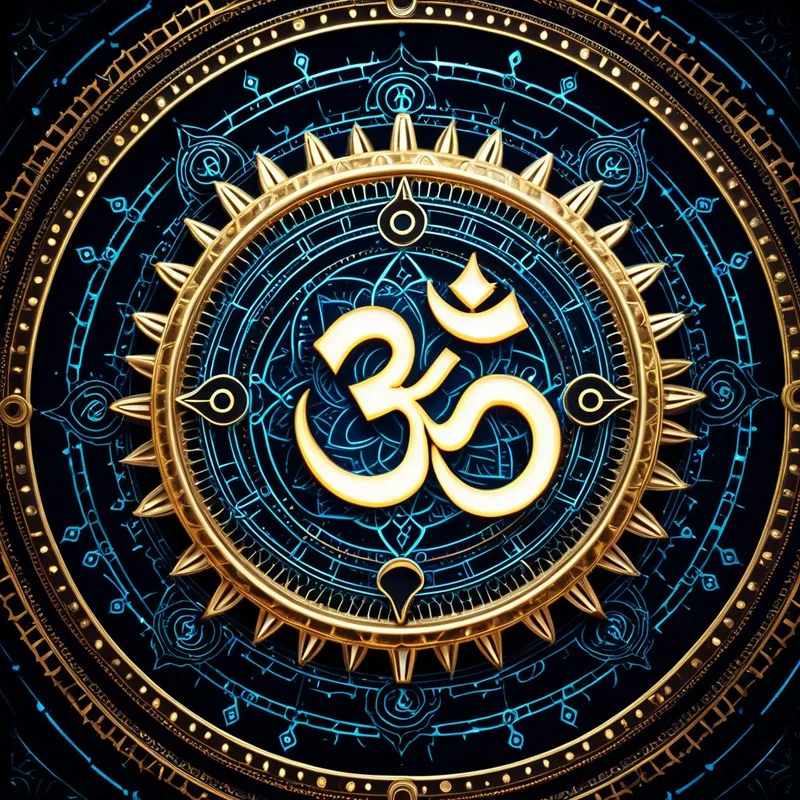
The sacred syllable AUM is the primordial vibration from which all reality emerges, containing the cycle of creation, preservation, and dissolution within its sound.
The Tale of AUM
In the beginning, there was not light, nor dark. There was not earth, nor sky. There was not even silence, for silence is a quality of a world that exists. There was only the Unmanifest, the boundless, undifferentiated potential of all that could ever be. It was a profound, pregnant stillness, a womb of pure consciousness waiting to breathe.
And then… it stirred.
Not with a movement of limbs, for there were none. Not with a thought, for there was no thinker. It stirred with an intention, a primal urge toward expression. From the very heart of that infinite potential, a vibration began. It was not a sound heard by ears, but the first tremor of being itself. It began as a deep, resonant hum, the seed of all frequency. This was ‘A’ (अ), the sound that emerges from the depths of the throat, the beginning of all articulation. It swelled from the core, the creative impulse bursting forth, filling the void with the raw material of existence. Stars spun into being from its resonance; the potential for all form trembled into life.
The vibration evolved, rolling forward. It became ‘U’ (उ), the sound that rolls across the palate, a sustaining wave. This was not a new sound, but the journey of the first sound through the medium of becoming. It carried the creative impulse forward, giving it duration, space, and relationship. The swirling stars found orbits, elements combined, and the dance of preservation began—the long, beautiful sigh of a universe holding itself in being.
Finally, the sound began to close. It tapered into ‘M’ (म), the resonant hum that closes the lips, a completion that is also a return. This was the sound of dissolution, of form folding back into its source. Galaxies cooled, stars died, and all manifested things began their journey home, not into nothingness, but back into the essence from which they came.
But the tale does not end with the closing of the lips. After the ‘M’ fades into silence, there remains the fourth part, the Anusvara. This is the pure, unstruck resonance, the silence from which the sound emerged and into which it returns. It is the witness, the timeless consciousness that contains the entire cycle.
Thus, the one breath of the cosmos is A-U-M-… and the silence that holds it. It is not a word spoken by a god; it is the very breath of Brahman. Every moment, in every atom, this eternal syllable is being chanted. The roaring of galaxies is its ‘A’. The orbit of planets is its ‘U’. The decay of a leaf is its ‘M’. And the space between thoughts, the stillness at the heart of all things, is its transcendent silence.
Cultural Origins & Context
The myth of AUM is not a narrative bound to a single text or era, but the foundational sonic architecture of Hindu cosmology. Its earliest and most authoritative exposition is found in the Upanishads, particularly the Mandukya Upanishad, which is entirely devoted to unraveling its mystery. Here, it is presented not as a story to be told, but as a reality to be realized.
It was passed down through the shruti tradition—meaning “that which is heard.” Sages (rishis) in states of profound meditation (samadhi) perceived this primordial vibration as the substrate of all reality. Its transmission was, therefore, sonic and experiential long before it was written. It functioned as the ultimate mantra, the key to unlocking higher states of consciousness. Every Vedic chant begins with AUM, every prayer is infused with it, and every temple ritual resonates with its sound. It served, and still serves, as both a cosmological map and a practical tool for spiritual alignment, uniting the individual’s microcosm with the cosmic macrocosm.
Symbolic Architecture
AUM is a perfect symbolic vessel for the totality of existence. Its three phonetic components map onto fundamental triads that structure reality.
- The Trinity of Time: ‘A’ is creation (the past), ‘U’ is preservation (the present), and ‘M’ is dissolution (the future). The entire cycle of time is contained within one breath.
- The Trinity of Consciousness: ‘A’ represents the waking state (Jagrat), ‘U’ the dreaming state (Svapna), and ‘M’ the state of deep, dreamless sleep (Sushupti). The fourth, the silence, is pure consciousness itself (Turiya), the witness of all three.
- The Trinity of the Divine: It embodies the trimurti: ‘A’ for Brahma, ‘U’ for Vishnu, and ‘M’ for Shiva.
AUM is the universe contracting into a point of sound, and the individual psyche expanding to meet it. It is where the macrocosm and microcosm discover they are made of the same vibrating stuff.
Psychologically, it represents the full spectrum of the psyche: the emergent ego (‘A’), the flowing realm of personal and collective images and relationships (‘U’), and the deep, formless unconscious from which all arises and to which all returns (‘M’). The dot or crescent often seen above the symbol, and the ensuing silence, symbolize the transcendent Self, the central, unifying principle of wholeness that observes and contains the entire drama of the personality.
The Dreamer's Resonance
When the pattern of AUM resonates in the modern psyche, it often surfaces in dreams not as a literal syllable, but as an experience of foundational vibration. One might dream of a place humming with a deep, sub-audible frequency that structures everything—the walls, the light, the dream figures. There is a somatic quality to it; the dreamer may feel their own body vibrating, or hear a tone that seems to originate from within their bones.
This dream motif signals a process of psychic re-tuning. The conscious mind (the ‘A’), perhaps rigid or over-identified with a single role, is being challenged to remember it is part of a larger flow (‘U’) and a deeper source (‘M’). It often accompanies periods of significant life transition—birth, death, career change, spiritual awakening—where the old structure of the self is dissolving so a new, more authentic one can coalesce. The dream is an invitation from the unconscious to stop identifying with just one curve of the symbol and to experience the whole, transformative cycle from a place of witnessing stillness.
Alchemical Translation
The journey of individuation—the process of becoming an integrated, whole Self—is perfectly modeled by the AUM myth. We begin in the unconscious unity of the silence (the Self). From this, the ego-consciousness (‘A’) erupts, defining itself against the world. This is necessary creation. Then, we spend much of our lives in the ‘U’ state: building, preserving, and navigating the complex world of persona, relationships, and cultural norms.
The alchemical work begins with the conscious engagement with the ‘M’—the dissolution. This is the shadow work, the confronting of what we have repressed, the letting go of outdated identities, the acceptance of mortality and limitation. It is the vibratio of the alchemists, the breaking down of fixed forms. This is not destruction for its own sake, but a return to the source for renewal.
The goal is not to remain in ‘A’, ‘U’, or ‘M’, but to become the silent witness that can consciously participate in all three. To chant AUM is to ritually enact the death and rebirth of the ego, returning it to the service of the Self.
The ultimate transmutation is achieving the state of the fourth, Turiya. Here, one no longer is their thoughts (A), their emotions (U), or even their unconscious drives (M). One is the awareness in which these states arise and pass away. The individual psyche, having fully traversed the cycle of manifestation, realizes its fundamental identity with the primordial vibration. The seeker discovers they are not the sound, but the source of the sound. The creator archetype is fulfilled not by building a external monument, but by realizing the Self as the eternal, silent space from which all creation perpetually springs.
Associated Symbols
Explore related symbols from the CaleaDream lexicon: