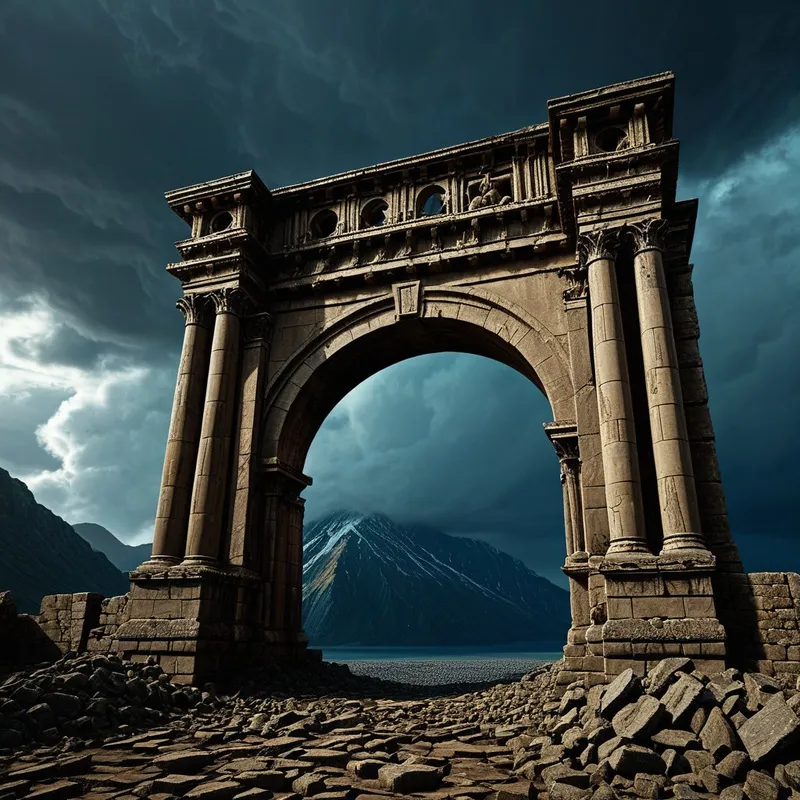
Augean Stables Myth Meaning & Symbolism
Hercules, to atone for a crime, must clean stables holding a divine herd's filth for decades, a task deemed impossible until he reroutes two rivers.
The Tale of Augean Stables
Hear now a tale not of glorious battle, but of filth. A story where the hero’s foe was not a hydra or a lion, but the sheer, suffocating weight of decay itself.
In the land of Elis, King Augeas ruled, blessed—or cursed—with a divine gift. His father, the sun god Helios, had granted him herds of cattle beyond counting, beasts whose health was immortal, whose numbers never dwindled. For thirty years, these magnificent animals thrived in their enclosures. But for thirty years, their waste was never cleared. The stables, vast as a city’s foundations, became a geological stratum of dung. The stench was a physical presence, a miasma that choked the land for miles. The very air grew thick and pestilential. It was a monument to neglect, a mountain range of putrescence that seemed as eternal and immutable as the king’s wealth.
Enter Heracles, though men called him Hercules. Reeling from a madness sent by Hera, a fury in which he slew his own wife and children, he sought purification. The oracle at Delphi sent him to his cousin, King Eurystheus, who devised ten labors—later twelve—as penance. The fifth of these was not to kill, but to clean. “Go to Elis,” said Eurystheus, a cruel smile playing on his lips. “Clean the stables of Augeas. Do this in a single day.”
It was a joke, a divine insult. To clear what generations of beasts had deposited? Impossible for any mortal, even one sired by Zeus. Hercules stood before the gates of that foul kingdom, the reek assaulting him, the sight a lesson in despair. He did not flinch. He went to Augeas and made a bargain: clean the stables in a day for a tenth of the king’s immortal herd. Augeas, certain of failure, agreed.
Hercules did not reach for a shovel. He did not begin to move the mountain piece by piece. Instead, he walked the land. He studied the lay of the rivers. He saw the twin forces of nature, the Alpheus and the Peneus, flowing with relentless power. With his god-born strength, he took up his tools and he changed the world. He breached the stable walls. He dug new channels. He diverted the courses of the two mighty rivers themselves.
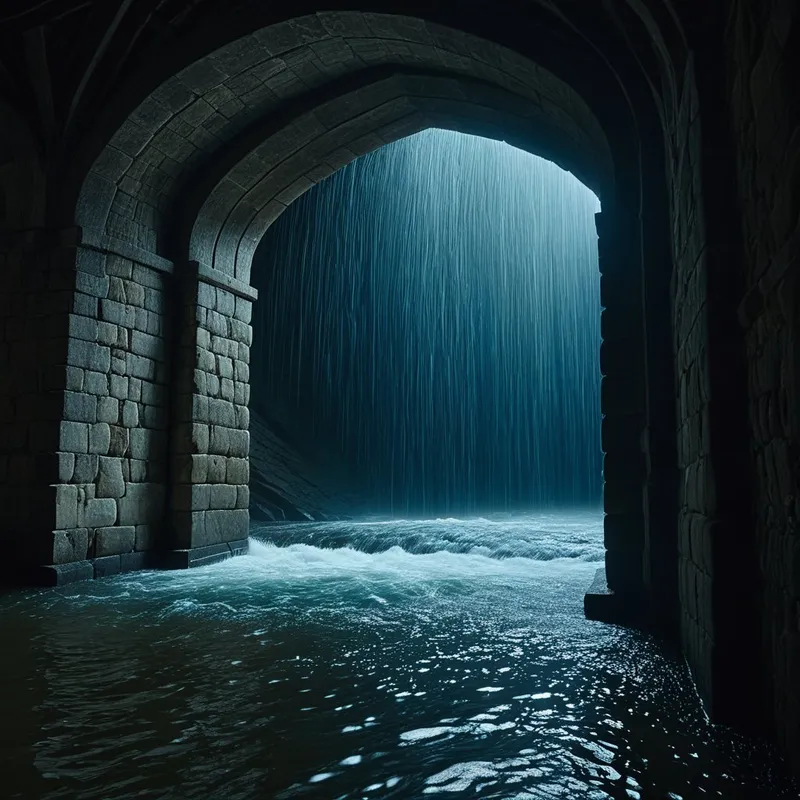
And then, the roar. Not of a beast, but of water. A cataclysm of cleansing force. The twin rivers, turned from their beds, poured through the gates, through the courtyards, through every channel and pen of Augeas’s estate. They scoured the decades of filth in a great, brown, churning flood, washing it all out to sea in a single, thunderous day. The task was done. The land, for the first time in a human lifetime, breathed clean air. Hercules claimed his reward. But Augeas, learning this was a labor for Eurystheus, reneged. Later, Hercules would return for vengeance, but that is another tale. For now, the lesson was written in the mud: the impossible had been made possible, not by moving the mess, but by moving the world around it.
Cultural Origins & Context
This myth comes to us primarily from the pen of the Hesiod, and later, was codified in the exhaustive Library of Apollodorus. It was one of the canonical Twelve Labors, a cycle of stories that functioned as the ultimate curriculum for the Greek heroic ideal. Unlike tales of straightforward combat, the Augean Stables presented a narrative puzzle. It was a test of wit as much as strength, a “clever hero” story nested within the “strong hero” saga.
Societally, it served multiple functions. On one level, it was an etiological myth, a fanciful explanation for the might and course of the Alpheus and Peneus rivers. On another, it reinforced the Greek value of metis—cunning intelligence. Hercules, often portrayed as brute force, here demonstrates the strategic mind necessary for true leadership. The myth also played a role in the political landscape of the Peloponnese, as the later conflict between Hercules and Augeas was used to legitimize the historical Dorian claim to the region of Elis. It was a story told to remind listeners that some problems are too vast for conventional tools, demanding a radical re-visioning of the landscape itself.
Symbolic Architecture
The Augean Stables are not merely a dirty barn. They are the archetypal symbol of the accumulated, neglected, and overwhelming mess of life. The thirty years of filth represent the unaddressed consequences of our actions, the psychic refuse we allow to pile up through avoidance, busyness, or sheer despair. King Augeas, with his immortal herds, is the part of the psyche that benefits from a system of productivity and wealth but is utterly blind or indifferent to the decay it generates. The wealth is divine, but the cost is a poisoned environment.
The greatest obstacles are often not walls to be smashed, but systems to be rerouted.
Hercules, in this labor, embodies the conscious ego forced to confront a task it did not choose—the penance, the “labors” life assigns us. His initial agreement with Augeas for payment is crucial; it represents the attempt to find personal gain or meaning within the imposed, dirty work. The ultimate solution—rerouting the rivers—is the myth’s masterstroke of symbolism. It signifies the application of transcendent, natural force (the rivers as divine, cyclical power) to a stagnant, man-made problem. He does not fight the mess on its own terms. He changes the terms entirely.
Purification is not a careful sorting; it is sometimes a catastrophic flood that leaves only the essential structures standing.
The reneging of Augeas adds a critical layer: the world often refuses to honor its bargains after we have done the impossible. The internal cleansing is its own reward, but the external world may still require a later, more direct confrontation (Hercules’s return to wage war). The labor is for Eurystheus (an external authority), but the true transformation is within the landscape of the self.
The Dreamer's Resonance
When this myth stirs in the modern unconscious, it manifests in dreams of overwhelming, impossible cleanup. The dreamer may find themselves in a childhood home grown grotesquely large and filled with rotting clutter, or at a workplace where paperwork or digital files have become a literal, physical avalanche they must sort. The somatic feeling is one of sinking, of being engulfed by a task that has no beginning or end. There is a profound anxiety of futility.
This dream pattern signals that the psyche is grappling with a “stable” that has been filling for years—perhaps a relationship dynamic choked with unspoken resentments, a career path built on compromises that have become toxic, or a personal identity cluttered with the expectations of others. The dream is the psyche’s declaration that piecemeal efforts (the shovel) will no longer suffice. The emotional and psychological “filth” has reached a critical mass, threatening to stifle all life. The dreamer is on the cusp of realizing that their current resources are inadequate; a fundamental rerouting of their inner energies—their emotional and psychic rivers—is required.

Alchemical Translation
In the alchemical process of individuation—becoming one’s whole, integrated self—the Augean Stables represent the nigredo stage: the blackening, the putrefaction. It is the confronting of the shadow in its most concrete, repulsive, and accumulated form. This is not a single repressed memory, but the compounded weight of a lifetime of avoided truths, unlived potentials, and moral compromises. The ego, like Hercules, is tasked by the Self (the inner Eurystheus, the guiding center) to undertake this purification as a non-negotiable labor.
The alchemical genius of the myth is in its method. The prima materia (the filthy stables) is not attacked directly. Instead, the aqua permanens—the everlasting water, the divine, transformative fluid—is invoked. Psychologically, this is the conscious ego aligning itself with the powerful, natural flow of the unconscious itself. It is the decision to stop trying to “manage” a depression or anxiety and instead to allow a flood of authentic feeling, perhaps through therapy, art, or a radical life change, to wash through the clogged channels of the psyche.
Individuation often requires an act of divine hydrology: breaking the dams we built to control our own nature and letting the river of the Self find its true course.
The stable walls that must be breached are our rigid defenses and identifications. The redirected rivers are the libidinal and spiritual energies we had dammed up or misdirected. The task, done in a “single day,” symbolizes the moment of decisive insight and action that, while prepared for over time, feels like a sudden, total revolution. The cleaned stables are not the end goal, but the newly cleared space—the albedo or whitening—where new, conscious life can now be stabled. One is not just cleaner; one’s entire internal geography has been forever altered. The hero has learned that his greatest strength lies not in carrying the world’s weight, but in understanding its flow.
Associated Symbols
Explore related symbols from the CaleaDream lexicon: