Atropos Myth Meaning & Symbolism
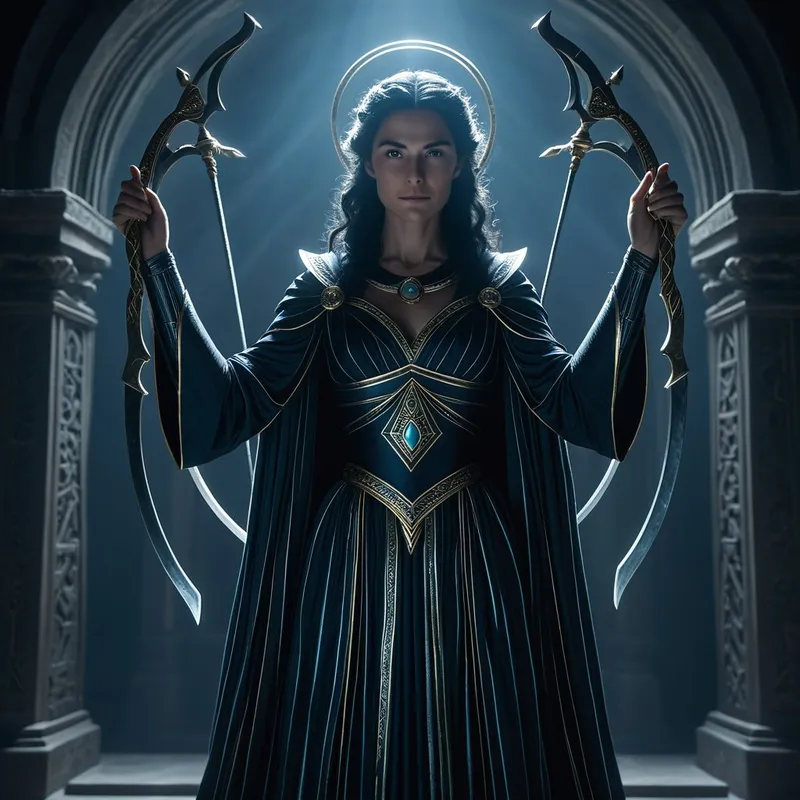
Atropos, the eldest Moirai, wields the shears that sever the thread of mortal life, embodying the inescapable finality of destiny.
The Tale of Atropos
In the deep, silent chambers where time itself is spun, there is no sound but the whisper of thread and the turning of a spindle. Here, in a place older than Olympus, work the three sisters, the Moirai. Clotho, the youngest, sings softly as she draws the raw wool of possibility from a basket of mist and spins it upon her distaff, creating the bright, humming line of a life. Lachesis, the measurer, receives the thread with solemn hands. Her fingers, wise and knowing, trace its length, feeling for its texture—its joys, its sorrows, its strength and its frailty. She allocates its portion, determining the span.
But it is to the eldest that all threads must finally come. She is Atropos. She who cannot be turned.
No music accompanies her work. No song softens her task. She sits, a figure of immense and quiet authority, her face a landscape of irrevocable decisions. Before her, the threads arrive, each one a story, a world, a universe of breath and beating heart. They glow with the unique light of their being—some fierce and golden, some a steady blue, others a flickering, fragile silver. They pulse with the music of existence.
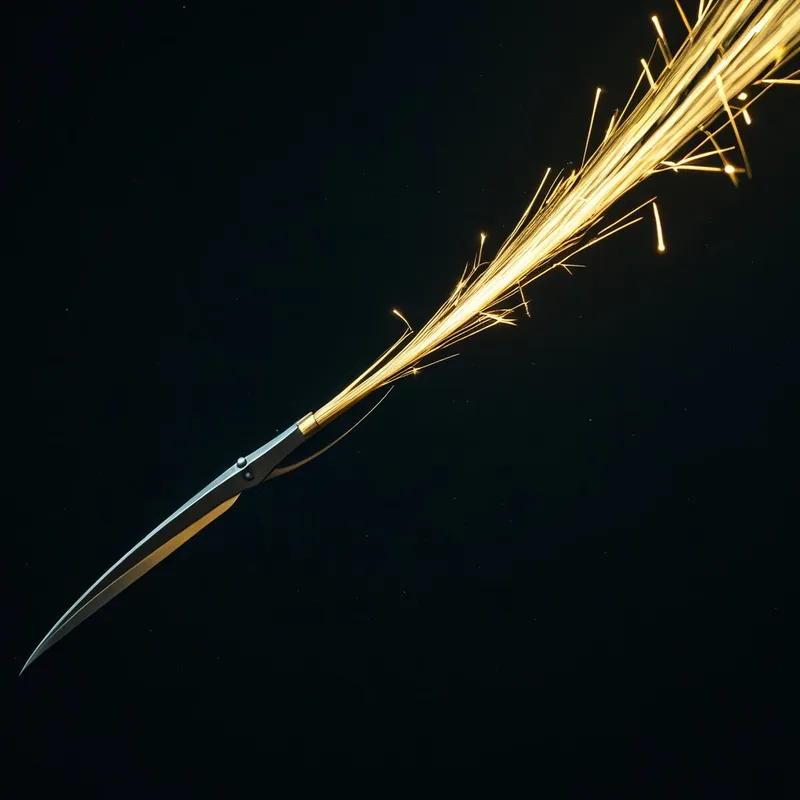
Her instrument is not a spindle, but the Shears. Forged in a furnace beyond mortal understanding, their blades are of a substance that reflects no light, absorbs all sound. They are the final argument, the ultimate full stop. Atropos does not hurry. She does not rage. With a gaze that holds the patience of mountains, she observes the thread laid before her. She sees the point where Lachesis’s measure ends. There is no negotiation in her eyes, no malice, no pity. There is only the truth of the measure itself.
And then, with a motion that is both utterly simple and cosmically profound, she brings the shears together.
Snip.
The sound is not loud, but it echoes in the marrow of the universe. The brilliant thread goes dark. Its light winks out, not with a bang, but with the quiet finality of a door closing in a distant room. The severed end falls into a basket at her feet, a basket that is both empty and infinitely full. Atropos does not watch it fall. Her attention is already on the next thread, arriving from her sister’s hands, glowing with its own brief, beautiful, and doomed fire. The shears wait, patient and absolute. For her name is Inevitable, and her work is forever.
Cultural Origins & Context
The myth of Atropos and her sisters emerged from the deepest, most primal layer of Greek religious thought. They were not Olympians to be placated with sacrifice and sweet words, but older, darker powers whose authority even Zeus was said to respect. Their origins are murky, likely pre-dating the classical pantheon, born from the human need to personify the most terrifying and inscrutable forces of existence: birth, life’s course, and death.
They were central to the Greek understanding of Moira (μοῖρα), a concept far sterner than mere "luck." Moira was the apportioned share, the fixed boundary of one’s life and potential. Heroes might rage against it, but to transgress it was hubris, inviting divine retribution. The myth was passed down through epic poetry like Hesiod’s Theogony, where their lineage is described, and woven into the tragedies of Aeschylus and Sophocles, where characters grapple with their destined threads. In the household, small figurines or mentions of the Fates served as a constant, humbling reminder of life’s limits, structuring a worldview where acceptance of one’s portion was a key to dignity.
Symbolic Architecture
Atropos is the archetypal embodiment of Limit. She is the necessary negation that gives shape to existence itself. Without her cut, life would be an endless, undifferentiated line—a nightmare of immortality without meaning, purpose, or story. Her shears are the instrument of definition.
The story only matters because it ends. The sentence only has meaning because of the period. Atropos is that period.
Psychologically, she represents the superordinate function of the unconscious that enforces psychic reality. She is the inner principle that says "no more," that ends a phase of life, a pattern of behavior, an identity that has outlived its purpose. She is the crisis that forces transformation, the depression that follows a loss, the undeniable physical symptom that halts a life of avoidance. While Clotho symbolizes the Ego’s sense of agency and Lachesis the conscious planning of the Persona, Atropos is the voice of the Self. She cuts the ego’s illusion of control, returning the individual to the foundational truth of their being. She is not death as an external event, but death as an internal, structuring principle.
The Dreamer's Resonance
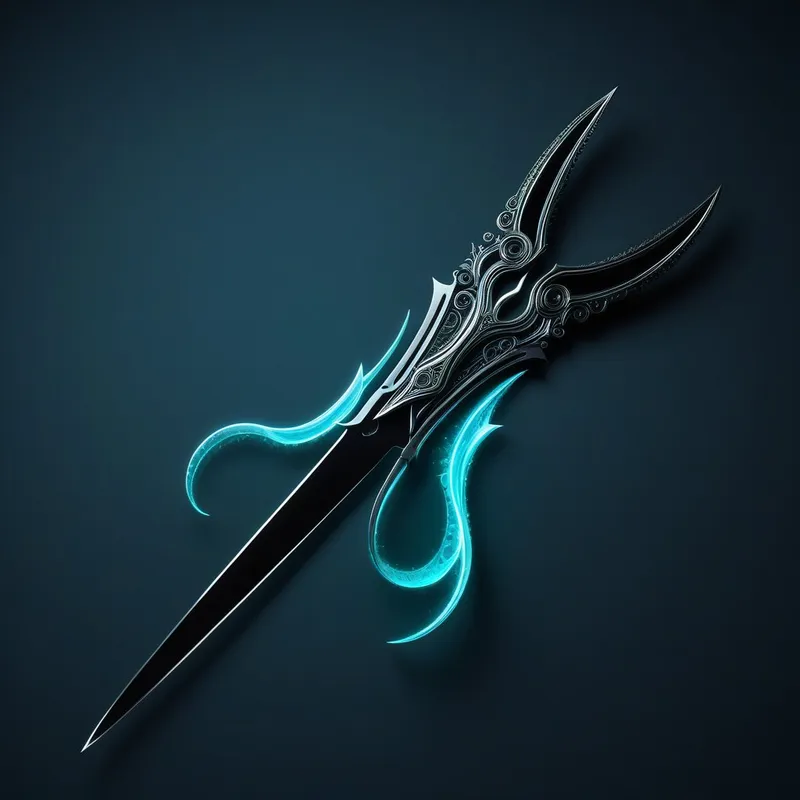
When Atropos appears in the modern dreamscape, she rarely comes as a literal ancient goddess. Her presence is felt through her symbols and actions. To dream of something being irrevocably cut—a rope, a connection, a power line—often signals her work. Dreams of final deadlines, of clocks stopping, of doors sealing shut, or of a silent, authoritative figure who ends a debate with a single gesture are visitations from this archetype.
Somatically, this process can feel like a collapse, a profound exhaustion, or a sudden, chilling clarity. It is the psychological process of ending. The dreamer may be undergoing the necessary death of an old self, the termination of a toxic relationship, or the acceptance of a real-world limitation (like an illness or the end of a career). The psyche, through the Atropos motif, is performing a brutal but essential surgery: severing the thread of what was to make space for what must be. The anxiety in such dreams is the ego’s terror of this psychic amputation, its protest against the shears of the Self.

Alchemical Translation
The alchemical journey of individuation is not a straight path of growth, but a spiral of repeated deaths and rebirths. Atropos governs the nigredo stage—the blackening, the putrefaction, the moment when the old form dissolves into chaotic, dark matter. For the modern individual seeking wholeness, engaging with the Atropos archetype is the work of conscious surrender.
To wield the shears on one’s own behalf is the ultimate act of self-sovereignty. It is to become the ruler of one’s own destiny by accepting its ultimate limit.
This is not passivity, but active, courageous acceptance. It is the addict choosing to cut the thread of their substance, forever. It is the person in a stagnant career allowing that identity to die, plunging into the unknown. It is accepting the aging of the body, not with despair, but with the dignity of one who acknowledges the measure. The "alchemical translation" is this: we cannot avoid Atropos’s cut, but we can, through consciousness, collaborate with it. We can identify the threads in our own lives that are spent—the worn-out stories, the draining commitments, the outmoded beliefs—and, with the terrifying clarity she embodies, sever them ourselves. In doing so, we transmute her act from one of fateful imposition to one of sacred, self-authored closure. We integrate the Ruler who says, "This ends now," and in that ending, find the silent, dark fertility from which Clotho will, in time, spin anew.
Associated Symbols
Explore related symbols from the CaleaDream lexicon: