Atlantis Myth Meaning & Symbolism
A tale of an advanced, hubristic island civilization that angered the gods and was swallowed by the sea in a single day and night.
The Tale of Atlantis
Listen. Beyond the Pillars of Heracles, where the ocean swallows the sun, there was an island. Not just any island, but a continent born of the sea itself, gifted by the Earth-Shaker, Poseidon, to his mortal love. From their union sprang ten kings, and a race of power and splendor unseen before or since.
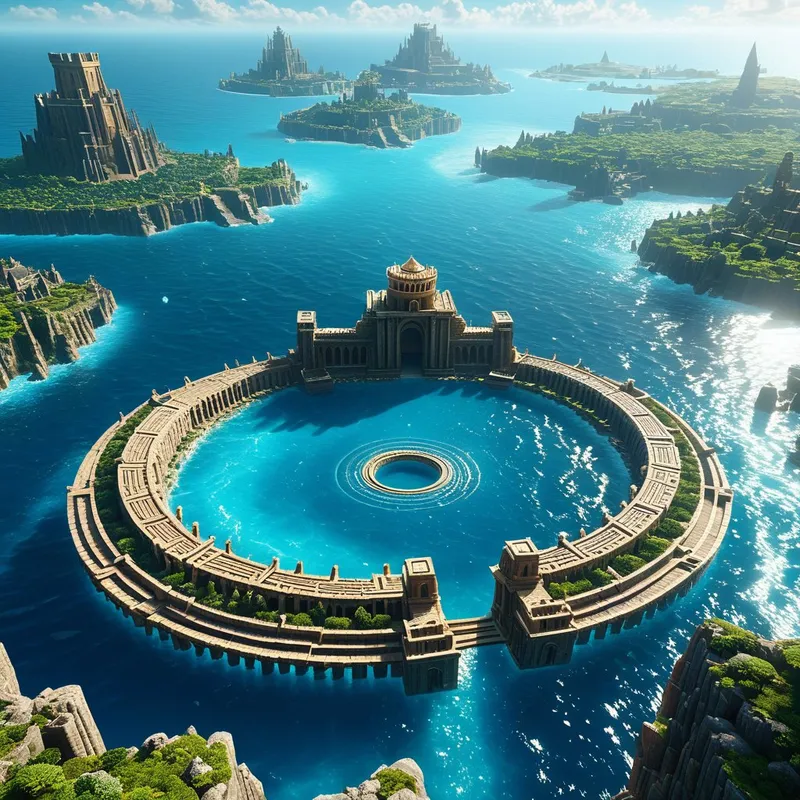
The land was a perfect geometry of power: concentric rings of water and earth, carved by the god’s own trident. The outer ring held a bustling port, a thunder of commerce from every known land. The inner rings held gardens of such fragrance they could calm a storm, and temples sheathed in a metal that burned like fire—orichalcum. At the very heart, on the central hill, stood the palace of the high king, a citadel of silver, gold, and ivory that caught the first and last light of each day, a beacon to the world.
For generations, the people of Atlantis lived in accordance with the ancient laws inscribed on a pillar of orichalcum in the temple of Poseidon. They were just, pious, and masters of land and sea. Their engineers tamed waters, their architects defied gravity, their wisdom was deep as the ocean trenches. They were the children of a god, and the world lay open before them.
But the blood of the gods thins over generations. The noble bearing of the first kings gave way to arrogance. The divine spark in their eyes was replaced by a hungry, mortal fire—the fire of ambition. They forgot the laws of the pillar. The love for wisdom curdled into a lust for dominion. They looked upon the lands east of their island, upon the young and virtuous city of Athens, and saw not peers, but subjects.
They marshaled a fleet of ten thousand ships, a host that darkened the sea. They came not as traders, but as conquerors, a wave of polished bronze and arrogant pride ready to break upon the shores of the free world. And in that moment of ultimate hubris, as their prows first touched the sacred soil of Attica, the Earth-Shaker awoke.
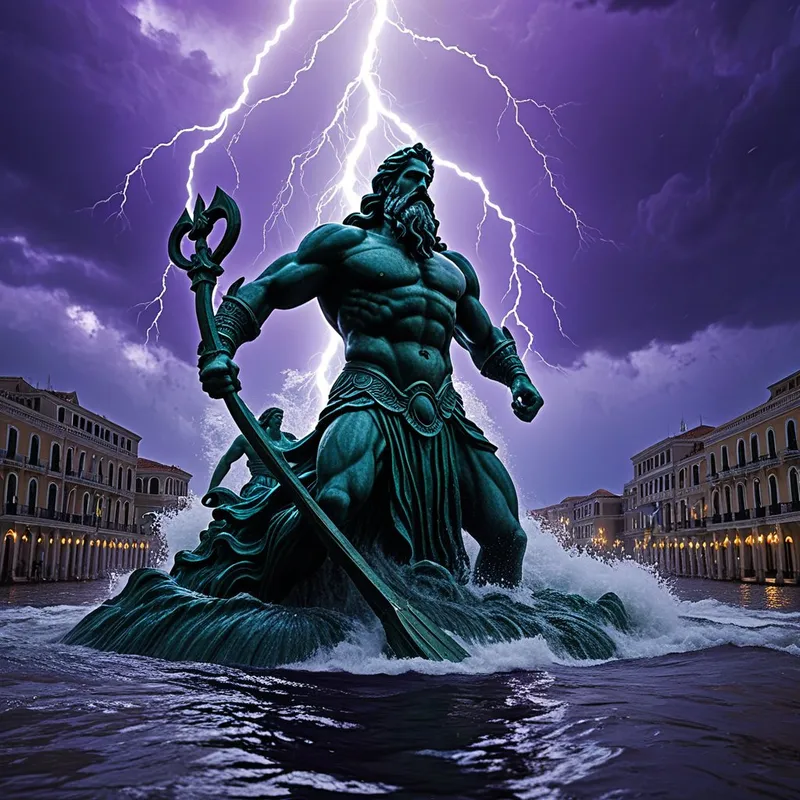
He did not rise with a roar, but with a sigh—a deep, seismic sigh of ultimate disappointment. The very foundation of the world, which he held in his hands, trembled. In a single day and night of terrible misfortune, the judgment fell. The earth shook with such violence that the concentric rings shattered. The sea, which had been their moat and their highway, rose up in a single, mountainous wall of water. It did not crash upon the shores; it swallowed the island whole. Every gleaming temple, every bustling agora, every proud king and hopeful child was pulled down into the abyss. The roar of the cataclysm faded, replaced by the eternal, silent gurgle of the deep. Where a continent of light had been, there was only a thick blanket of mud, impassable and void, a warning to all who sail thereafter.
Cultural Origins & Context
The myth of Atlantis springs from a singular, profound source: the philosophical dialogues of the Athenian thinker Plato, written around 360 BCE. In his works Timaeus and Critias, Plato does not present it as a common folktale, but as a "true story" passed down through generations, from an Egyptian priest to the Athenian lawgiver <abbr title">Solon. This framing is critical. Atlantis is not a myth of origin for the Greeks, but a philosophical and political device.
Its primary societal function was didactic. For Plato, Atlantis served as the ultimate counterpoint to his idealized Republic. It represented the fate of a society that begins with divine favor and perfect constitution but succumbs to its "mortal nature" of greed, imperialism, and spiritual decay. The story was told in the rarefied air of the Academy, a cautionary tale for statesmen and philosophers about the fragile nature of civilization and the inevitable punishment for hubris—overweening pride that offends the cosmic order. It was a story meant to be analyzed, debated, and internalized as a principle of statecraft and ethics, making its "loss" not just a geological event, but a moral and psychological one.
Symbolic Architecture
Atlantis is not merely a lost city; it is the psyche's own lost continent of potential. It symbolizes the zenith of human achievement, a state of integrated consciousness where technology, art, spirituality, and governance exist in harmonious, geometric perfection. It is the ego's proudest castle, built upon a foundation it believes is eternal.
The fall of Atlantis is the psyche's necessary correction to the tyranny of perfection. The island must sink so that the ocean, the unconscious, can reclaim its territory.
The concentric rings represent ordered consciousness, layers of defense and identity. The central citadel is the fortified ego, the "I." The orichalcum is the luminous, almost divine energy of the Self in its unrealized potential. The cataclysm, therefore, is the eruption of the repressed. The "divine portion" within—the connection to Poseidon, the deep Self—becomes corrupted by "the human portion," the ego's greed. The resulting earthquake and flood are not external punishments, but the autonomous uprising of the unconscious (the sea) to dismantle an ego-structure that has grown arrogant, rigid, and cut off from its source. The mud that remains is the fertile, chaotic prima materia of the soul after a catastrophic breakdown, from which new growth must begin.
The Dreamer's Resonance
When Atlantis appears in modern dreams, it rarely manifests as a literal, historical city. More often, it is felt as an atmosphere, a topology of the inner world. One may dream of discovering a vast, beautiful, and technologically advanced complex in one's own basement, only to watch it slowly fill with water. One may find a perfect, ancient artifact in a backyard pond. Or one may simply feel a profound, melancholic certainty that something magnificent has been lost, just out of reach.
These dreams signal a process of somatic recollection. The psyche is confronting a pattern of inflation and subsequent collapse. The dreamer may be experiencing, or on the verge of, a profound disillusionment—the collapse of a long-held self-image ("I am a perfect leader"), a relationship, or a life structure that was built on unstable, prideful foundations. The flooding is the somatic release, the emotional tsunami that accompanies such a collapse. The dream is not merely a warning of hubris, but often a retrospective map of a cataclysm that has already occurred internally. The task it sets is not prevention, but integration: to acknowledge the drowned city within, to mourn its loss, and to learn to navigate the new, open, and seemingly empty sea it has become.

Alchemical Translation
The alchemical journey mirrored in the Atlantis myth is the solve et coagula—dissolve and coagulate—applied to the very structure of the personality. The first, golden age of Atlantis represents the coagula, a magnificent but premature crystallization of the personality around an ideal. It is beautiful, but static and destined for corruption.
The cataclysm is the violent, involuntary solve. The ego's proud citadel, its rings of defense and identity, are dissolved back into the massa confusa, the primal waters of the unconscious. This is the darkest phase of the individuation process, experienced as utter ruin, depression, and the loss of all that once defined the self.
The mud of the Atlantic plain is the alchemical nigredo, the blackening. It is not an end, but the essential, fertile starting point for true gold.
The triumph of the myth is not in Atlantis's survival, but in its legacy—its memory. For the modern individual, the alchemical work begins in this mud. One must sift through the debris of the collapsed persona—the shattered ideals, the drowned ambitions—not to rebuild the same city, but to recover the fragments of orichalcum, the genuine, incorruptible spark of the Self that survived the flood. The new consciousness that coagulates from this work is not an island fortress, but something more fluid and resilient: a consciousness that knows it is not separate from, but a conscious participant in, the vast and unpredictable sea of the unconscious. One does not rule the deep; one learns to sail upon it, forever carrying the memory of what lies beneath.
Associated Symbols
Explore related symbols from the CaleaDream lexicon: